


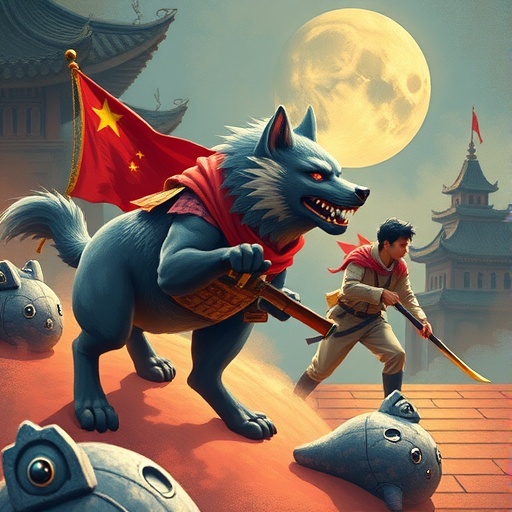
China’s recent diplomatic strategy, branded as “Wolf Warrior Diplomacy,” has garnered significant global attention for its aggressive and confrontational communication style. Originating from the title of a popular Chinese patriotic action film series, this approach is characterized by vehement criticism of foreign countries and assertive nationalist rhetoric. While this style of diplomacy aims to assert China’s power and defend its interests robustly, particularly on digital and social media platforms, its efficacy in influencing public opinion abroad, especially in East Asia’s democratic societies, remains contentious. A groundbreaking experimental study led by Professor Tetsuro Kobayashi and his colleagues delves into this question, revealing unexpected and critical insights about the interplay between authoritarian messaging and democratic resilience.
Conducted across Japan, South Korea, and Taiwan, three pivotal East Asian democracies where public opinion routinely informs foreign policy, the study utilized preregistered online survey experiments involving over 6,000 participants. These experiments ingeniously simulated real-world exposure to Chinese diplomatic messaging by presenting respondents with social media posts. Two sets of content were tested: one consisting of neutral, non-political posts related to China, and the other comprising distinctively “Wolf Warrior” posts that glorified China while sharply criticizing the United States. By employing this controlled experimental design, the researchers were able to precisely isolate the effects of aggressive diplomatic messaging on public perceptions.
Contrary to what might be anticipated by China’s diplomatic strategists, the results were striking. Exposure to “Wolf Warrior” diplomatic posts triggered a clear and statistically significant decline in favorability towards China across all three countries. South Korea exhibited the most pronounced and consistent negative shift, including diminished trust in the Chinese government and skepticism about China’s influence on the global stage. This pronounced backlash in South Korea underscores the sensitivity of public opinions in democratic societies to confrontational foreign messaging and illustrates how aggressive tactics can backfire.
Interestingly, the study also found that perceptions of the United States were impacted, although these effects were inconsistent and context-dependent. This nuanced outcome suggests that while the hardline messaging targets the U.S. as a rival, democratic citizens in East Asia do not uniformly foreground these antagonistic cues in their broader geopolitical evaluations. Thus, China’s messaging failed to simultaneously undermine the U.S. image while promoting a favorable view of China, reflecting a complex reception that is not easily manipulated through overtly aggressive narratives.
One of the most profound findings of this research lies in its demonstration of democratic resilience. Despite the overt criticism of democratic values embedded within the “Wolf Warrior” messages, participants’ fundamental support for democracy remained stable and robust across all surveyed populations. This resiliency serves as a testament to the deep-rooted democratic norms within these societies and highlights the limits of authoritarian influence attempts aimed at eroding democratic ideals through propaganda.
Another significant dimension of the study explored the potential for such aggressive diplomatic messaging to spread virally through social networks. Participants exhibited a marked reluctance to share “Wolf Warrior” content with others, indicating that the persuasive power and organic dissemination potential of these messages are severely constrained in democratic contexts. This low willingness to propagate hardline messages further diminishes their impact, rendering “Wolf Warrior Diplomacy” less effective as a tool of influence in tightly connected, open-information environments.
The methodology employed by Kobayashi and his team exemplifies rigorous experimental social science research. Through random assignment and careful control of message exposure, the study circumvents many biases typical of observational research in international relations and communication. This rigorous approach provides compelling causal evidence that confrontational state messaging can deteriorate rather than improve the sender’s reputation among democratic publics, thereby challenging assumptions about the utility of aggressive public diplomacy.
From a geopolitical communication perspective, the findings offer crucial lessons for policymakers and public diplomacy practitioners. They underscore the pitfalls of zero-sum messaging strategies that seek to elevate one country by aggressively denigrating another. Within the complex and interconnected information ecosystems of East Asian democracies, such approaches risk engendering reciprocal distrust and suspicion rather than fostering nuanced understanding or influence.
Moreover, this study contributes to the growing discourse on authoritarian mechanisms of influence beyond borders. As autocratic regimes increasingly deploy digital tools for international persuasion and disinformation, understanding the normative and psychological defenses of democratic publics becomes paramount. The demonstrated ineffectiveness of “Wolf Warrior” tactics signals that democratic societies possess durable cognitive and social filters that can neutralize aggressive foreign propaganda, at least in this regional context.
Critically, these insights may inform media literacy initiatives, social media platform policies, and diplomatic communication strategies that seek to mitigate the impact of hostile foreign messaging. By highlighting the limits and consequences of such approaches, the research advocates for engagement strategies grounded in respect, transparency, and constructive dialogue, rather than coercion or confrontation.
In conclusion, the comprehensive study led by Professor Tetsuro Kobayashi and his colleagues calls into question the strategic wisdom of China’s “Wolf Warrior Diplomacy” within democratic East Asia. Their experimental evidence reveals that aggressive nationalistic messaging not only fails to garner public support but may actively erode China’s image and influence abroad. Democratic values demonstrate resilience in the face of anti-democratic rhetoric, and citizens’ reluctance to disseminate such content further constrains its reach. This research illuminates vital pathways for future inquiry into international communication, sociopolitical psychology, and the dynamics of global diplomacy in an era of intense geopolitical rivalry.
News Publication Date: 2-Apr-2026
Web References:
https://doi.org/10.1177/19401612261431042
References:
Zhou, Y., Kobayashi, T., & Seki, L. (2026). Evaluating the Impact of China’s “Wolf Warrior Diplomacy” in East Asia: An Experimental Approach. The International Journal of Press/Politics. https://doi.org/10.1177/19401612261431042
Cite Scienmag News
Courtney Benton. (April 28, 2026). The Influence of China’s “Wolf Warrior Diplomacy” on Public Opinion in East Asia. Scienmag. https://scienmag.com/the-influence-of-chinas-wolf-warrior-diplomacy-on-public-opinion-in-east-asia/
Courtney Benton. "The Influence of China’s “Wolf Warrior Diplomacy” on Public Opinion in East Asia." Scienmag, 28 April 2026, https://scienmag.com/the-influence-of-chinas-wolf-warrior-diplomacy-on-public-opinion-in-east-asia/. Accessed 1 September 2026.
Courtney Benton. "The Influence of China’s “Wolf Warrior Diplomacy” on Public Opinion in East Asia." Scienmag. April 28, 2026. https://scienmag.com/the-influence-of-chinas-wolf-warrior-diplomacy-on-public-opinion-in-east-asia/


