


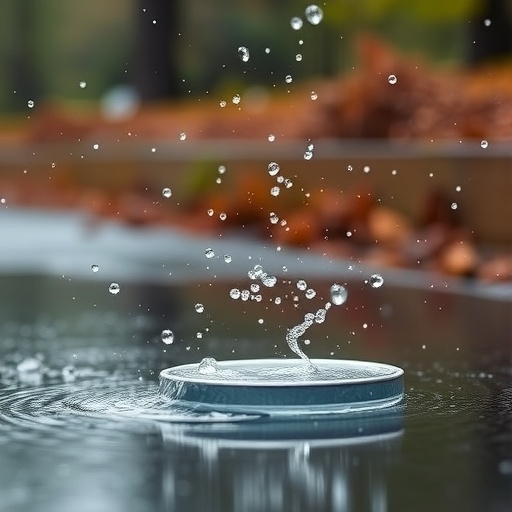
In the realm of collision dynamics, a groundbreaking discovery has emerged from the laboratories of Osaka University, shedding new light on the behavior of high-speed particles striking wet surfaces. Contrary to longstanding expectations, scientists have observed that particles impacting wet walls at high velocity rebound with significantly greater vigor than traditional models have predicted. This paradoxical conclusion, stemming from meticulous experimental procedures coupled with sophisticated numerical simulations, challenges fundamental assumptions about energy dissipation in fluid-mediated impacts and opens new pathways for safety and efficiency in diverse industrial arenas.
Central to this discovery is the observation of a remarkable morphological transition in the thin liquid films that coat impacted surfaces. When a particle collides with a liquid-coated wall at moderate speeds, the residual liquid film elongates into a slender filament or “bridge” spanning the gap between the particle and the surface. However, as the impact speed increases beyond a critical threshold, this dynamic portrait drastically alters. The post-impact liquid film assumes a dome-like structure, a hemispherical vapor cavity encapsulating the interface between the particle and the wall. This transition fundamentally changes the force interactions during the rebound phase and directly influences the energy retained by the particle.
The implications of this liquid film morphology shift are profound. One crucial metric in collision physics—the coefficient of restitution (COR)—which quantifies the fraction of pre-impact kinetic energy preserved during rebound, exhibits an unexpected dependence on impact speed. Relative to impacts on dry surfaces, the COR not only fails to diminish but actually increases markedly in the presence of the dome-shaped film. This surprising enhancement of the rebound effect suggests a reduced energy loss, countering conventional wisdom that fluid layers generally dampen particle motion by absorbing impact energy through viscous dissipation and adhesion.
The driving mechanism behind this counterintuitive rebound amplification was traced to cavitation phenomena within the narrow particle-wall gap immediately following impact. The rapid compression and subsequent deceleration generate a significant drop in local pressure, plummeting below the saturation vapor pressure of the liquid film. This pressure drop nucleates a vapor cavity, or cavitation bubble, which grows into the observed dome. This vapor pocket effectively isolates the particle from direct liquid contact, significantly attenuating capillary and viscous forces that would otherwise resist particle rebound.
Notably, the formation of the vapor cavity also suppresses the attractive force typically exerted by the wet film on the particle. In liquid-mediated impacts, surface tension and viscous adhesion generate an attractive pull that counters the rebounding momentum, converting kinetic energy into fluid deformation and heat. By interrupting this interaction, the vapor dome mitigates the braking effect, enabling the particle to retain a larger share of its initial kinetic energy and bounce away with unexpected strength.
This research bears vital significance across sectors where wet surfaces and high-velocity particulate impacts coexist. Modern aerospace and automotive engineering communities, accelerating toward electrification and extreme rotational speeds, face elevated risks from debris-induced damage. Protective liquid coatings, widely employed as cushioning layers inside rotors and engines, were hitherto poorly characterized in their high-speed impact response. The elucidated mechanisms provide a foundational understanding indispensable for designing optimized wet coatings that maximize protective efficacy while minimizing energy loss and wear.
The insights gained arise from an interdisciplinary approach whereby experimental visualizations—capturing transient film shapes post-collision—were integrated with advanced computational fluid dynamics models. These simulations accounted for multiphase interactions, pressure fluctuations, and phase change phenomena, enabling researchers to dissect the transient evolution of vapor-filled cavities and quantify their impact on particle rebound kinetics. Such holistic modeling transcends previous analytical simplifications, revealing the complex, nonlinear interplay between fluid mechanics and solid dynamics at microsecond timescales.
These findings mark a departure from traditional collision studies, which predominantly addressed low-speed impacts or dry contact scenarios. The nuanced behavior under high-velocity, wet conditions highlights the intricate fluid-structure couplings that have often been overlooked. It underscores the importance of resolving microscale dynamics to accurately predict macroscopic energy exchanges and mechanical responses in real-world engineering environments.
Given the broad applicability, the research team envisions extending these studies to explore a diverse array of liquid properties, including viscosity variations, surfactant effects, and temperature dependencies. Such extensions could uncover further complexities in cavitation behavior and particle rebound, potentially enabling the engineering of bespoke coatings tuned to specific operational regimes.
Lead author Hironori Hashimoto emphasizes the deceptively complex nature of these collisions. “Despite the apparent simplicity of a bouncing particle, the transient fluid dynamics and phase changes compel us to revisit foundational theories,” he remarks. “Our integrated experimental and numerical approach has illuminated critical mechanisms that will inform the next generation of industrial equipment design, enhancing both safety and efficiency.”
As industries continue to confront escalating mechanical stresses from high-speed particulate environments, this pioneering work from Osaka University provides an indispensable framework for predicting and controlling particle-wall interactions in wet conditions. Ultimately, these advancements will support the development of more resilient, adaptive machinery that can safely harness higher operational speeds in an increasingly electrified world.
Cite Scienmag News
Florence Redgrave. (April 28, 2026). Why Do Particles Bounce Higher in Wet Conditions at High Speeds? Scienmag. https://scienmag.com/why-do-particles-bounce-higher-in-wet-conditions-at-high-speeds/
Florence Redgrave. "Why Do Particles Bounce Higher in Wet Conditions at High Speeds?" Scienmag, 28 April 2026, https://scienmag.com/why-do-particles-bounce-higher-in-wet-conditions-at-high-speeds/. Accessed 28 August 2026.
Florence Redgrave. "Why Do Particles Bounce Higher in Wet Conditions at High Speeds?" Scienmag. April 28, 2026. https://scienmag.com/why-do-particles-bounce-higher-in-wet-conditions-at-high-speeds/


