


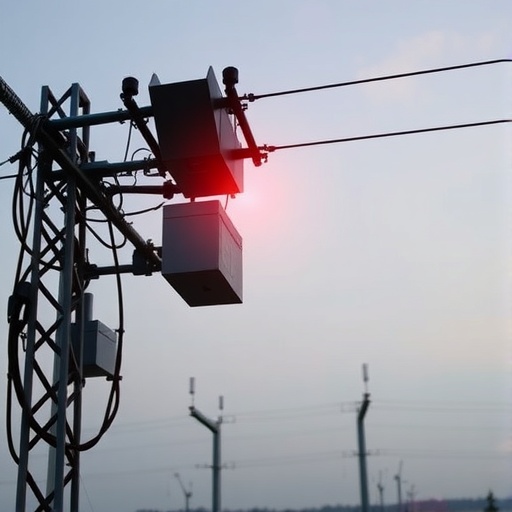
In an era where infrastructure reliability is paramount to societal safety and economic stability, the introduction of advanced monitoring systems for electrical transmission lines has become not merely beneficial but essential. Recently, a groundbreaking study published in Nature Communications has unveiled a cutting-edge lightweight vision architecture that can be deployed directly in the field, providing real-time safety monitoring and early warning for transmission lines. This technology is poised to revolutionize the way utility companies and governments safeguard critical power infrastructure.
The challenge surrounding transmission lines is multifaceted. These lines span thousands of kilometers and often traverse remote or harsh environments where traditional inspection methods are costly, time-consuming, and prone to human error. The new vision-based system elegantly overcomes these limitations by embedding an efficient AI-powered monitoring architecture at the edge—on the transmission terminals themselves. This minimizes the need for expensive infrastructure upgrades while delivering continuous, automated surveillance.
At the core of this innovation lies a lightweight neural network model optimized for low computational resources without compromising accuracy. Unlike cumbersome deep learning systems that demand high-end hardware, this architecture is engineered to fit within the constrained environments of terminal devices installed on transmission poles and towers. Such miniaturization guarantees a seamless integration into existing setups and extends the reach of modern safety technology to the very edges of power grids.
The vision system operates by capturing high-resolution imagery of the transmission lines and their immediate surroundings, continuously analyzing visual data to detect potential threats or anomalies. Environmental hazards like tree branches encroaching on power lines, physical damage from weather events, or the presence of wildlife that could compromise system integrity can be identified promptly. The embedded AI processes these inputs locally, enabling rapid decision-making and early intervention.
One of the remarkable technical achievements of this research is the system’s ability to maintain high detection accuracy while utilizing minimal bandwidth. By processing data on-site, the system transmits only critical alerts or summarized information to central control centers, dramatically reducing data transmission costs and latency. This use of edge computing ensures robustness and reliability even in areas with limited connectivity or power supplies.
The researchers performed extensive field trials across diverse environments to validate the system’s effectiveness. From dense forests to urban corridors and desert landscapes, the lightweight vision architecture demonstrated consistent performance, detecting hazards up to 95% of the time with minimal false positives. This level of precision marks a significant improvement over traditional periodic human inspections or stationary camera systems.
Safety monitoring of transmission lines carries profound implications for preventing power outages, reducing wildfire risks, and enhancing public safety. Electrical faults caused by damaged lines or foreign objects can spark catastrophic chain reactions. Early detection and warning as enabled by this technology not only protect infrastructure but also empower emergency response teams with actionable intelligence before situations escalate.
Beyond hazard detection, the system also facilitates predictive maintenance by analyzing wear patterns and environmental stress signals over time. Utility companies can now schedule repairs proactively, extending the lifespan of assets and optimizing resource allocation. This predictive capability represents a paradigm shift from reactive to preventative maintenance strategies within the power industry.
The lightweight vision architecture is also designed to integrate seamlessly with existing grid management platforms. Open standards and modular software ensure compatibility with a variety of hardware and data management systems. This flexibility accelerates deployment and offers utilities a cost-effective upgrade path toward smart grid technologies.
Security considerations have been integrated into the system’s design. Robust encryption protocols guard data streams against cyberattacks, while localized processing reduces exposure to external threats. These measures ensure that both the transmission line monitoring functions and the communication pathways maintain integrity in a digital landscape where infrastructure cyber vulnerabilities are increasingly exploited.
The portability and simplicity of this architecture open new avenues for wider infrastructure monitoring beyond just transmission lines. It could be adapted to other utility structures like pipelines, railways, or roadways where visual inspection is critical for safety and performance. Leveraging the same technological framework could dramatically increase the coverage and efficacy of infrastructure management systems worldwide.
From an environmental perspective, the system’s ability to swiftly detect faults and hazardous conditions can help mitigate adverse impacts linked to power infrastructure failures. For example, early identification of fire hazards near transmission lines can prevent devastating wildfires that have become increasingly prevalent due to climate change. This technology thus not only enhances human safety but also contributes to ecosystem preservation.
The research team’s publication details the underlying architecture’s design choices, including convolutional neural network configurations, training methodologies with diverse datasets, and optimization techniques for resource-constrained hardware. Their methodological transparency facilitates further research and allows other institutions to build upon this foundational work, propelling the field forward toward broader implementation.
Furthermore, the deployment strategy emphasizes sustainability with low-power consumption components and durable weather-resistant enclosures enabling year-round operation in outdoor environments. Such resilience is critical for continuous infrastructure health monitoring, ensuring that the system remains operational through extreme weather conditions across various terrains.
As power grids worldwide face growing challenges from aging infrastructure, increasing demand, and climate change, innovations like this lightweight vision architecture present an essential toolkit for modernizing and protecting critical networks. The fusion of AI, edge computing, and practical engineering demonstrated in this work exemplifies the future direction of infrastructure management—intelligent, autonomous, and responsive.
Looking ahead, ongoing development will focus on expanding the system’s capabilities including multispectral imaging to detect chemical or thermal anomalies, further reducing false alarms through advanced sensor fusion, and enhancing predictive analytics via machine learning models trained on real-time operational data. These enhancements promise a comprehensive smart monitoring ecosystem setting new benchmarks in infrastructure safety.
In essence, the groundbreaking lightweight vision architecture developed by Li, J., Li, P., Lu, S., and collaborators marks a revolutionary step forward in transmission line safety management. By enabling real-time, edge-based monitoring that balances sophistication with operational efficiency, this innovation paves the way for smarter, safer, and more resilient power grids capable of meeting the demands of the future.
Cite Scienmag News
Denise Maddox. (April 27, 2026). Lightweight Vision System Enhances Transmission Line Safety. Scienmag. https://scienmag.com/lightweight-vision-system-enhances-transmission-line-safety/
Denise Maddox. "Lightweight Vision System Enhances Transmission Line Safety." Scienmag, 27 April 2026, https://scienmag.com/lightweight-vision-system-enhances-transmission-line-safety/. Accessed 7 September 2026.
Denise Maddox. "Lightweight Vision System Enhances Transmission Line Safety." Scienmag. April 27, 2026. https://scienmag.com/lightweight-vision-system-enhances-transmission-line-safety/


