


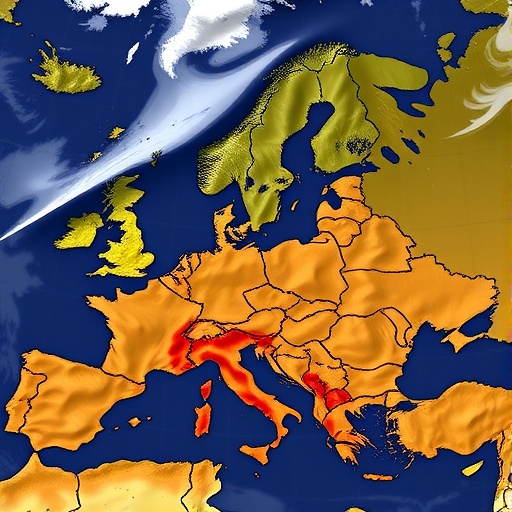
In a groundbreaking study that redefines our understanding of Europe’s climatic past and future, researchers have uncovered the profound influence of the Scandinavian atmospheric pattern coupled with substantial temperature variations on the occurrence and severity of European summer droughts over the last thousand years. This landmark research, published recently in Nature Communications, leverages high-resolution paleoclimatic data and advanced climate modeling to reconstruct and analyze the intricate interactions that have shaped drought patterns on the continent since the medieval period.
The heart of this study lies in disentangling the complex dynamics between atmospheric circulation patterns and temperature oscillations and their joint effects on hydrological extremes. European summer droughts, already recognized as one of the most impactful climatic hazards, have been notoriously difficult to predict due to the multiplicity of factors involved. This research provides compelling evidence that the Scandinavian pattern—an atmospheric pressure anomaly typically centered over northern Europe—plays a decisive role in modulating moisture transport and precipitation during the vulnerable summer months.
Employing state-of-the-art climate reconstructions, the researchers meticulously compiled tree-ring, ice-core, and sediment data sourced from throughout Europe to generate a millennium-scale record of summer drought indices. This paleoclimatic archive reveals not just isolated events but persistent multi-decadal trends in drought frequency and intensity that closely mirror fluctuations in the Scandinavian atmospheric pattern. By integrating these proxies with sophisticated numerical climate simulations, the study unveiled previously obscured causal mechanisms triggered by shifts in atmospheric circulation.
One of the most intriguing findings is the pronounced coupling between the Scandinavian pattern’s positive phase—characterized by anomalously high pressure over Scandinavia—and prolonged summer droughts spanning large swaths of central and southern Europe. This phase tends to suppress the usual storm tracks, effectively blocking moisture-rich air masses from penetrating into continental interiors. Concurrently, the study highlights how temperature anomalies, often driven by broader hemispheric climate variability, exacerbate drought severity by modifying evapotranspiration rates and soil moisture retention.
Beyond these direct atmospheric influences, the paper discusses the critical feedback loops between land surface conditions and atmospheric dynamics. During extended droughts, drying soils reflect more solar radiation and reduce evapotranspiration, which in turn can reinforce high-pressure systems and maintain the dry conditions. Such feedbacks complicate drought prediction but also underscore the importance of considering both atmospheric patterns and land surface processes in climate models.
The research team also underscores the variable impacts of these dynamics across different regions of Europe. While central and southern Europe bore the brunt of drought stress during positive Scandinavian pattern phases, northern Europe experienced counterintuitive wetting trends due to altered moisture transport pathways. This spatial heterogeneity provides a nuanced perspective crucial for regional water resource management and drought mitigation strategies.
Significantly, the reconstructed drought record challenges prevailing assumptions derived solely from modern observational datasets, which span only a fraction of the climatic variability inherent in the last millennium. By extending the temporal window, the research offers invaluable context for understanding rare yet catastrophic drought events, such as those that could result from similar atmospheric configurations occurring in a warming world.
This context is particularly urgent as climate change accelerates and shifts baseline temperature and precipitation regimes. The study’s projections, informed by historical analogs, suggest that rising global temperatures may amplify the intensity and duration of Scandinavian pattern-induced droughts. The implications for agriculture, ecosystems, and human water supply across Europe are profound, calling for enhanced adaptive capacity and anticipatory governance informed by deep-time climate insights.
To achieve this synthesis, the researchers innovated in both methodological design and interdisciplinary collaboration. The integration of paleoclimatology, atmospheric physics, and hydrology enabled a holistic approach seldom applied at such temporal scales. Advances in machine learning algorithms also played a role in analyzing complex datasets, identifying teleconnections, and constructing reliable climate reconstructions and future scenarios.
The study additionally revisits significant historical drought episodes documented in annals and chronicles, offering meteorological explanations for their occurrence. Events such as the severe 1540 European drought, which devastated multiple regions, now find their atmospheric precursors in the records of Scandinavian pattern fluctuations and concurrent temperature anomalies. These historical validations enhance confidence in the study’s reconstructions.
Furthermore, the detailed examination of climate variability modes clarifies how the Scandinavian pattern interacts with other key teleconnection phenomena, including the North Atlantic Oscillation and the Atlantic Multidecadal Oscillation. Understanding these interactions is critical for disentangling overlapping influences on precipitation patterns and for improving seasonal to decadal climate forecasts.
This research also contributes insights into the potential tipping points within the climate system that could lead to abrupt shifts in drought regimes. The identification of thresholds in atmospheric circulation strength or temperature beyond which drought frequency increases markedly adds a dimension of urgency to mitigation efforts aimed at preventing destabilizing climate feedbacks.
Importantly, the findings carry direct implications for water management infrastructure and policy in Europe. Anticipating periods of extended drought can inform reservoir management, agricultural planning, and urban water distribution, potentially averting crises. The nuanced regional drought sensitivities uncovered advocate for tailored adaptation strategies rather than one-size-fits-all approaches.
The amalgamation of data spanning tree rings, ice cores, and sedimentology with climate modeling represents a methodological advancement likely to inspire further research across other continents. Such long-term reconstructions are invaluable for framing future climate risks within a realistic spectrum of natural variability and anthropogenic influence.
As the scientific community grapples with reconciling climate projections and observed extremes, this work profoundly enhances our conceptual and practical toolkit. The Scandinavian pattern, once a relatively obscure player in climate dynamics narratives, emerges as a pivotal driver of European summer droughts whose influence is deeply intertwined with temperature fluctuations.
Ultimately, this study embodies a leap forward in climate science, bridging millennial-scale perspectives with urgent contemporary challenges. It presents a powerful case for sustained investment in paleoclimate research and integrative modeling to safeguard Europe’s ecological and societal resilience against the mounting threat of drought intensified by global change.
Cite Scienmag News
Violet Maxwell. (April 27, 2026). Scandinavian Pattern Drives European Summer Droughts Millennium. Scienmag. https://scienmag.com/scandinavian-pattern-drives-european-summer-droughts-millennium/
Violet Maxwell. "Scandinavian Pattern Drives European Summer Droughts Millennium." Scienmag, 27 April 2026, https://scienmag.com/scandinavian-pattern-drives-european-summer-droughts-millennium/. Accessed 1 September 2026.
Violet Maxwell. "Scandinavian Pattern Drives European Summer Droughts Millennium." Scienmag. April 27, 2026. https://scienmag.com/scandinavian-pattern-drives-european-summer-droughts-millennium/


