


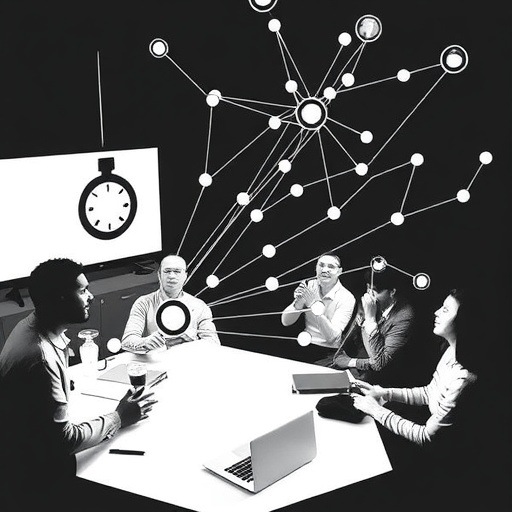
In the realm of network science, the spread of ideas, behaviors, or activity is often viewed through the lens of static connections. These models assume that once relationships between nodes—be they people, neurons, or animals—are established, they remain unchanged, forming fixed pathways along which influence or signals propagate. However, a groundbreaking study led by physicists at Northwestern University challenges this static perception by embedding the fundamental principles of learning directly into network dynamics. Their findings, published on April 27, 2026, in Communications Physics, reveal that the adaptability of connections—informed by past interactions—critically shapes how activity diffuses across complex systems.
Traditional network models have long rested on the assumption that the architecture of connections remains fixed throughout processes like information dissemination or disease transmission. Imagine a social network where friendships or contacts are permanent, and each interaction, no matter how frequent or meaningful, does not alter these links. Yet, in reality, relationships evolve: repeated positive experiences can reinforce bonds, while negative interactions may weaken them, prompting individuals to seek new contacts. This dynamic plasticity of networks is what the Northwestern team aimed to capture, recognizing that learning and adaptation are foundational to both biological and social systems but remain underexplored in computational models.
Taking inspiration from the classical Hebbian learning rule—famously summarized as “neurons that fire together wire together”—the researchers developed a theoretical framework that integrates these learning dynamics into network propagation models. Hebbian learning, introduced by psychologist Donald Hebb in 1949, describes how the simultaneous activation of neurons strengthens synaptic connections, contributing to memory and learning in the brain. By embedding this principle, the study moves beyond static representations, allowing connections to strengthen or weaken based on the positivity or negativity of interaction outcomes, effectively giving the network a memory of prior activity.
The model identifies two distinct forms of reinforcement at play: positive reinforcement, whereby nodes that interact successfully become more likely to engage in future interactions, and negative reinforcement, where unsuccessful interactions lead to weakened connections. This dynamic restructuring profoundly influences the spread of activity. Contrary to intuitive expectations, the strengthening of existing links does not necessarily enhance propagation; instead, positive feedback loops can trap activity in repetitive cycles. Conversely, weakening of connections encourages exploration of novel pathways, leading to more expansive dissemination.
This counterintuitive finding echoes phenomena observed in nature, such as the ‘ant mill’ in fire ants—an endless circular march caused by the insects following pheromone trails they themselves reinforce. Similar to ants caught in a never-ending loop, the model shows that positive reinforcement can create “echo chambers” within networks, where activity circulates among a familiar set of nodes without permeating new areas. This dynamic encapsulates the risk of over-reliance on established relationships, whether in social groups or neuron assemblies, potentially stalling the spread of innovation or signals.
The implications of this work transcend social or neural networks. Since the model addresses fundamental processes of activity propagation shaped by past interactions, it holds promise for understanding diverse phenomena: the transmission of infectious diseases where behavioral changes alter contact patterns, the routing of signals within the brain that support learning and cognition, and the behavioral patterns seen in animal groups navigating complex environments. By highlighting the pivotal role of adaptive link strength, the study sheds light on systemic vulnerabilities and opportunities for intervention to either facilitate or contain spreading phenomena.
One of the most striking aspects of the research is the nuanced role of where learning occurs within the network. The emergent behaviors vary depending on whether positive or negative learning happens at the source node initiating activity, the target node receiving it, or at both ends. This nuanced understanding adds granularity to how feedback loops shape not only connection strength but also the directionality and reach of propagated activity. It underscores the importance of considering agent-specific learning rules when modeling real-world networks.
From a methodological standpoint, the team employed sophisticated computational simulations to test these learning rules embedded within evolving network structures. Unlike traditional models with static adjacency matrices, their simulations dynamically adjusted link weights in response to reinforcement signals associated with each interaction, thereby mirroring adaptive phenomena seen in natural systems. This methodological advance enables the study of temporal evolution in networks and the feedback effects of learning on propagation patterns.
The broader theoretical contribution of this study lies in its integration of complex systems theory with neuroscientific principles, opening a fertile interdisciplinary dialogue. It bridges gaps between abstract network models and biologically inspired mechanisms, offering explanations for how memory-like processes operate at the level of network interactions. This synthesis invites further exploration into how cognitive processes and social dynamics intertwine to influence the spread of ideas, diseases, or signals.
Looking forward, the Northwestern team intends to validate these computational insights in empirical settings, examining whether the predicted learning-induced spreading patterns manifest in real-world social networks or biological systems. Such validation will require sophisticated data capturing the dynamics of contact formation and dissolution over time, coupled with measurable indicators of positive or negative reinforcement at play. If successful, these investigations could revolutionize our capacity to manage spreading phenomena, from curtailing epidemics by encouraging network exploration, to fostering innovation by breaking down entrenched echo chambers.
This pioneering research was conducted under the aegis of the National Science Foundation, supported also by the Hungarian Academy of Sciences and Hungary’s National Research, Development and Innovation Office. Collaborations with the HUN-REN Wigner Research Centre for Physics in Hungary played a pivotal role in advancing the theoretical framework. The cross-continental partnership reflects the growing necessity of combining diverse expertise in physics, biology, and social sciences to tackle the intricacies of adaptive networks.
In sum, the study “Activity propagation with Hebbian learning” invites us to reimagine networks not as static webs but as living, learning entities whose history shapes present and future possibilities. It cautions against the seductive allure of familiar connections, which may inadvertently stifle growth and dissemination. By embracing a model where weakening ties encourages exploration, this work opens pathways to more resilient, adaptable systems capable of balancing stability with innovation. Its profound insights promise transformative applications across disciplines that grapple with how activity, be it neuronal firing or cultural innovation, propagates through interconnected networks.
News Publication Date: 27-Apr-2026
Web References: https://doi.org/10.1038/s42005-026-02638-z
References: Kovács, I., Engedal, W., et al. (2026). Activity propagation with Hebbian learning. Communications Physics.
Cite Scienmag News
Drew Townsend. (April 27, 2026). To Amplify Ideas, Disrupt Connections. Scienmag. https://scienmag.com/to-amplify-ideas-disrupt-connections/
Drew Townsend. "To Amplify Ideas, Disrupt Connections." Scienmag, 27 April 2026, https://scienmag.com/to-amplify-ideas-disrupt-connections/. Accessed 1 September 2026.
Drew Townsend. "To Amplify Ideas, Disrupt Connections." Scienmag. April 27, 2026. https://scienmag.com/to-amplify-ideas-disrupt-connections/


