


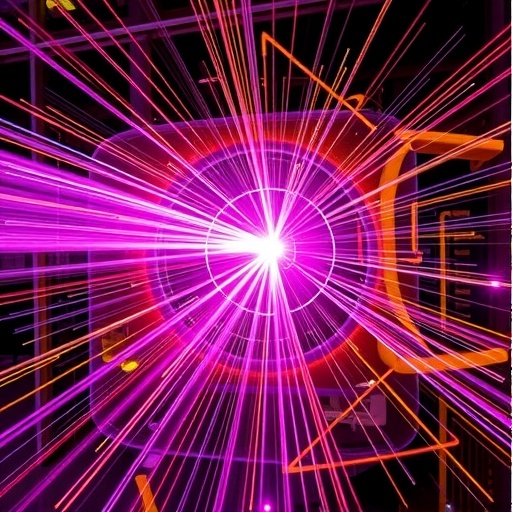
Marking an extraordinary milestone, the U.S. Naval Research Laboratory (NRL) recently celebrated the 60th anniversary of its Plasma Physics Division, a hub for cutting-edge research that has propelled the understanding of plasma science and yielded pivotal advancements in defense technologies, space science, and advanced materials. Founded in 1966, this division rapidly coalesced experts focusing on domains ranging from magnetic fusion and nuclear effects to space plasma physics and the propagation of intense laser and particle beams through Earth’s atmosphere. In its formative years, the division’s scientific efforts were catalyzed by the exigencies of the Cold War, particularly the necessity to comprehend the ramifications of high-altitude nuclear detonations on Earth’s ionospheric plasma environment.
The early Cold War plasma research concentrated on understanding the ionospheric disturbances produced by artificial plasma clouds created through nuclear tests. These disturbances, capable of disrupting radio communications and radar, posed critical threats to satellites and military infrastructure. Over time, the division’s capabilities have broadened dramatically. Today, under the stewardship of experts like Dr. Joseph Peñano, the division is organized into four specialized branches: laser-plasma interactions, space plasmas, pulsed power, and directed energy. This diversification has enabled NRL to build sophisticated experimental apparatuses simulating complex plasma environments, develop comprehensive theoretical and computational models, and pioneer transformative technologies with applications spanning fusion energy to advanced directed-energy weapon systems.
At its core, plasma is an electrically charged, quasi-neutral gas composed of ions and free electrons – the most abundant state of matter in the cosmos, constituting stars, including our Sun, and permeating interplanetary space. The plasma environment near Earth is especially dynamic and turbulent, forming the ionosphere and magnetosphere where countless satellites operate. Understanding the behavior and variability of space plasma is paramount to safeguarding both military and civilian assets in orbit. According to Dr. William Amatucci, who heads the Space and Laboratory Plasma Branch, NRL has leveraged cutting-edge large-scale laboratory plasma devices alongside space-deployed advanced sensors to replicate and analyze near-Earth plasma conditions. Their work in crafting sophisticated theoretical and computational frameworks bridges laboratory results and orbital plasma behaviors, enhancing predictive capabilities for space weather phenomena threatening satellite operations.
One of the modern, escalating challenges involves the ever-growing cloud of high-speed space debris — remnants of decades of human space activity. These particles travel at hypervelocity approaches, creating immense kinetic energy upon impact that can catastrophically damage satellites. The division has pioneered innovative approaches exploiting the unique plasma signatures produced when charged debris interacts with the ionospheric plasma. As Dr. Guru Ganguli explains, these signatures often exhibit scale sizes exceeding that of the debris itself, thereby opening novel possibilities for space situational awareness, detection, and ultimately mitigation of this hazardous debris.
High-energy density physics forms another cornerstone of the division’s contributions. This discipline investigates matter under extremities of pressure, temperature, and electromagnetic fields akin to those found in nuclear explosions or stellar interiors. NRL’s development of pulsed-power technology — encompassing devices like the rod-pinch diode and reflex triode — has empowered researchers to generate ultra-intense x-ray bursts to probe matter’s behavior under such extraordinary conditions. These pulsed x-rays are instrumental for diagnostics in national laboratory experiments, assessing material responses vital for nuclear deterrence and advanced weapon system resilience. This work exemplifies how fundamental plasma research interfaces critically with strategic defense missions.
Simultaneously, the division has advanced the science of laser–matter interactions and directed energy. Here, the physics of high-power laser beams propagating through air, water, and materials is intricately studied to optimize their effects and control. Dr. Daniel Gordon highlights that knowledge in this arena facilitates development of shipboard missile defense systems and counter-unmanned aerial vehicle (UAS) operations. The division has assembled a suite of unconventional laser sources and integrated artificial intelligence to dynamically control beam propagation, markedly extending operational ranges. They have also innovated mobile laser laboratories for versatile field testing, underscoring the blend of theoretical insight and applied technology in directed-energy pursuits.
A seminal achievement was the early demonstration and patenting of long-range incoherent laser beam combining. This breakthrough directly underpinned the creation of the Navy’s first operational shipboard laser weapon, the Laser Weapon System (LaWS), which was successfully deployed aboard the USS Ponce in 2014. Looking ahead, researchers such as Dr. Michael Helle are exploring pulsed laser systems that promise effects inaccessible to current continuous-wave high-energy lasers. Such pulses could revolutionize threat neutralization capabilities by increasing lethality and introducing new tactical mission profiles, altering the future landscape of naval directed-energy warfare.
Beyond weaponry and defense, plasma science has profound implications in materials science, particularly in precision surface processing. Ionized gas plasmas enable the delicate tailoring of surfaces at an atomic scale without damaging underlying layers — a capability essential for next-generation semiconductor manufacturing and microelectronics. In the late 1990s, NRL’s innovation brought forth the Large Area Plasma Processing Source (LAPPS), which revolutionized plasma-based surface modification. This system achieves atomic-level precision while preserving substrate integrity, thus opening new frontiers in materials synthesis and device fabrication vital for maintaining technological superiority.
Fusion energy research represents a crescendo in plasma physics endeavors. Fusion, the process fueling stars, involves merging light nuclei to release vast energy. Controlled fusion on Earth has been a longstanding scientific and engineering holy grail. NRL’s Plasma Physics Division contributes foundational expertise to this global pursuit by collaborating with universities, national laboratories, and emerging fusion enterprises. Their historical work in electron beam technology and excimer lasers has nurtured environments for studying high-pressure, uniform shock waves necessary in fusion experiments. These platforms now also serve Department of War needs by enabling testing of materials under extreme conditions analogous to battlefield environments, highlighting the multifaceted impact of plasma science.
The division’s future outlook embraces expansion and innovation, with planned facilities like the Gamble III pulsed-power system poised to extend high-energy plasma physics investigations and reinforce support for nuclear deterrence programs. Research continues to push the envelope in high-power laser-plasma interactions, radiation source development, space plasma dynamics, and directed-energy beam control. Moreover, electromagnetic launcher technology, including railguns, is under development to deliver potent offensive and defensive naval capabilities, promising transformative shifts in warfare.
Reflecting on six decades of discovery, the NRL Plasma Physics Division’s contributions include pioneering powerful neodymium glass lasers instrumental in laser fusion initiatives, devising computational transport methods critical to urban defense simulations, and developing pulsed x-ray radiography techniques for nuclear weapon diagnostics. Their sustained innovation in high-current pulsed-power generators, excimer laser fusion technology, and shipboard laser weapon concepts exemplify a legacy of scientific excellence intertwined with national service.
As Dr. Peñano affirms, plasma research at NRL epitomizes the fusion of boundary-pushing physics with real-world operational relevance, a synergy that has endured across generations. With an unwavering commitment, the Plasma Physics Division stands ready to propel discovery, innovation, and mission success for the Navy and the Nation for decades to come.
Cite Scienmag News
Katie Riggs. (April 27, 2026). NRL Marks Six Decades of Breakthroughs in Plasma Physics. Scienmag. https://scienmag.com/nrl-marks-six-decades-of-breakthroughs-in-plasma-physics/
Katie Riggs. "NRL Marks Six Decades of Breakthroughs in Plasma Physics." Scienmag, 27 April 2026, https://scienmag.com/nrl-marks-six-decades-of-breakthroughs-in-plasma-physics/. Accessed 1 September 2026.
Katie Riggs. "NRL Marks Six Decades of Breakthroughs in Plasma Physics." Scienmag. April 27, 2026. https://scienmag.com/nrl-marks-six-decades-of-breakthroughs-in-plasma-physics/


