

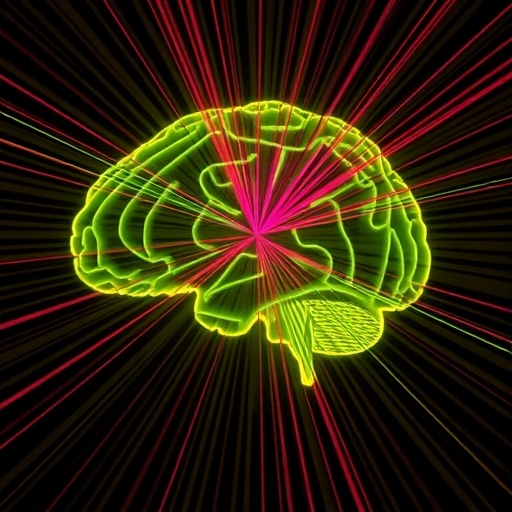
In a groundbreaking leap for optical physics and bioimaging technology, researchers at the Massachusetts Institute of Technology (MIT) have unveiled a perplexing yet transformative phenomenon: under meticulously controlled conditions, a chaotic laser beam can spontaneously self-organize into an exquisitely focused pencil-like beam. This counterintuitive discovery shatters traditional paradigms about laser behavior in multimode optical fibers and paves the way for ultrafast, high-resolution imaging methodologies with profound potential applications in medical and biological sciences.
This pioneering work centers on a nonlinear optical effect that enables a disordered mass of laser light—typically disrupted by fiber imperfections and scattering—to coalesce into a highly coherent and needle-sharp beam within a commonly used multimode optical fiber. This type of fiber, which usually suffers from disorder-induced scattering at high power levels, surprisingly gives rise to a highly stable and tight laser beam when two critical conditions are rigorously met: zero-degree input alignment and ultra-high power that initiates nonlinear interactions within the fiber’s glass material. The phenomenon manifests as a dynamic equilibrium, where the nonlinearity counterbalances inherent fiber disorder, effectively transforming chaos into order.
The implications of this ultrafast pencil beam phenomenon are considerable. Utilizing this natural self-organization, MIT scientists successfully captured three-dimensional images of the human blood-brain barrier (BBB) at speeds approximately 25 times faster than conventional gold-standard imaging techniques, without sacrificing spatial resolution. Such a leap accelerates the ability to visualize complex biological interfaces and interactions in real time, which has long been an elusive goal for researchers striving to understand cellular processes within living tissue.
One of the most significant advantages of this novel pencil beam lies in its performance superiority over traditional beams, which often suffer from sidelobe artifacts—blurry halos of light that degrade image clarity. The self-organized beam produced by this technique maintains an ultra-clean spatial profile, free from distortion, thereby enhancing imaging fidelity. This elevated precision permits detailed examinations at cellular and molecular scales, critical in contexts where minute structural and functional details are paramount.
Beyond mere imaging speed and clarity, the technology addresses a critical bottleneck in pharmaceutical research: tracking drug delivery and absorption at the blood-brain barrier. The BBB serves as a formidable protective interface that selectively restricts access to the brain, often impeding the efficacy of therapeutics targeting neurodegenerative diseases such as Alzheimer’s and amyotrophic lateral sclerosis (ALS). With this technology, scientists can observe individual cells absorbing drugs in real time, shedding light on whether and how various compounds penetrate the barrier—a vital step for developing effective treatment strategies.
The intuitive elegance of the methodology is striking. Whereas traditional high-power laser experiments in multimode fibers overwhelmingly result in chaotic scattering, this technique cleverly harnesses nonlinearity to act as a self-correcting mechanism. The rigorous on-axis input alignment condition, coupled with the powering of the laser to a threshold where nonlinear effects emerge, ensures that instead of diffusing, the light self-reorganizes into the stable, ultra-focused pencil beam. Crucially, these conditions are straightforward enough to be reproduced with standard optical setups, obviating the need for complex beam shaping components or extensive domain expertise.
From a fundamental physics perspective, this discovery challenges deeply held assumptions about light propagation in disordered media and opens avenues for exploring the interplay between disorder and nonlinear optical effects. The team plans to delve further into the precise mechanisms that underlie this self-organization process, aiming to broaden its applicability across diverse scientific and technological fields.
Moreover, the team envisions extending the utility of this pencil beam imaging beyond the blood-brain barrier to other biological tissues, including neuronal structures in the brain. The ability to perform volumetric multiphoton imaging—capturing dynamic processes in three dimensions swiftly and with unprecedented detail—could revolutionize neuroscience, immunology, and tissue engineering by enabling direct observation of living systems interacting with their microenvironments in real time.
The research also promises broader impacts on bioengineering and pharmacology as a powerful tool for time-resolved molecular tracking without the necessity for artificial fluorescent labeling, which often complicates biological experiments. The ultrafast, high-precision pencil beam method offers a new lens through which scientists can monitor biochemical and cellular events as they naturally unfold, thus improving the biological relevance and accuracy of experimental findings.
At the heart of this breakthrough lies a sophisticated manipulation of laser physics: the precise tuning of multidimensional parameters governing light’s behavior in multimode fibers. This includes spatial alignment, power input, and nonlinear optical feedback mechanisms. The approach dances delicately on the edge of fiber damage thresholds yet harnesses this precarious balance to attain remarkable beam stability and focus.
The broader scientific community anticipates that this discovery will ignite new research streams, blending nonlinear optics, materials science, and biomedical imaging. It accentuates the potential for simple, elegant solutions to emerge from embracing complexity and unpredictability rather than attempting to eliminate them—a philosophical shift with tangible practical outcomes.
Ultimately, this MIT-led innovation exemplifies how the intersection of fundamental physics and application-driven research can forge transformative technologies. The self-localized ultrafast pencil beam phenomenon not only redefines how chaotic laser light can be tamed but also promises to accelerate the pace of biomedical discoveries, inspiring optimism for future breakthroughs in detecting, understanding, and treating human diseases.
News Publication Date: 27-Apr-2026
Keywords
Applied sciences and engineering, Applied physics, Applied optics, Laser systems, Lasers, Photonics
Cite this news
SCIENMAG. (April 27, 2026). MIT Researchers Develop Self-Organizing “Pencil Beam” Laser to Advance Brain-Targeted Therapy Design. https://scienmag.com/mit-researchers-develop-self-organizing-pencil-beam-laser-to-advance-brain-targeted-therapy-design/
SCIENMAG. "MIT Researchers Develop Self-Organizing “Pencil Beam” Laser to Advance Brain-Targeted Therapy Design." Scienmag, 27 April 2026, https://scienmag.com/mit-researchers-develop-self-organizing-pencil-beam-laser-to-advance-brain-targeted-therapy-design/. Accessed 28 August 2026.
SCIENMAG. "MIT Researchers Develop Self-Organizing “Pencil Beam” Laser to Advance Brain-Targeted Therapy Design." Scienmag. April 27, 2026. https://scienmag.com/mit-researchers-develop-self-organizing-pencil-beam-laser-to-advance-brain-targeted-therapy-design/


