


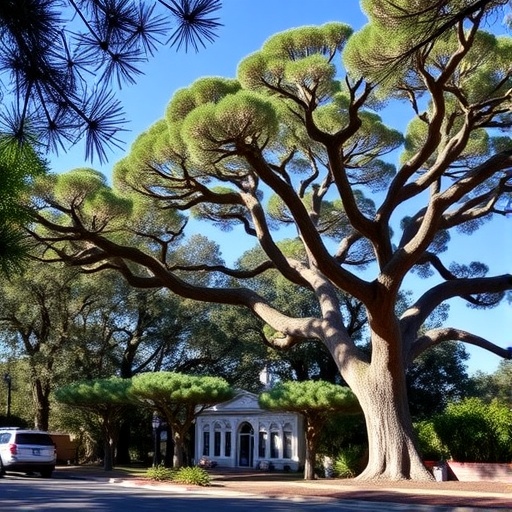
California’s iconic trees, essential pillars of the state’s diverse ecosystems, are facing a far graver threat from climate change than current global conservation assessments indicate. A groundbreaking study emerging from the University of California, Santa Cruz reveals that foundational tree species, sacred to many indigenous cultures and vital to ecological health, are poised to lose a significant portion of their climatically suitable habitats in the coming century. This stark revelation comes courtesy of a novel climate-informed risk-assessment framework that challenges the adequacy of the International Union for Conservation of Nature’s (IUCN) Red List designations for these species.
Endemic and near-endemic species of California’s forests, woodlands, and savannas are projected to experience habitat reductions ranging from 50 to 75 percent over the next hundred years. The study, published in Global Change Biology, warns that the currently listed conservation statuses vastly underestimate the vulnerability of these trees. State-of-the-art modeling techniques were employed alongside ground-truthing through extensive field observations, lending unprecedented validation to projections that forecast widespread decline in biodiversity and ecosystem services.
At the heart of this ecological crisis lies the blue oak (Quercus douglasii), a quintessential species emblematic of California’s inland foothills and rangelands. This tree is deeply woven into the cultural fabric of numerous indigenous communities, as well as the economic livelihoods of ranchers who depend on the shade and soil stabilization blue oaks provide. Beyond their cultural importance, these trees play multifaceted roles in ecosystem function, including carbon sequestration, wildlife habitat provision, and soil nutrient cycling — functions that cannot be undervalued in the face of accelerating climate shifts.
The researchers argue that the implications of unchecked blue oak decline go beyond mere species loss; the disappearance of mature blue oak woodlands would likely usher in pervasive invasive grasslands, fundamentally altering landscape character and ecological processes. Describing blue oak woodlands as “living connections to a pre-European settlement California,” lead author Blair McLaughlin highlights the irreplaceable legacy embodied by these centuries-old trees and the urgency of conserving them in the face of warming and drying trends.
This investigation evaluated 27 foundational tree species that collectively define the structure and functioning of California’s terrestrial ecosystems. These trees serve as the structural backbone, shaping habitat complexity and species interactions for myriad flora and fauna. However, the study’s findings portend a future where the loss of climatically suitable habitats will dismantle these ecological frameworks, destabilizing regional biodiversity and ecosystem resilience.
Intriguingly, the research team took a multifaceted approach that integrates climate projection models with empirical demographic data—tracking tree mortality rates and recruitment patterns on the ground. This “ground-truthing” reveals that shifts predicted by models are already visibly manifesting in natural populations. This real-world feedback loop underscores the robustness of their climate-informed risk assessments and signals that climate-driven declines are no longer theoretical but occurring in real time.
Of particular concern are so-called “zombie forests,” ecosystems comprising aging stands that appear outwardly healthy but exhibit drastically reduced seedling recruitment. These forests are effectively demographic dead ends; without intervention, the current adult trees will perish without successive generations to sustain the woodland, resulting in eventual ecosystem collapse. Identifying and managing these vulnerable stands will be critical to future conservation efforts.
Spatial risk mapping generated by the study uncovers high-risk “loss hotspots” concentrated in regions like the Sierra Nevada foothills, the eastern margins around the San Francisco Bay Area, and sections of the Transverse Range north of Los Angeles. These areas are projected to experience the steepest declines in foundational tree species. Conversely, areas such as the Central Coast, northern San Francisco Bay region, and elevated Sierra Nevada locales emerge as critical refugia with greater potential for species persistence under changing climate regimes.
These spatial insights offer a strategic compass for conservation planning. Protecting and managing persistence hotspots can maximize ecological resilience, while loss hotspots demand proactive measures such as habitat restoration, genetic resource conservation, and increased monitoring to safeguard remnant populations. The study thus advocates for shifting from a reactive conservation paradigm toward a forward-looking strategy calibrated for a rapidly warming world.
The collaborative effort draws on complementary expertise spanning ecology, evolutionary biology, anthropology, and quantitative modeling. The authors emphasize the importance of integrating cultural knowledge and traditional ecological insights with cutting-edge science. For instance, blending anthropology with ecological forecasting brings a nuanced appreciation of the cultural and symbolic significance of these foundational trees, making the case for their conservation not just ecological but also deeply societal.
Ultimately, the research underscores the imperative to rethink conservation frameworks in the context of climate dynamics. Making decisions based solely on historical or present-day conditions is insufficient as the pace of environmental change accelerates. Instead, safeguarding California’s emblematic tree species requires adaptive strategies informed by projections, ongoing monitoring, and community engagement to conserve the living heritage that shapes both natural landscapes and human identity.
Published under the auspices of UC Santa Cruz’s Conservation Science and Stewardship Lab, this work exemplifies the intersection of scientific rigor and practical stewardship. It highlights the urgency of mobilizing informed conservation action before foundational tree species and their ecosystems are irreparably altered. Given the myriad ecological, cultural, and economic values intertwined with these trees, their decline presages profound consequences across California’s environment and society.
The authors of the study concur that immediate conservation efforts grounded in dynamic, climate-informed assessments offer the best hope for mitigating the cascading effects of habitat loss. Protecting these cornerstone species is critical to sustaining biodiversity, ecosystem services, and the cultural landscapes that define California. Their research presents a clarion call for aligning conservation science with forward-looking climate adaptation to preserve the natural world for future generations.
News Publication Date: 24-Apr-2026
Web References:
Global Change Biology DOI
IUCN Red List
UC Multicampus Research Programs and Initiatives
Conservation Science and Stewardship Lab
Cite Scienmag News
Margaret Porter. (April 24, 2026). Arbor Day Alert: California’s Native Trees Face Greater Threat Than Previously Estimated. Scienmag. https://scienmag.com/arbor-day-alert-californias-native-trees-face-greater-threat-than-previously-estimated/
Margaret Porter. "Arbor Day Alert: California’s Native Trees Face Greater Threat Than Previously Estimated." Scienmag, 24 April 2026, https://scienmag.com/arbor-day-alert-californias-native-trees-face-greater-threat-than-previously-estimated/. Accessed 5 September 2026.
Margaret Porter. "Arbor Day Alert: California’s Native Trees Face Greater Threat Than Previously Estimated." Scienmag. April 24, 2026. https://scienmag.com/arbor-day-alert-californias-native-trees-face-greater-threat-than-previously-estimated/


