


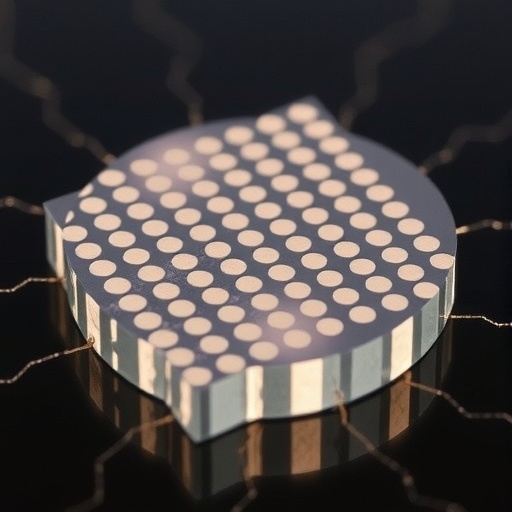
In a groundbreaking advance for the field of flexible electronics, researchers have successfully developed a wafer-scale method for integrating single-crystalline molybdenum disulfide (MoS₂) onto flexible substrates, preserving its exceptional electronic properties without the contamination typically introduced by conventional processing techniques. Transition metal dichalcogenides (TMDs) like MoS₂ have long been heralded for their outstanding mechanical flexibility and remarkable electronic performance at atomic thicknesses, positioning them as prime candidates for next-generation semiconductor technologies. However, scaling up their integration onto flexible materials has been hampered by the limitations of wet-transfer processes, which often degrade device quality through surface contamination from polymers and solvents.
Addressing these challenges, the research team pioneered a dry-transfer technique utilizing a high-dielectric constant oxide interlayer of aluminum oxide (Al₂O₃), enabling the direct, contamination-free transfer of four-inch single-crystalline MoS₂ films grown on sapphire substrates to flexible platforms. This sophisticated approach circumvents the adverse effects of wet chemistry, substantially preserving the intrinsic electronic characteristics of the MoS₂ material. The breakthrough creates new possibilities for wafer-scale, high-performance flexible electronics, bridging the gap between laboratory-scale demonstrations and practical, manufacturable devices.
A key feature of this dry-transfer methodology is the introduction of a thin Al₂O₃ interlayer, which serves as a stable, high-κ dielectric interface facilitating strong adhesion and excellent dielectric properties. The oxide layer protects the fragile MoS₂ throughout the transfer process, preventing contamination and mechanical damage that frequently occur in polymer-assisted transfer methods. The resultant MoS₂ films maintain their pristine single-crystalline nature post-transfer, which is critical for achieving superior electronic performance in flexible semiconductor components.
Field-effect transistor (FET) arrays constructed using this innovative dry-transfer technique demonstrate remarkable electrical parameters comparable to their rigid substrate counterparts, showcasing the technological potential of this approach. Devices exhibit a maximum electron mobility of 117 cm² V⁻¹ s⁻¹, indicative of high-quality conduction channels within the flexible MoS₂ films. Moreover, the subthreshold swing reaches as low as 68.8 mV dec⁻¹, signaling excellent gate control and energy efficiency—crucial factors for low-power electronics. The on/off current ratio, a measure of switching capability, attains an impressive value of 10¹², ensuring reliable digital logic operations.
Moving beyond individual transistors, the researchers successfully fabricated flexible inverters operating in the subthreshold regime, achieving a voltage gain of 218. Such high gain values reflect the transistors’ robust amplification capabilities essential for flexible integrated circuits. Impressively, the power consumption of these devices is measured at only 1.4 picowatts per micrometer, positioning them among the most energy-efficient flexible semiconductors to date. These characteristics underscore the feasibility of deploying MoS₂-based electronics in ultralow-power flexible systems with high functional density.
The versatility of the dry-transfer approach is further demonstrated by its application in an active-matrix tactile sensing system integrated onto a robotic gripper. This innovative platform leverages the flexible MoS₂ transistor arrays to perform real-time tactile mapping and object recognition, showcasing the material’s utility in complex sensing and artificial intelligence applications. The integration onto a robotic interface highlights the potential of this technology for next-generation wearable devices, smart robotics, and human-machine interaction systems that demand conformability and robustness.
The authors emphasize that this advancement could revolutionize the fabrication of flexible electronic devices by enabling scalable production of high-performance 2D semiconductor films without resorting to deleterious wet chemical processes. This dry-transfer strategy is poised to accelerate the commercialization of flexible electronics by aligning with existing wafer-scale manufacturing protocols, a crucial step toward widespread industrial adoption. The technique’s compatibility with large-area substrates and industrial scalability marks a significant stride toward practical flexible semiconducting circuits.
One of the noteworthy implications of this work is the preservation of the MoS₂’s monocrystalline quality throughout the transfer and integration processes. Maintaining a single-crystal structure is vital for minimizing grain boundary defects and charge trap sites that typically degrade electronic properties. The retention of crystallinity ensures stable device performance over extended operational lifetimes and under mechanical strain, a key requirement for flexible electronics subjected to bending and twisting stresses during use.
Furthermore, the use of an Al₂O₃ interlayer provides an additional engineering dimension via its high dielectric constant, which improves electrostatic gating in transistor devices. This strategic integration enhances gate capacitance, enabling better modulation of charge carriers in the ultrathin MoS₂ channel. The result is an optimized field-effect transistor operation with reduced threshold voltage and improved switching characteristics, which collectively contribute to enhanced device efficiency and speed.
This research also addresses longstanding reliability concerns associated with 2D material-based devices on flexible substrates. By eliminating polymer residues and solvent-induced defects typically introduced during wet transfers, the oxide dry-transfer process significantly reduces hysteresis effects and charge scattering in MoS₂ devices. This results in more stable, repeatable electrical responses, critical for sophisticated applications such as flexible displays, sensory skins, and wearable electronics that require consistent functionality over millions of bending cycles.
The fabrication process’s compatibility with standard semiconductor manufacturing techniques is another compelling advantage of this approach. The use of sapphire substrates for initial chemical vapor deposition growth of MoS₂ ensures the availability of large-area, single-crystalline films, which can then be seamlessly moved onto flexible circuits through the dry transfer. This synergy between high-quality material synthesis and clean transfer enriches the prospects for integrating 2D semiconductors into commercial flexible electronic platforms.
By introducing a scalable dry-transfer technique that preserves the electronic excellence of single-crystal MoS₂, this study charts a clear path forward for the field of flexible electronics. It signals a transformative approach where device performance is no longer sacrificed at the altar of mechanical flexibility, but instead fully harnessed and optimized. Future iterations of this process may extend to other 2D materials, broadening the palette of atomically thin semiconductors readily deployable in flexible, stretchable, and wearable electronic applications.
The demonstration of a real-time tactile sensing system capable of recognizing objects and mapping pressure patterns underlines the practical impact of this technology. Flexible electronics incorporating MoS₂ transistors can enhance robotic dexterity and tactile perception, opening new frontiers in soft robotics and interactive wearable feedback devices. The coupling of mechanical flexibility with high electronic performance invites unprecedented innovation in areas ranging from biomedical sensors to adaptive human-machine interfaces.
This work also sets an important benchmark for the power efficiency of 2D semiconductor devices on flexible substrates. Achieving power consumptions as low as a few picowatts per micrometer fulfills the demanding criteria for battery-powered and energy-harvesting wearable devices. Such remarkable power efficiency, coupled with high gain and electrical stability, suggests that MoS₂-based flexible electronics will play a critical role in the development of sustainable, long-lasting, and miniaturized electronic systems.
In conclusion, the wafer-scale integration of single-crystalline MoS₂ onto flexible substrates using a high-κ oxide dry-transfer method represents an unprecedented leap forward in flexible electronics fabrication. By preserving the pristine electronic properties of MoS₂ and eliminating contamination sources, this technology enables flexible devices with performance metrics equal to rigid counterparts, while delivering the mechanical resilience and form factors required for the future of wearable and integrated electronics. The research opens exciting new pathways for commercial-scale, flexible semiconductor devices that marry ultra-thin 2D materials with advanced oxide dielectrics.
Cite Scienmag News
Florence R. (April 24, 2026). Wafer-Scale MoS2 Integration via Oxide Dry Transfer. Scienmag. https://scienmag.com/wafer-scale-mos2-integration-via-oxide-dry-transfer/
Florence R. "Wafer-Scale MoS2 Integration via Oxide Dry Transfer." Scienmag, 24 April 2026, https://scienmag.com/wafer-scale-mos2-integration-via-oxide-dry-transfer/. Accessed 28 August 2026.
Florence R. "Wafer-Scale MoS2 Integration via Oxide Dry Transfer." Scienmag. April 24, 2026. https://scienmag.com/wafer-scale-mos2-integration-via-oxide-dry-transfer/


