


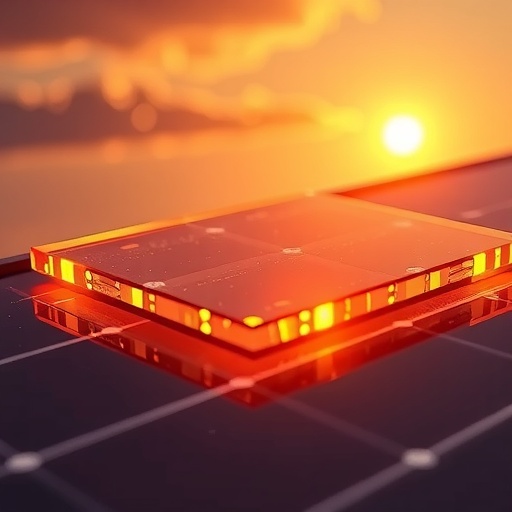
Metal halide perovskite solar cells (PSCs) are redefining the future of photovoltaic technology by combining remarkable energy conversion efficiencies with the promise of low manufacturing costs. Since their inception, PSCs have demonstrated an impressive trajectory of performance gains, now rivalling and in some cases surpassing traditional silicon-based solar cells. Despite such potential, the pervasive use of lead—a toxic heavy metal—in their composition remains a critical barrier to widespread adoption and commercialization. The environmental and health risks linked to lead exposure have intensified calls for responsible development paths, prompting researchers to explore the delicate balance between harnessing perovskite benefits and mitigating lead hazards.
The lead content intrinsic to PSCs raises significant concerns not only during device operation but also at the end of their lifecycle, when solar panels are disposed of or recycled. Lead’s toxicity, coupled with its potential for environmental leakage, demands rigorous strategies to contain and neutralize its impact. Recent studies have advanced beyond qualitative assessments, introducing quantitative frameworks to measure how effectively lead can be isolated and stabilized within perovskite modules. Among these, metrics such as sequestration efficiency and lifetime provide a foundational understanding of how long and how well lead can be immobilized, affording practical benchmarks for evaluating different mitigation approaches.
Sequestration efficiency refers essentially to the degree to which lead is chemically or physically confined within the solar device structure under various conditions, including damage scenarios. A high sequestration efficiency indicates that, even in the event of panel breakage, lead will not leach into the surrounding environment in harmful concentrations. Complementing this, the sequestration lifetime metric estimates the durability of lead immobilization over time, thus shedding light on long-term safety profiles. Together, these metrics enable a more precise and actionable evaluation of lead mitigation techniques, informing material selection, device engineering, and end-of-life handling strategies.
Several methods have emerged to improve lead containment within PSCs. Encapsulation is a popular approach wherein perovskite layers are sandwiched between protective barriers designed to prevent lead exposure. Chemical immobilization involves binding lead ions to stable compounds or structures within or adjacent to the perovskite matrix, thereby reducing mobility. Advances in the use of lead-absorbent materials, such as certain phosphates or silicates, show promise in creating internal “sinks” that trap lead even when the cell’s integrity is compromised. The challenge lies in optimizing these methods without compromising device efficiency or economic feasibility.
Device efficiency remains a pivotal factor. Any lead mitigation strategy must not detract significantly from the photovoltaic performance that positions PSCs as disruptive technologies. Recent innovations indicate that some sequestration materials can be integrated without detrimental effects on charge transport or light absorption, highlighting the possibility of harmonizing safety with performance. Furthermore, these methods must be scalable and cost-effective to facilitate mass production and commercial viability, ensuring that lead remediation does not transform into an economic or manufacturing bottleneck.
Beyond device-level engineering, the sourcing and lifecycle management of lead used in PSCs constitute another pillar of sustainable commercialization. Advocating the use of recycled lead, particularly from ubiquitous lead-acid batteries, resonates with circular economy principles. Lead from spent batteries offers a sustainable feedstock that diminishes reliance on virgin lead mining, which is associated with severe environmental degradation and occupational hazards. Incorporating recycled lead into PSC manufacturing not only reduces raw material costs but also provides a built-in channel for end-of-life lead recovery, promoting a closed-loop system.
Such closed-loop recycling infrastructure requires collaboration across industries, regulatory bodies, and manufacturers. Policies fostering producer responsibility can incentivize the collection and recycling of expired or damaged perovskite modules. This systemic approach ensures that lead does not escape into the environment but is continuously reprocessed into new solar cells, minimizing waste and hazard accumulation. However, the establishment of such frameworks demands considerable investment, coordinated logistics, and robust regulatory oversight to be effective at scale.
The review also identifies critical bottlenecks in current lead mitigation efforts, particularly the need for comprehensive field testing and long-term durability studies under real-world operational conditions. Laboratory tests under controlled environments may underestimate degradation, mechanical stress, and environmental interactions occur over years. Therefore, continuous monitoring and accelerated aging protocols are essential to validate the sustained effectiveness of lead sequestration technologies and predict potential failure modes.
Addressing public perceptions and regulatory hurdles linked to lead use is equally crucial. Public apprehension regarding toxic materials in renewable energy systems can slow market acceptance and policy support. Transparent communication about risks, mitigation strategies, and environmental safeguards can bolster trust and accelerate deployment. Meanwhile, regulatory agencies must balance precautionary principles with innovation support, crafting guidelines that enable responsible commercialization without stifling technological progress.
In addition to chemical and physical containment, emerging research explores alternative perovskite compositions with reduced or eliminated lead content. Tin-based perovskites have attracted attention but currently suffer from stability and efficiency challenges. While lead-free alternatives are a promising long-term direction, their current performance gap means that lead-containing PSCs remain the near-term focus. Consequently, emphasis is rightly placed on managing lead risks effectively until more viable substitutes emerge.
The broader implications for global photovoltaic deployment are profound. PSCs hold the potential to accelerate energy transitions by lowering the expense and broadening the applicability of solar technology, especially in regions where cost-sensitive solutions are needed. Ensuring the safe use of lead within PSC systems aligns with broader sustainability goals, integrating environmental protection, public health, and renewable energy advancement into a coherent framework.
In conclusion, the path to safer commercialization of perovskite solar cells involves a multi-pronged effort across material science, engineering, policy, and industry collaboration. Quantitative metrics like sequestration efficiency and lifetime provide valuable tools to assess and optimize lead immobilization strategies. The integration of recycled lead sources and the establishment of closed-loop recycling systems promise to transform lead from an environmental liability into a manageable and sustainable resource. Ultimately, by confronting lead toxicity head-on with scientifically informed approaches, the photovoltaic community can unlock the transformative potential of perovskite solar technology while safeguarding health and the environment.
This comprehensive review serves as a roadmap for stakeholders aiming to responsibly harness the advantages of PSCs. It emphasizes that lead toxicity challenges are neither insurmountable nor static but rather dynamic issues requiring continued innovation and vigilance. As research and policy evolve in tandem, the vision of affordable, high-efficiency, and environmentally safe perovskite solar cells comes into ever-sharper focus, heralding a promising era in clean energy technology.
Lin, D., Huang, Y., Chen, Q. et al. Mitigating lead toxicity towards safer commercialization of perovskite solar cells.
Nat Energy (2026). https://doi.org/10.1038/s41560-026-02037-2
Cite Scienmag News
Florence R. (April 24, 2026). Reducing Lead Risks for Safer Perovskite Solar Cells. Scienmag. https://scienmag.com/reducing-lead-risks-for-safer-perovskite-solar-cells/
Florence R. "Reducing Lead Risks for Safer Perovskite Solar Cells." Scienmag, 24 April 2026, https://scienmag.com/reducing-lead-risks-for-safer-perovskite-solar-cells/. Accessed 28 August 2026.
Florence R. "Reducing Lead Risks for Safer Perovskite Solar Cells." Scienmag. April 24, 2026. https://scienmag.com/reducing-lead-risks-for-safer-perovskite-solar-cells/


