


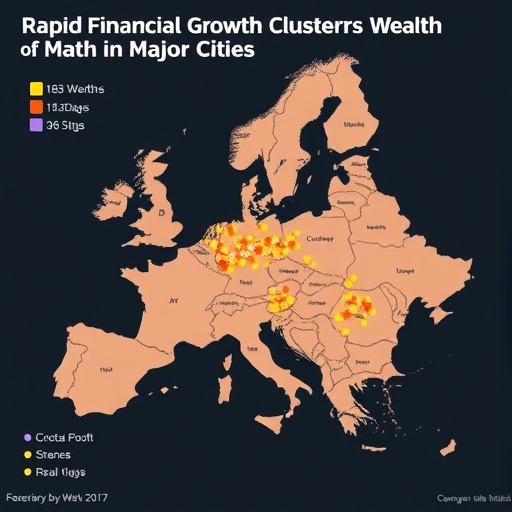
A groundbreaking new study reveals how surging earnings in the financial sector are reshaping the economic landscape of major global cities, concentrating the wealthiest incomes within a handful of financial hubs. Drawing on an unprecedented dataset encompassing nearly one billion linked employer–employee records across nine countries, researchers have identified stark patterns of top earnings concentration that highlight the pivotal role of finance-driven income growth in urban inequality.
The analysis centers on detailed administrative data derived from comprehensive labor force records in countries including Canada, Denmark, Sweden, Norway, France, Germany, Spain, the Netherlands, Japan, and the United States. These datasets enable a fine-grained examination of wage dynamics, even in small metropolitan areas, although variations in sample sizes and data coverage—especially in countries like Germany and Japan—require robust imputation techniques to address issues like top-coding in earnings reports.
By focusing on the spatial distribution of earnings, the study uncovers that the escalation of top-tier incomes is not uniformly spread but tightly clustered in financial cities such as New York, Tokyo, Paris, Frankfurt, and Toronto. In northern Europe, Stockholm emerges as a central node for finance, serving three countries, while Copenhagen, Oslo, and Madrid function as national financial hubs. These cities disproportionately contribute to the national increase in income shares earned by the wealthiest, an effect clearly illustrated through comparisons with demographically and economically similar comparison cities lacking major financial centers within the same countries.
The methodology employed involves calculating earnings concentration at both national and local levels using established percentile thresholds—primarily the 99th percentile nationally and the 95th percentile locally—to define what constitutes top earners. Researchers compute shares of total earnings accruing above these thresholds and apply odds ratios to quantify the extent to which financial cities are overrepresented among high earners, compared to their domestic peers. These rigorous measures expose a marked amplification of top earnings shares within financial centers over recent decades.
Central to the study is the decomposition of earnings growth into contributions from the financial sector versus other economic segments within the cities examined. Counterfactual modeling techniques effectively isolate the impact of finance by estimating scenarios where earnings growth in finance is held constant at zero, enabling a quantification of the net effect that financial sector expansion has on concentrating wealth. The findings confirm that finance sector earnings growth accounts for a substantial, and often dominant, portion of the increase in high-income concentration in key financial cities.
Despite the methodological assumptions that financial and nonfinancial drivers of earnings growth operate independently—a simplification necessary but imperfect—the researchers argue that the financial sector’s expansion appears as a critical causal factor. This conclusion is supported by the known exogenous influences on finance-sector wages, such as deregulation and rent sharing, which are largely uncorrelated with local labor market sorting and agglomeration effects, adding robustness to the inference of causality in the observed income patterns.
The study further examines the notorious volatility of local top earnings metrics, emphasizing that short-term year-to-year fluctuations arise not only from actual economic shifts but also from data-specific factors like sample construction and reporting changes. This complexity challenges straightforward interpretations but reinforces the need for sophisticated econometric strategies to capture the underlying long-term trends.
To reinforce their findings, the authors employ cross-country regression analyses using panel data models with country and year fixed effects, controlling innovatively for GDP per capita and population along with proxies for global financial integration such as foreign direct investment stock ratios. These statistical models consistently validate the strong association between finance-related employment shares in cities and the magnified concentration of top earnings, underscoring the pervasive influence of financial markets on urban income dynamics.
A striking implication of the research is that urban income inequality hinges heavily on the agglomeration of financial talent and capital. Financial cities are not just wealth magnets; they structurally reshape earnings distributions both within their boundaries and relative to national baselines. This phenomenon elucidates why the richest segments of the workforce gather disproportionate income in a select few metropolitan areas, highlighting geography as a critical dimension in global inequality debates.
The granular data also enable identification of differential effects across sectors, with finance standing out as the key driver. While other industries contribute variably to local earnings growth, none approach the outsized impact of financial sector expansion. This specificity provides a compelling narrative about the role of sectoral composition in shaping urban economic inequalities, complementing existing literature on agglomeration economies and labor market segmentation.
Looking ahead, the research points to the need for further exploration of the feedback loops between financial sector growth and broader local economic conditions, including spillover effects that may either amplify or dampen earning disparities over time. The current study lays a methodological foundation for future work leveraging exogenous shocks or regulatory changes to disentangle cause and effect more conclusively.
Ultimately, the study calls attention to the critical role of financial markets as engines of top-end income growth and spatial income stratification, offering policymakers stark evidence about where and how income inequality is intensifying. With finance increasingly centralized in a few global cities, efforts to address income disparities must reckon with the unique dynamics unleashed by financialization on a localized scale.
In sum, this novel multi-country analysis unveils the rapid concentration of top earnings in financial cities fueled by finance sector growth, reshaping not only cityscapes but also national earnings distributions. As urban economies become ever more intertwined with financial markets, understanding these patterns becomes indispensable for crafting informed economic and social policy capable of tackling mounting inequality at its roots.
Cite Scienmag News
Denise Maddox. (April 24, 2026). Rapid Financial Growth Clusters Wealth in Major Cities. Scienmag. https://scienmag.com/rapid-financial-growth-clusters-wealth-in-major-cities/
Denise Maddox. "Rapid Financial Growth Clusters Wealth in Major Cities." Scienmag, 24 April 2026, https://scienmag.com/rapid-financial-growth-clusters-wealth-in-major-cities/. Accessed 5 September 2026.
Denise Maddox. "Rapid Financial Growth Clusters Wealth in Major Cities." Scienmag. April 24, 2026. https://scienmag.com/rapid-financial-growth-clusters-wealth-in-major-cities/


