


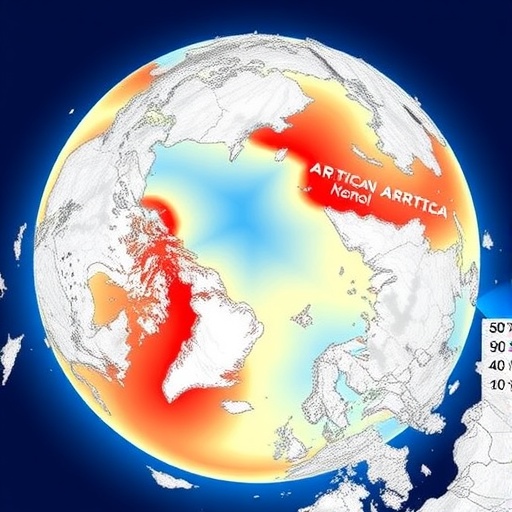
In recent decades, the Arctic has been a focal point for climate scientists, environmentalists, and policymakers alike due to its rapid transformation. One of the most critical indicators of climate change in this polar region has been the lengthening of the sea ice melt season, a phenomenon with profound implications for global climate systems, ecosystems, and human activity. However, new research conducted by Boisvert, Parker, Valkonen, and their colleagues, published in Communications Earth & Environment, reveals a surprising trend: after years of steady extension, the lengthening of the Arctic sea ice melt season has recently stabilized, but this apparent plateau is accompanied by remarkable variability that challenges previous assumptions.
For over thirty years, climate models and satellite observations have consistently shown that the Arctic’s melt season—the period during which sea ice thins and retreats—is becoming longer. This elongation has been tightly correlated with rising global temperatures, especially in the high latitudes where warming occurs at more than twice the global average. The melt season traditionally begins in spring as temperatures rise and sunlight intensifies, culminating in the summer minimum extent before refreezing begins in autumn. A longer melt season has dire consequences ranging from diminishing habitat for native wildlife to accelerating global sea-level rise due to the albedo effect—the reflective sea ice replaced by darker ocean water absorbs more solar energy, amplifying warming feedback loops.
Boisvert et al.’s study leverages an unprecedented dataset combining satellite remote sensing, in situ measurements, and advanced climate models to probe recent trends in the Arctic melt season. Their methodology focuses on delineating both the onset and termination dates of melt, scrutinizing how these are shifting over the past three decades. The researchers highlight that while earlier observations pointed toward a relentlessly expanding melt window, the past five years have witnessed a departure from this unequivocal trend. Instead, the timing of melt start and end dates has exhibited heightened interannual fluctuations, signaling a transition into a new regime of variability.
The stabilization in lengthening does not imply a halt in Arctic warming. Rather, it reflects a complex interplay of atmospheric and oceanic dynamics that modulate the energy balance at the ice-ocean interface. For example, variations in cloud cover, wind patterns, and ocean heat transport influence surface temperatures and ice melting rates on short timescales. Such episodic patterns can mask or accentuate underlying warming trends, thus complicating the interpretation of melt season timing. The study underscores that increased variability challenges predictive models, cautioning against complacent conclusions about Arctic sea ice trajectories.
A significant factor contributing to this newfound variability is the increasingly erratic behavior of the Arctic jet stream and associated weather systems. As the polar amplification of warming distorts temperature gradients between the poles and mid-latitudes, storm tracks and prevailing wind patterns show more frequent deviations from historical norms. These atmospheric perturbations can, on some years, delay the onset of melt by bringing cooler, cloudier conditions, while in other years, they accelerate melting through enhanced solar radiation and warmer ocean currents. Such factors demonstrate how Arctic sea ice dynamics are embroiled in a delicate and multifaceted climatic dance.
Oceanographic processes also play a crucial role in shaping the melt season length. The Arctic Ocean, connected to the Atlantic and Pacific via narrow straits, receives large influxes of warmer water masses at varying intensities and timings. This variability influences basal melting of sea ice—melting from beneath the ice—distinct from surface melting. Boisvert and colleagues’ analysis identifies episodes where increased ocean heat anomaly coincides with shortened freeze-up timing, effectively modifying the freeze-melt cycle and resulting in an inconsistent melt season length. In addition, stratification changes in the upper ocean layers, driven by freshwater influx from melting ice and river discharge, affect heat transfer to the ice.
Beyond physical drivers, internal ice sheet properties have also evolved. The Arctic’s multi-year ice—the older, thicker ice that survives summer melt—has diminished historically, leaving behind more seasonal, thinner ice that responds more rapidly to environmental shifts. This transitional ice composition increases sensitivity to short-term weather extremes and ocean energy fluctuations, further fueling melt season variability. Boisvert et al. emphasize that understanding these micro-scale physical processes within the ice is essential to fully grasp the broader seasonal trends.
The consequences of this stabilization and variability extend beyond climatological curiosity. Ecosystems dependent on predictable ice conditions face growing uncertainty. Species such as polar bears, seals, and migratory birds that rely on specific ice cues for breeding, hunting, and migration are increasingly beleaguered by the irregular chronologies of melt and freeze. Marine food webs, coupled with nutrient cycling influenced by ice cover dynamics, also experience stress from these changes. Additionally, indigenous communities that subsist on ice-based hunting routes and rely on seasonal ice for transportation face socio-economic challenges as timing unpredictability escalates.
From a global perspective, the Arctic’s altered melt season impacts weather patterns farther south. The interaction between the polar atmosphere and mid-latitudes is a subject of burgeoning research interest, relating to phenomena such as extreme cold spells and heatwaves in continental regions. Variability in Arctic sea ice extent and melt timings modulate atmospheric pressure systems and temperature gradients, leading to “teleconnections” affecting weather extremes. The new findings by Boisvert and colleagues suggest that increased melt season variability could amplify these teleconnections, heightening weather unpredictability in densely populated areas.
The research also bears implications for climate modeling and policy frameworks. Previous projections often assumed relatively linear or monotonic trends in Arctic ice melt characteristics, with gradual and predictable lengthening. Yet, the emergent high variability regime detected here necessitates revisions in model parametrizations to incorporate stochastic or episodic behavior better. Policymakers reliant on climate model outputs for long-term planning, adaptation strategies, and emission targets must account for this increased uncertainty envelope, accommodating a broader range of potential Arctic ice futures.
Methodologically, this study epitomizes the power of integrating multi-source data—satellite-derived ice concentration and thickness measurements, airborne radar observations, ocean buoy data, and advanced model assimilation approaches—to reveal subtleties in large-scale environmental trends. The multi-decadal temporal coverage allows detection of regime shifts that would be obscured in shorter datasets. Furthermore, emerging machine learning techniques applied to disentangle complex climatic interactions hold promise for future Arctic sea ice dynamics research, a path inspired by the comprehensive approach of Boisvert et al.
The socio-cultural ramifications stemming from this transition to variability accentuate the intimate link between environmental science and human dimensions. As Arctic navigation routes fluctuate unpredictably, economic activities such as shipping, fishing, and resource exploration face elevated risks. Insurance models, supply chain logistics, and even geopolitical strategies must adapt to a new normal where seasonal timing is less certain. International collaboration to monitor and mitigate associated risks is increasingly vital, underscoring Arctic research’s global significance.
In summary, the research by Boisvert, Parker, Valkonen, and colleagues marks a pivotal advance in understanding the Arctic sea ice melt season’s recent trajectory. The decade-long expectation of uninterrupted lengthening has plateaued, but this pause is not a stable endpoint. Instead, the Arctic has transitioned into a state of enhanced variability, a regime characterized by fluctuating melt timing influenced by complex atmospheric, oceanic, and ice-specific processes. This development demands renewed attention from the scientific community and beyond, as it reshapes prognoses, ecological outcomes, and policy frameworks around one of the planet’s most sensitive and consequential environments.
As the Arctic continues to respond dynamically to a warming world, continuous observation and model refinement are imperative. The findings invite an urgent reexamination of how we conceptualize climate system tipping points, feedback mechanisms, and resilience. In a region where environmental stability once seemed painfully fragile but predictable in its decline, the newfound unpredictability heralds a challenging frontier filled with unknowns, spanning from microscopic ice crystal physics to planetary-scale climate ramifications. Boisvert et al.’s groundbreaking study offers both a stark warning and a clarion call for deeper investigation into an Arctic climate system that remains as enigmatic as it is essential to global sustainability.
Cite Scienmag News
Violet Maxwell. (April 24, 2026). Arctic Sea Ice Melt Season Shifts to Variability. Scienmag. https://scienmag.com/arctic-sea-ice-melt-season-shifts-to-variability/
Violet Maxwell. "Arctic Sea Ice Melt Season Shifts to Variability." Scienmag, 24 April 2026, https://scienmag.com/arctic-sea-ice-melt-season-shifts-to-variability/. Accessed 5 September 2026.
Violet Maxwell. "Arctic Sea Ice Melt Season Shifts to Variability." Scienmag. April 24, 2026. https://scienmag.com/arctic-sea-ice-melt-season-shifts-to-variability/


