


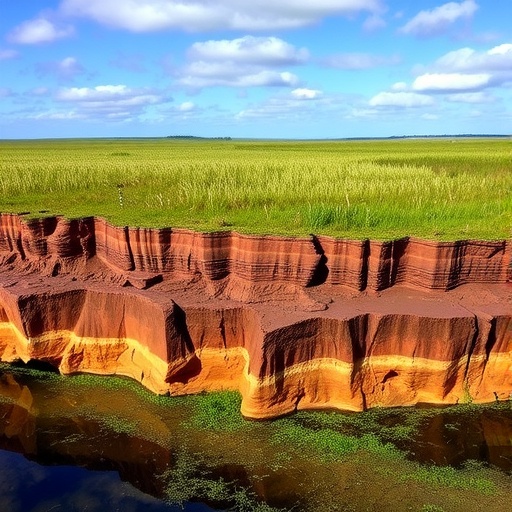
In the complex interplay between natural processes and rising sea levels, coastal marshes represent critical battlegrounds in the fight against climate change. New research published in Communications Earth & Environment reveals how accretionary marsh levees—natural sediment ridges that form alongside marsh edges—may unexpectedly be hindering the elevation gains of the marsh interiors themselves. This groundbreaking study by Himmelstein, Cooper, McKee, and colleagues unpacks how these levees, once thought to be protective features, are in fact emerging barriers that could dramatically alter wetland resilience and survival as global sea levels continue to rise.
Coastal salt marshes are dynamic ecosystems, sustained by sediment accumulation and organic matter that help maintain their elevation relative to surrounding water levels. Their ability to keep pace with rising seas is paramount, as marshes provide crucial services including carbon sequestration, storm surge protection, and habitat for diverse wildlife. However, the process by which these ecosystems gain elevation is intricate, involving the delivery and retention of sediments through tidal action and vegetation growth. Until recently, accretionary marsh levees formed at marsh edges were perceived primarily as natural defenses, slowing water intrusion and promoting sediment deposition within the marsh interior.
This new study challenges that assumption by employing high-resolution topographic surveys and sediment accumulation measurements across multiple marsh systems. These data reveal an unexpected effect: while marsh levees rise over time through sediment build-up, they simultaneously impede sediment and water flow into the adjacent interior marsh. The result is a form of internal hydrological isolation, limiting the extensive redistribution of sediments that is essential for the interior to gain elevation at a rate sufficient to counteract sea-level rise.
The team utilized a combination of remote sensing technologies, sediment core analysis, and detailed hydrodynamic modeling to elucidate how these physical features alter tidal connectivity. Their findings suggest that as levees accrete and grow more pronounced, they effectively act as partial dams, restricting the inland migration of sediments carried by flooding tides. Consequently, these levees create microenvironments where sediment deposition stagnates, and the marsh interiors receive markedly less material critical for vertical accretion.
This process is particularly problematic under accelerating sea-level rise scenarios. Marsh interiors that cannot keep pace with rising water levels risk becoming submerged, leading to loss of vegetation, reduced carbon storage capacity, and ultimately, conversion from productive marsh to open water or mudflats. The feedback mechanism discovered highlights a paradox where natural levee growth—once an adaptive response to sediment supply—may shift toward a maladaptive factor under rapid environmental change.
The implications of this research are far-reaching. Coastal management and restoration efforts traditionally emphasize sediment enhancement to bolster marsh resilience. Yet, if levees inhibit sediment redistribution into interior zones, these strategies may require reevaluation. Researchers advocate for integrated management approaches that consider the structural impacts of levees and explore methods to maintain or restore hydrological connectivity. This could involve targeted levee breaches or engineered channels designed to facilitate tidal flow and sediment delivery.
Ecologically, the study also emphasizes the nuanced role of marsh topography in influencing plant community dynamics and wetland biodiversity. Variations in elevation control zonation patterns, waterlogging intensity, and nutrient availability—factors crucial to the survival and distribution of native marsh species. By impeding interior elevation gain, levees indirectly shape habitat quality and, over longer timescales, affect ecosystem function.
Furthermore, understanding these internal barriers is vital for predicting future marsh trajectories in the context of climate adaptation. Models that fail to incorporate the effects of levee-induced isolation may overestimate the capacity of marsh interiors to accrete sediment and maintain elevations, thereby underestimating vulnerability to inundation and habitat loss. The authors call for the integration of high-resolution geomorphic data into predictive models to improve sea-level rise adaptation strategies.
The study also sheds light on the sediment sourcing and transport pathways feeding marsh systems. It underscores the critical balance between sediment supply from rivers and coastal shelf processes with internal redistribution mediating habitat persistence. Disruptions to sediment budgets—due to damming, land-use changes, or altered hydrology—may exacerbate the isolating effects of levees, compounding marsh fragility.
Significantly, the research methodology demonstrates the value of cross-disciplinary approaches combining field measurements, remote sensing, and numerical modeling. Such frameworks provide a more holistic understanding of geomorphological processes and their ecological consequences. Future inquiries may build on this work by investigating the thresholds at which levee formation transitions from beneficial to detrimental, as well as how sediment characteristics influence these dynamics.
In sum, the identification of accretionary marsh levees as inadvertent internal barriers redefines how scientists and coastal managers conceptualize marsh resilience. By framing these natural features as both products and modifiers of sedimentary dynamics, this study offers a paradigm shift that can guide adaptive management in rapidly changing marine environments. It also calls for urgent reassessment of conservation priorities, taking into account the complex physical and ecological feedbacks influencing wetland sustainability.
As sea levels continue their inexorable rise, safeguarding marshes becomes ever more critical—not only for biodiversity and carbon storage, but also for human communities reliant on the protection these ecosystems afford against storms and flooding. The insights from Himmelstein and colleagues illuminate pathways forward for sustaining marshland functions by addressing the subtle geomorphic processes at play. In doing so, this research provides a beacon for proactive stewardship amid one of the most pressing environmental challenges of our time.
This study stands as a testament to the intricate balance in natural systems, where features that appear protective can have hidden costs under shifting environmental conditions. By decoding these complexities, scientists can better anticipate the future of coastal landscapes and inform pragmatic solutions that align with nature’s own rhythms. The research marks a pivotal step toward integrated coastal resilience, blending geomorphology, ecology, and climate science to chart sustainable futures for vital marsh ecosystems worldwide.
Cite Scienmag News
Violet Maxwell. (April 24, 2026). Accretionary Marsh Levees Limit Interior Elevation Gain. Scienmag. https://scienmag.com/accretionary-marsh-levees-limit-interior-elevation-gain/
Violet Maxwell. "Accretionary Marsh Levees Limit Interior Elevation Gain." Scienmag, 24 April 2026, https://scienmag.com/accretionary-marsh-levees-limit-interior-elevation-gain/. Accessed 3 September 2026.
Violet Maxwell. "Accretionary Marsh Levees Limit Interior Elevation Gain." Scienmag. April 24, 2026. https://scienmag.com/accretionary-marsh-levees-limit-interior-elevation-gain/


