


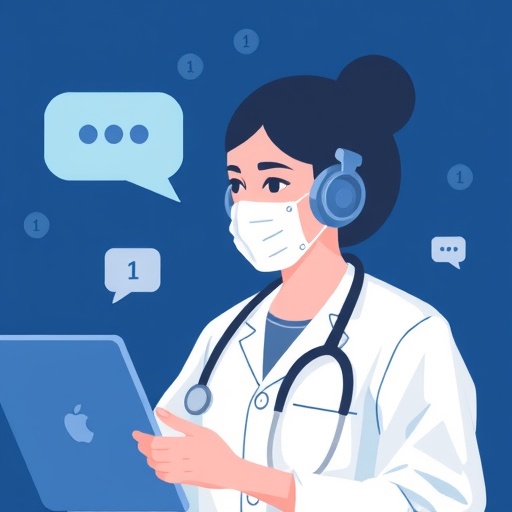
A groundbreaking advancement in digital health technology has been unveiled by a team of engineers at the University of California San Diego. This innovation takes the form of an AI-driven chatbot explicitly engineered to aid individuals in making well-informed decisions about their health symptoms. By leveraging clinician-validated protocols and sophisticated language processing abilities, this system aims to revolutionize the self-triage process, reducing unnecessary emergency visits while ensuring timely medical attention for those in need.
Self-triage, the critical process by which individuals evaluate the severity of their symptoms before seeking professional care, has traditionally been fraught with uncertainty and inconsistency. While online symptom-checkers and generic chatbots exist, they often suffer from a lack of medical validity, overwhelming users with conflicting information or impersonal interactions. The UC San Diego team’s new approach integrates trusted medical flowcharts, turning symptom assessment into a fluid, human-like conversation grounded in evidenced clinical pathways.
At the core of this AI system lies the incorporation of over one hundred detailed medical flowcharts developed by the American Medical Association. These stepwise decision trees provide the clinical backbone for the chatbot’s guidance, ensuring every recommendation is traceable to a validated medical standard. Unlike conventional large language models, which often operate as opaque “black boxes,” this multi-agent AI architecture offers unparalleled transparency and clinical reliability.
The chatbot works through a sophisticated triad of AI agents operating in concert. The first agent identifies the patient’s primary complaint by analyzing their natural language input, selecting the most appropriate medical flowchart while taking contextual factors such as age and sex into account. The second agent interprets nuanced patient responses—not just simple affirmations or negations—and dynamically determines subsequent questions, thus maintaining a logical and coherent diagnostic dialogue. The third agent translates technical clinical queries into patient-friendly language, enhancing comprehension and response accuracy.
Consider a prototypical interaction where a 35-year-old male reports abdominal pain. The system swiftly selects the abdominal pain flowchart, then poses questions akin to a clinical intake, such as pain intensity and associated symptoms, but framed in accessible terms. This iterative dialogue continues until the AI can confidently recommend whether symptom monitoring, primary care consultation, or emergency services are warranted. This patient-centered conversational design aligns with real-world clinical workflows, promoting user engagement and trust.
Extensive testing was conducted, involving more than 30,000 simulated patient conversations featuring diverse symptom descriptions and linguistic variations. The chatbot demonstrated remarkable efficacy, correctly selecting the appropriate medical flowchart approximately 84% of the time and adhering to the prescribed clinical decision-making process with over 99% accuracy. These robust performance metrics underscore the potential for reliable symptom evaluation in real-world settings.
Despite the impressive results, the developers emphasize that this AI system is not intended to replace clinicians but to serve as an adjunct resource capable of offloading routine triage tasks. By providing accessible, clinically sound guidance at home, the chatbot empowers patients with timely information while allowing healthcare professionals to focus on complex cases. Moreover, the design accommodates clinician oversight by enabling review of chatbot-patient interactions to ensure safety and quality.
Looking forward, the team envisions expanding this technology through integration with electronic health records, fostering seamless continuity of care. Plans include the development of a mobile application, incorporation of voice command capabilities, multilingual support, and the ability to process patient-shared images. These enhancements will broaden accessibility, addressing barriers faced by older adults and non-English speaking populations, and facilitating more comprehensive symptom assessment.
The innovation reflects a significant stride in combining the strengths of large language models with rule-based medical knowledge. By embedding trusted clinical algorithms within an AI conversational framework, the system merges accuracy with flexibility, navigating the complexities of human symptom description while adhering to the highest standards of medical ethics and practice.
Professors and researchers leading this initiative envision a future where AI-powered self-triage tools become integral components of healthcare delivery. Such systems could transform initial symptom evaluation, optimizing health system efficiency by guiding patients accurately and reducing the strain on emergency services caused by inappropriate visits. Ultimately, this technology aspires to bring high-quality medical triage guidance into the hands of everyday users, wherever they may be.
This pioneering chatbot exemplifies how artificial intelligence, when thoughtfully designed to respect clinical rigor and patient experience, can transcend current limitations of digital health tools. The elegant synergy between large language models and structured flowcharts exemplifies a new paradigm—one that prioritizes transparency, user-centeredness, and medical integrity in AI health applications. As real-world testing with hospital partners begins, this approach holds promise for transforming how people manage health concerns at home.
Full study: “A multi-agent framework combining large language models with medical flowcharts for self-triage,” published in the prestigious journal Nature Health, details the technical architecture, clinical validation, and extensive evaluation of this innovative system. The research represents a collaborative effort among experts in engineering, clinical care, and artificial intelligence, with affiliations spanning UC San Diego, Google Research, Kaiser Permanente, UC San Francisco, and Korea University Ansan Hospital.
News Publication Date:
20-Apr-2026
Web References:
https://www.nature.com/articles/s44360-026-00112-2
References:
Liu, Y., Wang, E., Liu, X., et al. (2026). A multi-agent framework combining large language models with medical flowcharts for self-triage. Nature Health. https://doi.org/10.1038/s44360-026-00112-2
Cite Scienmag News
Ophelia Keating. (April 23, 2026). New Conversational AI Leverages Trusted Medical Protocols to Guide Users on When to Seek Care. Scienmag. https://scienmag.com/new-conversational-ai-leverages-trusted-medical-protocols-to-guide-users-on-when-to-seek-care/
Ophelia Keating. "New Conversational AI Leverages Trusted Medical Protocols to Guide Users on When to Seek Care." Scienmag, 23 April 2026, https://scienmag.com/new-conversational-ai-leverages-trusted-medical-protocols-to-guide-users-on-when-to-seek-care/. Accessed 5 September 2026.
Ophelia Keating. "New Conversational AI Leverages Trusted Medical Protocols to Guide Users on When to Seek Care." Scienmag. April 23, 2026. https://scienmag.com/new-conversational-ai-leverages-trusted-medical-protocols-to-guide-users-on-when-to-seek-care/


