


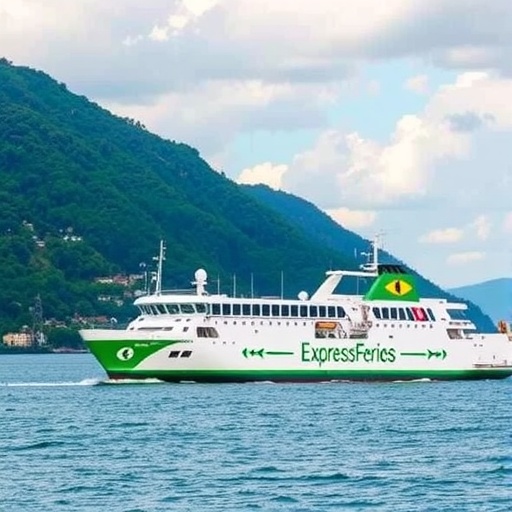
In a groundbreaking development that could revolutionize maritime transport along Norway’s extensive coastline, researchers at the Norwegian University of Science and Technology (NTNU) have devised a sophisticated computational model to enable zero-emission high-speed passenger vessels. The maritime sector, notorious for high greenhouse gas emissions, faces increasing regulatory pressure to innovate greener and cleaner technologies. Express ferries, vital for passenger transport but also recognized as some of the most polluting per kilometer, have traditionally presented significant challenges to decarbonization efforts. The new research offers a promising pathway to overcoming these challenges by leveraging a hybrid propulsion system that combines batteries and hydrogen fuel cells.
The NTNU team’s work centers around an advanced simulation framework that meticulously analyzes real-world operational data collected from existing high-speed ferries, focusing particularly on the demanding Bodø to Sandnessjøen route. This 220-kilometer stretch, known for difficult weather conditions and multiple frequent stops with limited charging opportunities, acts as a rigorous testbed for validating the feasibility of zero-emission ferry technology. The model not only calculates the vessel’s resistance and energy consumption by incorporating environmental variables such as wind, waves, and currents, but also accounts for seasonal variation by analyzing a full year of Automatic Identification System (AIS) data.
Fundamentally, the research confronts the ‘vicious circle’ inherent in ferry electrification: heavy batteries and hydrogen fuel cells increase vessel weight, which in turn elevates water resistance and energy consumption, necessitating even greater power capacity. Despite these intertwined challenges, the model reveals that zero-emission operation is achievable—with the key insight being the strategic combination of hydrogen fuel cells and batteries to optimize energy management while ensuring operational reliability and efficiency.
Through rigorous computational optimization, the researchers explored three main propulsion scenarios: battery-only operation with charging or swapping at ports, hybrid fuel cell-battery operation without port charging, and a plug-in hybrid solution where batteries are charged at designated stops. The results underscored the limitations of battery-only configurations for challenging routes like the Nordland Express; these approaches are simply not feasible due to weight, charging time, and energy density constraints. Instead, the most promising outcomes emerged from hybrid systems utilizing fuel cells fueled by hydrogen alongside batteries that can absorb transient load demands and provide system stability.
Delving deeper into system dynamics, the study highlights the complementary nature of batteries and fuel cells in addressing the complex power profile of high-speed ferries. Hydrogen fuel cells perform optimally when operating steadily near their design output, making them well-suited to provide continuous baseline power. Batteries, in contrast, excel at rapid response, smoothing out power fluctuations caused by variable speeds, maneuvers, and environmental disturbances. Effective energy management, therefore, requires intelligent algorithms to dynamically allocate load between these two sources, balancing hydrogen consumption and battery discharge to extend fuel economy while preserving performance.
Operationalizing such hybrid powertrains demands structural and hydrodynamic optimization of vessels themselves. Current ferries, constructed primarily with carbon fiber composites and powered by conventional diesel engines, must adapt to accommodate the increased mass and altered weight distribution from energy storage and conversion equipment. This includes optimizing hull length and form to reduce resistance and enhance propulsion efficiency, thereby mitigating the incremental energy penalty imposed by heavier fuel systems.
Importantly, the researchers emphasize the scalability of their model. Its parameterized design allows it to be tailored for a broad range of vessel sizes, routes, and operating profiles, providing maritime operators and policymakers a versatile decision-support tool. This capability enables the pre-assessment of fleet electrification potentials and the identification of optimal powertrain configurations based on route-specific constraints and infrastructure availability, such as hydrogen refueling capacity.
Infrastructure emerges as a critical component of the zero-emission ferry ecosystem. While batteries can be recharged or swapped at ports with sufficient electrical provisioning, the availability of hydrogen refueling stations along ferry routes is currently limited and requires substantial expansion to support a transitioning fleet. Coordinated investments in shore-side energy infrastructure thus represent a necessary complement to onboard technological advances, ensuring continuous operation and scalability.
Interestingly, the financial implications of adopting these zero-emission technologies were outside the scope of this research, indicating a need for further economic assessments. Given the capital-intensive nature of hydrogen fuel production and storage, as well as evolving battery technologies, future studies must incorporate cost-benefit analyses and lifecycle evaluations. Such studies will be pivotal in helping shipping companies and local governments weigh investment decisions against environmental mandates and long-term operational savings.
In conclusion, NTNU’s work lays a scientific foundation that overcomes prevailing skepticism about the maturity and feasibility of zero-emission high-speed express ferries. By validating a hybrid propulsion model grounded in real operational data and advanced energy management algorithms, they demonstrate that even Norway’s toughest maritime conditions can support emission-free passenger services. This breakthrough positions the maritime transport sector on a trajectory toward meaningful climate action, serving as an inspirational model for other coastal regions committed to sustainable transportation.
The research paves the way for a future where high-speed ferries no longer compromise environmental integrity for efficiency and speed. Instead, through technological ingenuity and systemic optimization, they can become exemplars of low-carbon mobility on the world’s waters.
News Publication Date: 30-Jan-2026
Web References:
DOI link to article
References:
Najjaran, Samieh; Sundvor, Ingrid; Thorne, Rebecca Jayne; Skjetne, Roger. (2026). Feasibility assessment of zero-emission high-speed passenger vessels using optimal energy scheduling and power allocation. Ocean Engineering.
Keywords
Zero-emission ferry, high-speed passenger vessel, hybrid propulsion, hydrogen fuel cells, battery technology, maritime decarbonization, energy optimization, computational modeling, Nordland Express, Bodø-Sandnessjøen route, sustainable marine transport, environmental innovation
Cite Scienmag News
Denise Maddox. (April 23, 2026). Express Ferries: Transforming from Climate Culprits to Green Innovators. Scienmag. https://scienmag.com/express-ferries-transforming-from-climate-culprits-to-green-innovators/
Denise Maddox. "Express Ferries: Transforming from Climate Culprits to Green Innovators." Scienmag, 23 April 2026, https://scienmag.com/express-ferries-transforming-from-climate-culprits-to-green-innovators/. Accessed 4 September 2026.
Denise Maddox. "Express Ferries: Transforming from Climate Culprits to Green Innovators." Scienmag. April 23, 2026. https://scienmag.com/express-ferries-transforming-from-climate-culprits-to-green-innovators/


