


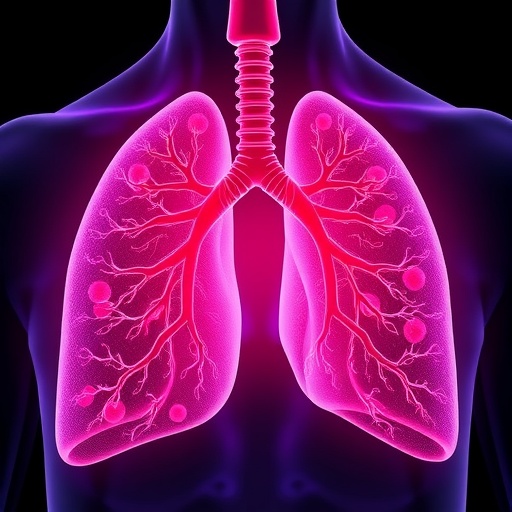
In the relentless battle against lung adenocarcinoma (LUAD), the complexity of the tumor microenvironment remains a formidable barrier to effective clinical management and therapeutic breakthroughs. A landmark study emerging from the frontier of cancer epigenetics has now spotlighted a critical molecular player — the Ras-association domain family 2 (RASSF2) gene — uncovering its profound tumor-suppressive function and opening promising avenues for innovative treatments. This research elucidates how epigenetic modifications, specifically promoter hypermethylation of RASSF2, reshape the malignancy and microenvironmental landscape of LUAD, offering new hope in the fight against one of the deadliest cancers worldwide.
Lung adenocarcinoma, a predominant subtype of non-small cell lung cancer, continues to challenge oncologists due to its insidious progression and resistance to conventional therapies. The intrinsic heterogeneity of its microenvironment — comprising cancer cells, immune infiltrates, stromal components, and signaling networks — complicates the understanding of its biology and the development of precision medicine approaches. Against this backdrop, the Ras-association domain family of proteins, known to govern critical cellular signaling pathways that regulate proliferation and apoptosis, emerged as a potential keystone in LUAD pathology.
The investigative team conducted a comprehensive bioinformatics survey across the RASSF family members, pinpointing RASSF2 as a gene of interest with notable downregulation patterns correlating with tumor aggressiveness. To experimentally validate its role, they deployed overexpression strategies in LUAD cell lines, harnessing sophisticated cell proliferation assays including CCK-8 and EdU incorporation tests. These assays revealed a marked suppression of cellular proliferation upon RASSF2 restoration, strongly supporting its candidacy as a tumor suppressor.
Beyond proliferation, the invasive and metastatic potential of LUAD was probed through transwell migration and wound healing assays. The data strikingly demonstrated that RASSF2 overexpression curtails not only cellular migration but also invasion, indicating that RASSF2 influences critical aspects of tumor dissemination. These phenotypic changes underscore the multifaceted impact of RASSF2 in restraining LUAD progression.
Of particular clinical significance is the observation that patients harboring RASSF2 promoter hypermethylation exhibited significantly reduced overall survival compared to those without such methylation. This epigenetic silencing mechanism, which represses gene transcription, was thus linked not only to molecular dysfunction but also to tangible clinical outcomes, highlighting its potential utility as a prognostic biomarker.
To deepen mechanistic insights, transcriptomic profiling via RNA sequencing was performed on LUAD tissue samples stratified by RASSF2 methylation status. The resulting data spotlighted an enrichment of NF-κB signaling pathway components and a concurrent dysregulation of T-cell activation circuits in methylation-positive tumors. Given the central role of NF-κB in inflammation and cancer cell survival, these findings suggest that RASSF2 silencing may unleash pro-tumorigenic inflammatory signaling cascades, while also impairing anti-tumor immune surveillance.
The interplay between epigenetic modifications and immune pathways elucidated in this study paints a complex picture of tumor microenvironment reprogramming. RASSF2 methylation seems to foster an immunosuppressive niche by modulating key signaling cascades that inhibit effective T-cell mediated responses, thereby facilitating immune evasion. This interaction posits RASSF2 as a strategic molecular switch at the crossroads of tumor growth and immune regulation.
Furthermore, the identification of RASSF2 promoter hypermethylation as a determinant of both malignant potential and microenvironmental characteristics introduces new perspectives on LUAD heterogeneity. It advocates for integrating epigenetic profiling into routine diagnostics to better predict disease trajectory and tailor individualized therapeutic regimens focused on reversing methylation marks or targeting downstream inflammatory pathways.
The implications of these findings transcend basic science, as the prospect of targeting epigenetic silencing of RASSF2 holds promise for novel immunotherapeutic strategies. Reactivating this tumor suppressor could restore anti-tumor immunity and potentiate the efficacy of existing immune checkpoint inhibitors, which have revolutionized cancer therapy but still face limitations due to tumor-induced immunosuppression.
Importantly, the study’s methodological rigor — combining robust in vitro assays with high-throughput RNA sequencing and comprehensive clinical correlation — sets a new standard for dissecting the molecular underpinnings of lung cancer. Such integrative approaches are pivotal to decoding the labyrinthine networks that govern tumor behavior and therapeutic resistance.
As the global burden of lung cancer persists, breakthroughs such as these underscore the indispensable role of epigenetics in oncogenesis and pave the way for precision medicine interventions. By illuminating how RASSF2 methylation shapes both the malignant phenotype and the immune milieu, this research invigorates the quest for biomarkers and therapeutics that can transform patient outcomes.
Looking forward, the challenge remains to translate these molecular insights into clinical tools and treatments that are accessible and effective. Ongoing studies will likely explore pharmacological agents capable of demethylating RASSF2 or inhibiting aberrant NF-κB signaling, alongside immunomodulatory therapies designed to reinvigorate T-cell functionality within the tumor microenvironment.
In sum, this seminal research not only validates RASSF2 as a potent tumor suppressor in LUAD but also exposes the intricate epigenetic and immunological mechanisms through which its silencing accelerates disease progression. The convergence of epigenetic regulation and immune evasion illuminated by this work heralds a promising paradigm shift in lung cancer therapeutics, emphasizing the synergy of genetic, epigenetic, and immunologic interventions.
Such discoveries chart a hopeful trajectory toward conquering LUAD’s formidable complexity by targeting the molecular switches at its core, reaffirming the transformative potential of epigenetics in modern oncology. As science advances, the integration of these insights into clinical practice promises to enhance survival rates and quality of life for patients grappling with this devastating disease.
—
Subject of Research: Lung adenocarcinoma (LUAD) and the epigenetic regulation of tumor suppressor gene RASSF2.
Cite Scienmag News
Juliet Wilcox. (April 22, 2026). RASSF2 Methylation Drives Lung Cancer Traits. Scienmag. https://scienmag.com/rassf2-methylation-drives-lung-cancer-traits/
Juliet Wilcox. "RASSF2 Methylation Drives Lung Cancer Traits." Scienmag, 22 April 2026, https://scienmag.com/rassf2-methylation-drives-lung-cancer-traits/. Accessed 3 September 2026.
Juliet Wilcox. "RASSF2 Methylation Drives Lung Cancer Traits." Scienmag. April 22, 2026. https://scienmag.com/rassf2-methylation-drives-lung-cancer-traits/


