In a fresh and revealing study conducted within a real-world grocery store setting, researchers have uncovered a counterintuitive finding: placing additional product displays directly in store aisles — a common retail strategy aimed at increasing product visibility — may actually suppress sales instead of boosting them. This striking discovery, presented by Mathias Streicher from Austria’s Department of Management and Marketing, shines a spotlight on the unintended consequences of spatial crowding in retail environments and its particularly strong impact on shoppers using carts. The study was published in the open-access journal PLOS One on April 22, 2026.
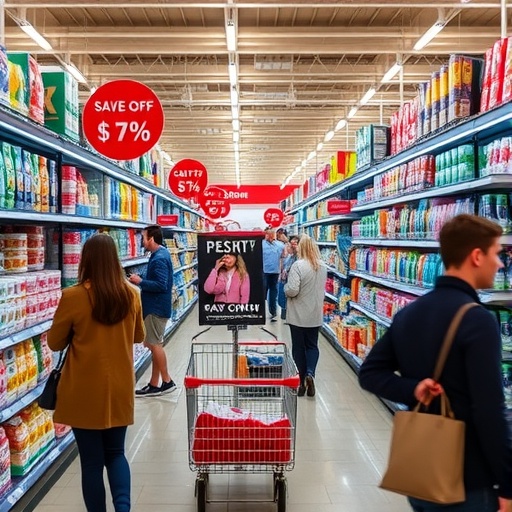
Retail stores frequently invest in elaborate in-aisle displays, essentially adding more merchandise in shoppers’ pathways, intending to catch their attention and encourage impulse buys. However, this new research introduces the concept of spatial crowding as a major factor undermining the efficacy of these displays. Spatial crowding occurs when shoppers perceive their physical freedom to move as restricted, a sensation that has been linked to purchase avoidance and overall shopping discomfort in behavioral science literature.
The investigation involved a congregation of methodologies, beginning with a longitudinal analysis of sales data within an aisle dedicated to household, baby, and pet products. Over a six-week interval, five mid-aisle display stands laden with additional merchandise were deployed, after which they were removed for a subsequent six-week period. Analysis of the data revealed an unexpected trend: weekly sales percentages tied to that aisle’s products increased following the removal of these mid-aisle stands, climbing from an average of 4.33% to 4.83% of the store’s total revenue.
To deepen their understanding, Streicher and his team conducted a secondary in-store observational experiment within the same aisle. They measured the frequency with which shoppers physically touched products — a behavior strongly correlated with eventual purchase decisions. Results demonstrated a sizable uptick in product interaction when mid-aisle displays were absent, with people using shopping carts engaging with products roughly 7.05 times more often without these displays than with them. Shoppers without carts exhibited a smaller increase of 3.81 times, suggesting that the negative effects of aisle crowding are amplified among cart users who need additional space to maneuver.
Complementing these findings, an online experimental simulation was performed with 200 participants. Subjects were asked to imagine themselves shopping with either a cart or a basket while viewing images of the store aisle configured both with and without the in-aisle displays. This simulation revealed that aisles filled with additional fixtures were consistently rated as significantly more crowded and restrictive, diminishing shoppers’ perceived control and comfort. This effect was notably more pronounced among those imagining cart shopping, underscoring how fixed physical objects restrict shopper movement and spatial freedom more for cart users than for basket shoppers.
The converging lines of empirical evidence suggest a fundamental tension in retail design between maximizing product exposure and preserving shopper comfort. While in-aisle displays aim to maximize visual merchandising, they inadvertently escalate spatial crowding, which can produce cognitive and physical discomfort that discourages purchasing. This effect seems most acute for cart users who require more maneuvering space and thus experience greater constraint.
One takeaway from this research is that retailers should be cautious about relying heavily on mid-aisle displays as a sales boost strategy. Instead, they could explore alternative approaches that enhance product visibility without encroaching too much on shoppers’ navigable space. For example, wall shelving, end-of-aisle displays, or digital interactive signage might better balance visibility with shopper mobility.
Moreover, the study sets the stage for follow-up research to investigate additional factors influencing the sales impact of in-aisle merchandise placements. Variables such as human crowding — when other shoppers populate aisles — promotional pricing, and seasonal shopping patterns might modulate or compound the observed negative effects. Understanding these contextual factors could further refine retail layout strategies and improve sales outcomes.
Further exploration might also consider the psychological dimensions of spatial crowding, detailing how such physical constraints translate into emotional responses like anxiety or frustration. These emotional states are likely mechanisms through which sales decrease, potentially mediated by reduced time spent browsing or impulse buying.
Streicher emphasizes the real-world importance of these findings, noting that “adding merchandise into store aisles can actually reduce overall sales by making the environment feel crowded and harder to navigate. Importantly, this negative effect is even stronger for shoppers using carts, as they experience greater spatial constraints and reduced control while shopping.” This insight challenges long-standing assumptions in retail marketing and underscores the complex interplay between physical environment, shopper behavior, and sales performance.
The implications extend beyond grocery stores to any retail space where movement and product interaction are critical components of the purchasing process. Designers and marketers alike might reconsider aisle clutter as a strategic choice, opting instead for layouts that foster openness, fluid navigation, and positive shopper experiences.
In conclusion, this comprehensive study uniquely combines empirical sales data, behavioral observations, and psychological experiments to illuminate the paradox of in-aisle displays: a tactic intended to increase shopper engagement can, under spatial constraints, suppress purchasing behaviors. Especially for cart users, the resultant feeling of crowding diminishes both perceived control and product interaction frequency, contributing to lower sales. Retailers should thus carefully evaluate their merchandising strategies, striving for configurations that maximize exposure while minimizing spatial discomfort.
News Publication Date: 22-Apr-2026
Web References: http://dx.doi.org/10.1371/journal.pone.0346492
References: Streicher MC (2026) When merchandise crowds the aisle and carts crowd the shopper: Joint effects on sales. PLoS One 21(4): e0346492.
Cite Scienmag News
Courtney Benton. (April 22, 2026). In-aisle store displays may crowd shoppers, potentially lowering overall sales, study finds. Scienmag. https://scienmag.com/in-aisle-store-displays-may-crowd-shoppers-potentially-lowering-overall-sales-study-finds/
Courtney Benton. "In-aisle store displays may crowd shoppers, potentially lowering overall sales, study finds." Scienmag, 22 April 2026, https://scienmag.com/in-aisle-store-displays-may-crowd-shoppers-potentially-lowering-overall-sales-study-finds/. Accessed 28 October 2026.
Courtney Benton. "In-aisle store displays may crowd shoppers, potentially lowering overall sales, study finds." Scienmag. April 22, 2026. https://scienmag.com/in-aisle-store-displays-may-crowd-shoppers-potentially-lowering-overall-sales-study-finds/