

In recent decades, the intersection of electoral processes and natural disasters has emerged as a critical area of concern for democratic systems worldwide. Elections, traditionally viewed as political events shaped by socio-political dynamics, are increasingly being disrupted by environmental catastrophes such as floods, wildfires, hurricanes, and heatwaves. This escalating trend has profound implications for the integrity, inclusivity, and operational resilience of elections across the globe. A comprehensive new report released by the International Institute for Democracy and Electoral Assistance (International IDEA) sheds unprecedented light on this growing phenomenon, underscoring the imperative for election management bodies (EMBs) to integrate disaster risk mitigation into electoral planning and execution.
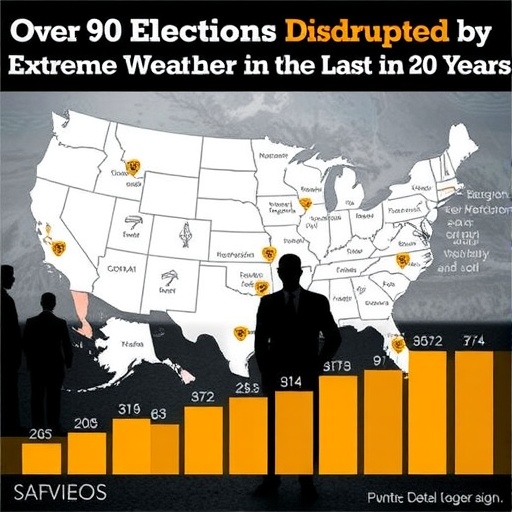
The report, co-authored by Professor Sarah Birch of King’s College London alongside Erik Asplund from International IDEA and Professor Ferran Martínez i Coma from Griffith University, represents the first global analytical framework examining how natural hazards impact every phase of the electoral cycle. Their analysis draws from more than 100 real-time crisis briefs supplied by the Election Emergency and Crisis Monitor, supplemented by thirteen extensive case studies spanning diverse geopolitical regions. This rich dataset reveals that over the past twenty years, at least 94 elections and referenda across 52 countries have faced disruption due to natural hazards, highlighting the pervasive and transboundary nature of this challenge.
From 2006 through projections extending to 2025, the frequency and severity of environmental disruptions to electoral processes have surged, with at least 26 elections having to be postponed either partially or entirely due to overwhelming natural calamities. Remarkably, 2024 alone witnessed the substitution or deferral of 23 electoral events in 18 countries, driven by unrelenting floods, hurricanes, heat waves, and wildfires that impaired essential infrastructure, displaced voters, and forced last-minute modifications to standard electoral protocols. These acute climate-related events not only jeopardize logistical planning but also threaten to erode public trust in democratic institutions when electoral outcomes or participation are compromised.
At the core of the report’s findings is the imperative for EMBs to develop collaborative frameworks that align closely with meteorological agencies, environmental authorities, and disaster response entities. Such partnerships would facilitate the incorporation of sophisticated early-warning systems and real-time environmental data into electoral operational planning. This approach enables the integration of elections into broader national disaster management agendas, ensuring that democratic participation is preserved even amidst environmental crises. For example, ahead of Taiwan’s upcoming election on 26 July 2025, electoral authorities have initiated direct coordination with the Central Weather Administration to receive enhanced meteorological briefings, illustrating the practical benefits of such integrative measures.
Temporal adaptation of elections emerges as another vital strategy advocated by the report. Timing electoral events to avoid peak seasons of natural hazards can significantly reduce the probability of disruption. Legislative changes, such as Alberta’s decision to move its fixed provincial election date from wildfire-prone May to October starting in 2027, exemplify proactive policy adjustments aligning electoral timelines with climate risk assessments. This forward-looking adjustment reflects a growing recognition that inflexible electoral schedules are increasingly untenable under accelerating climate volatility.
The report also emphasizes the crucial role of standardized training programs and comprehensive contingency planning in bolstering the preparedness of election officials. Effective disaster risk management extends beyond structural and temporal adjustments by mandating tailored training on crisis response, budgeting for emergencies, and detailed operational risk assessments specific to local hazard profiles. Peruvian electoral staff’s systematic disaster preparedness training and New Jersey’s deployment of scenario-based tabletop exercises ahead of the 2020 elections provide exemplary models. These exercises test coordination capabilities, response timing, and decision-making processes under simulated crisis conditions, thereby enhancing institutional resilience.
Moreover, coordination across multiple agencies is essential, as evidenced by Sri Lanka’s Election Commission collaborating with the National Disaster Management Centre to mobilize over 20 agencies during national elections in 2019 and 2024. Such multi-agency frameworks ensure swift and coordinated responses that uphold electoral integrity and voter safety. Similarly, California’s policy mandating counties to prepare detailed localized contingency plans targeting the risks of recurrent wildfires represents a scalable approach that can be adapted to other regions facing diverse climate threats.
Beyond logistics, the report warns of the cumulative strain that repeated environmental shocks impose on fragile democratic systems. Disruptions prolong electoral timelines, complicate result tabulations, and challenge the inclusiveness of voter participation—marginalized communities often suffer disproportionately due to displacement or infrastructure damage. These systemic risks underscore the necessity for sustained fiscal investments and policy innovations aimed at long-term resilience. Embedding climate risk mitigation within the electoral architecture will be pivotal to safeguarding democratic legitimacy in an increasingly unpredictable environment.
The implications of this report reach far beyond immediate crisis management. They signal an urgent call for electoral institutions worldwide to evolve from reactive entities to proactive hubs of resilience, capable of anticipating and mitigating climate-induced disruptions. Foregrounding climate considerations in electoral governance signals an important shift in the understanding of democracy itself—not merely as a political exercise, but as a vibrant system that must adapt dynamically to the earth’s shifting environmental realities. As natural hazard intensity and frequency are projected to escalate due to climate change, such integrative frameworks will be instrumental in maintaining democratic processes that are both reliable and inclusive.
To conclude, the analysis presented by Birch, Asplund, and Martínez i Coma offers transformative insights that must inform the global discourse on electoral governance and climate resilience. By systematically dissecting the complex dynamics between natural hazards and election management, their research provides a critical roadmap to policymakers and EMBs facing unprecedented environmental uncertainties. Only through collaboration, innovation, and adaptive foresight can democratic systems hope to withstand the mounting pressures of climate disruptions and continue to confer legitimacy through fair and accessible elections.
News Publication Date: April 22, 2024
Web References: https://doi.org/10.31752/98760
Cite this news
SCIENMAG. (April 22, 2026). Over 90 Elections Disrupted by Extreme Weather in the Last 20 Years. https://scienmag.com/over-90-elections-disrupted-by-extreme-weather-in-the-last-20-years/
SCIENMAG. "Over 90 Elections Disrupted by Extreme Weather in the Last 20 Years." Scienmag, 22 April 2026, https://scienmag.com/over-90-elections-disrupted-by-extreme-weather-in-the-last-20-years/. Accessed 27 August 2026.
SCIENMAG. "Over 90 Elections Disrupted by Extreme Weather in the Last 20 Years." Scienmag. April 22, 2026. https://scienmag.com/over-90-elections-disrupted-by-extreme-weather-in-the-last-20-years/


