


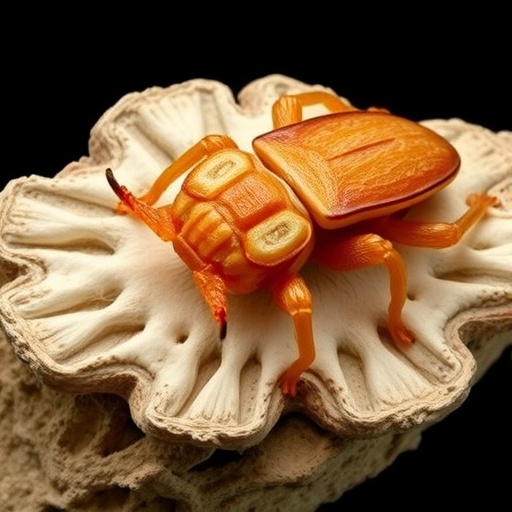
In a groundbreaking discovery that sheds new light on the evolutionary history of insects, researchers from Ludwig-Maximilians-Universität München (LMU) have unveiled a previously unknown species of true bug that boasts a rare and fascinating anatomical adaptation: crab-like claws on its front legs. This extraordinary specimen, preserved in 100-million-year-old amber from the Kachin region of Myanmar, challenges longstanding assumptions about the morphological diversity of insects during the Cretaceous period and opens fresh avenues for understanding arthropod evolution.
Amber fossils from Myanmar have long been prized for their exceptional preservation, capturing intricate details of ancient forest ecosystems that thrived during the mid-Cretaceous. These fossilized resin deposits serve as natural time capsules, revealing the biodiversity and ecological dynamics of a forest that existed approximately 100 million years ago. Among the trove of remarkable finds, the newly described true bug stands out for its possession of chelae—specialized grasping appendages akin to pincers—that are exceedingly uncommon in insect lineages.
Chelae, or claw-like structures, are well-known and widespread among certain crustaceans such as crabs, lobsters, and shrimps, where they serve critical roles in predation and interaction. However, their occurrence in insects is a striking exception rather than the norm, previously documented in only three distinct insect groups. The identification of these chelae in a member of the true bugs (order Heteroptera) signals a rare case of convergent evolution, wherein different lineages independently develop similar morphological solutions to ecological challenges.
The LMU team, led by zoologist Privatdozent Carolin Haug, employed cutting-edge micro-computed tomography (micro-CT) to peer inside the amber-encased fossil without causing any damage. This non-invasive imaging technique allowed the researchers to generate detailed three-dimensional models of the bug’s anatomy, revealing the precise structure and articulation of its clawed legs. Such digital reconstructions are invaluable for comparative analyses and have become vital tools in paleobiology for studying specimens where physical manipulation is impossible.
Through quantitative morphological analysis, the team compared over 2,000 specimens of chelae and analogous grasping structures from a vast array of both extinct and extant species across multiple arthropod groups. The results clearly demonstrated that the chelae of this fossilized true bug possessed unique shape characteristics that set it apart from known insect species and more closely resembled the pincers found in decapod crustaceans and tanaids. This finding underscores the extraordinary nature of the bug’s morphology and suggests an unusual ecological adaptation.
Due to its distinctive anatomical features, the researchers assigned the fossil to a newly erected genus and species, Carcinonepa libererrantes. The genus name creatively combines the Greek-derived prefix “carcino-,” meaning crab, with “nepa,” referring to the Nepomorpha, a subgroup of aquatic true bugs. The species epithet “libererrantes” pays homage to the globally popular K-pop group Stray Kids, playfully referencing the fossil’s claw posture which intriguingly mirrors the band’s signature dance move. This contemporary cultural nod also highlights the human dimension behind scientific discovery.
Analysis of the fossil’s overall body morphology places Carcinonepa libererrantes firmly within the Nepomorpha, the clade of aquatic true bugs, and reveals notable similarities to modern Gelastocoridae, commonly known as toad bugs. These living relatives are notable for their semi-terrestrial predatory lifestyle, typically inhabiting moist environments near bodies of water. Such morphological parallels suggest that C. libererrantes likely occupied a comparable ecological niche in its Cretaceous environment, adeptly hunting small insects and other prey.
The prominent, forceps-like chelae on the front legs of C. libererrantes would have functioned as highly effective predatory tools, enabling it to grasp and immobilize prey with precision. This adaptation likely conferred a significant evolutionary advantage, enhancing the bug’s ability to exploit diverse food sources within the dynamic forest ecosystem. Its potential terrestrial or semi-aquatic life near coastal regions of the ancient forest further illuminates the complexity of Cretaceous habitat utilization.
Beyond the immediate significance for paleontology, the discovery of independently evolved chelae in this true bug enriches our understanding of arthropod morphological innovation and convergent evolution. Such cases reveal how similar functional demands can drive the emergence of analogous anatomical structures across distantly related groups. This example adds a new dimension to the evolutionary narrative, illustrating how environmental pressures and ecological opportunities shape biodiversity through time.
The application of advanced imaging techniques like micro-CT continues to revolutionize the field of fossil research, circumventing limitations imposed by fossil fragility and inclusions within amber. The ability to examine fine morphological details in three dimensions without destruction enables scientists to revisit and reinterpret specimens that were previously inaccessible to detailed study, potentially unveiling many more evolutionary secrets preserved in fossil repositories.
Carcinonepa libererrantes stands as a testament to the remarkable evolutionary versatility of insects, demonstrating that even well-studied groups like true bugs still harbor hidden complexities and novel adaptations awaiting discovery. The meticulous work of the LMU team, in collaboration with the University of Rostock and Finland’s University of Oulu, highlights the importance of interdisciplinary and international cooperation in unraveling the deep history of life on Earth.
As amber fossils continue to emerge from Myanmar’s ancient forests, it is likely that further surprises will enrich our understanding of the diversity and evolutionary pathways of Cretaceous arthropods. Each finding not only expands the catalog of extinct species but also informs modern biodiversity studies by providing a long-term perspective on anatomical innovation and ecological specialization in insects.
This exciting discovery, recently published in the journal Insects, exemplifies the power of paleontological research to illuminate the complex pathways through which life on our planet has diversified. The unique crab-like chelae of Carcinonepa libererrantes remind us that nature’s inventiveness knows no bounds, and the fossil record remains an essential archive of evolutionary ingenuity.
News Publication Date: 17-Apr-2026
Web References: 10.3390/insects17040431
Cite Scienmag News
Gavin Prescott. (April 22, 2026). Remarkable Claws Discovered on Fossilized True Bug: Insights from Paleobiology. Scienmag. https://scienmag.com/remarkable-claws-discovered-on-fossilized-true-bug-insights-from-paleobiology/
Gavin Prescott. "Remarkable Claws Discovered on Fossilized True Bug: Insights from Paleobiology." Scienmag, 22 April 2026, https://scienmag.com/remarkable-claws-discovered-on-fossilized-true-bug-insights-from-paleobiology/. Accessed 3 September 2026.
Gavin Prescott. "Remarkable Claws Discovered on Fossilized True Bug: Insights from Paleobiology." Scienmag. April 22, 2026. https://scienmag.com/remarkable-claws-discovered-on-fossilized-true-bug-insights-from-paleobiology/


