


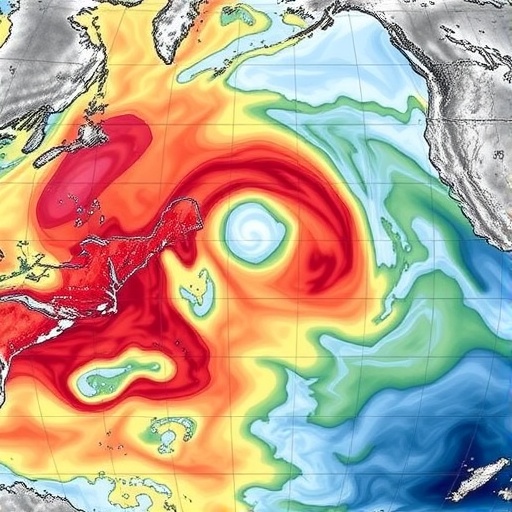
In recent years, the paradoxical relationship between the strength of atmospheric jet streams and the intensity of storms across different ocean basins has puzzled meteorologists and climate scientists alike. A new study led by researchers Hadas and Kaspi, published in Nature Communications, now provides a mechanistic understanding of why stronger jets may coincide with weaker storms, focusing on the stark contrast between Atlantic and Pacific storm activity. This breakthrough challenges long-held assumptions about how jet stream dynamics modulate storm systems and has significant implications for improving weather prediction and climate change models globally.
Jet streams are narrow bands of strong winds in the upper levels of the atmosphere—typically running from west to east—that shape the behavior of mid-latitude weather systems. These powerful air currents steer weather fronts and influence the formation, growth, and dissipation of storms. Traditionally, the intensity of the jet stream was thought to enhance storm strength directly, facilitating more vigorous development of cyclones and weather disturbances. However, while the Atlantic Ocean has a relatively modest jet stream and frequently experiences intense storms known as extratropical cyclones, the Pacific Ocean, which is characterized by a far stronger jet, tends to see weaker storm events on average. This seeming contradiction has long posed a fundamental atmospheric enigma.
Hadas and Kaspi approach this conundrum by employing advanced numerical simulations that integrate both atmospheric dynamics and thermodynamics, allowing for a detailed investigation into the jet-storm interplay. Their analysis reveals that stronger jets induce a more zonal flow—essentially a flow that is confined primarily along latitude lines with reduced meridional (north-south) disturbances. This configuration suppresses storm growth by limiting the horizontal and vertical tilt of developing storm systems, critical factors for their intensification. In other words, while a powerful jet stream propagates energy swiftly, it also streamlines the atmospheric flow in a manner that curtails storm maturation.
A central part of the researchers’ findings pertains to the role of baroclinic instability, the primary mechanism responsible for storm genesis and evolution in mid-latitudes. Baroclinic instability arises from the thermal gradient between warm and cold air masses, enabling disturbances to extract available potential energy and grow into fully developed cyclones. The study demonstrates that stronger jets sharpen this temperature gradient but simultaneously stabilize the atmosphere dynamically, creating a paradox: enhanced thermal contrasts characteristic of intense jets coincide with a dynamic environment less conducive to storm amplification.
This paradox is further elucidated by considering the vertical structure of the jet stream and its influence on storm tilt. Storm systems tend to intensify when their upper-level warm cores are displaced poleward relative to surface cold cores, facilitating an efficient conversion of potential energy into kinetic energy, thereby deepening cyclones. In a stronger jet regime, however, the vertical wind shear strengthens, narrowing the vertical extent where this favorable tilt can develop. This mechanism reduces the vertical alignment necessary for storm growth, thus effectively weakening storms despite the powerful jets present.
Furthermore, Hadas and Kaspi highlight differences in ocean-atmosphere coupling between the Atlantic and Pacific, which reinforce the jet-storm dynamics. The Atlantic basin, with its smaller size and unique sea surface temperature distributions, supports more heterogeneous thermal gradients, potentially enhancing localized baroclinic zones where storms can thrive. The Pacific, conversely, features broad, nearly zonal thermal contrasts driven by large-scale ocean currents and temperature patterns that promote jet stream uniformity and storm suppression in a feedback loop.
The implications of this study extend beyond academic curiosity. Better understanding the mechanistic drivers behind storm intensity variations relative to jet strength is crucial for improving mid-latitude weather prediction, especially as climate change modifies baseline temperature gradients and jet behavior. Current global climate models often struggle to capture regional storm intensity accurately, in part due to incomplete representations of storm-jet interactions. The insights offered by Hadas and Kaspi enable modelers to refine their simulations with more realistic, physics-based parameterizations of jet-induced dynamical stability.
Moreover, the study raises important questions about how future climate scenarios might alter regional storm patterns. If climate change leads to stronger jet streams—potentially through enhanced pole-to-equator temperature gradients or shifts in stratospheric wind patterns—it may paradoxically result in generally weaker storms in certain mid-latitude regions, with corresponding shifts in precipitation patterns and risk profiles. This nuanced effect contrasts with the often-stated expectation that warming necessarily results in more extreme storms, underscoring the complexity of atmospheric responses in a changing climate.
In addition to its meteorological significance, the work also contributes to a deeper theoretical understanding of atmospheric instability mechanisms. By combining state-of-the-art simulations with refined analytical frameworks, the researchers bridge the gap between observational anomalies and established fluid dynamics theories. They demonstrate how subtle variations in jet stream strength fundamentally alter the balance of forces governing storm development, providing a generalizable conceptual model that may be applicable to other planetary atmospheres characterized by jet streams and cyclonic activity.
The research article meticulously documents the interplay between jet-induced shear, temperature gradients, and vertical atmospheric structure, laying out a compelling narrative supported by quantitative results. Detailed analyses of case studies from both the Atlantic and Pacific basins showcase how their model reproduces observed variations in storm intensities and spatial distributions, validating the mechanistic perspective proposed. Such robust validation ensures confidence in applying these insights toward operational forecasting enhancements and developing adaptation strategies.
Looking forward, the authors advocate for expanded observational campaigns targeting jet stream signatures and storm development at multiple atmospheric levels. Incorporating targeted aircraft observations, satellite remote sensing, and ground-based radar analyses could help to further constrain model parameters and isolate key dynamical processes. Additionally, exploring the impact of other factors such as surface roughness, moisture availability, and jet variability on storm intensity could build upon this foundational work for even more comprehensive understanding.
In summary, the study by Hadas and Kaspi fundamentally reshapes how scientists perceive the relationship between jet stream intensity and storm strength in the Atlantic-Pacific context. By revealing a mechanistic “stronger jet, weaker storm” paradigm, it resolves a longstanding atmospheric mystery, offers a pathway to improved weather prediction, and identifies crucial considerations for assessing climatic risk under global change. As the complex choreography of jet streams and cyclones continues to unfold in an evolving climate system, such research underscores the value of integrating theory, modeling, and observation to foster more resilient societies in the face of atmospheric unpredictability.
Hadas, O., Kaspi, Y. Stronger jet, weaker storms: a mechanistic perspective on the Atlantic-Pacific storm paradox.
Nat Commun (2026). https://doi.org/10.1038/s41467-026-71784-3
Cite Scienmag News
Violet Maxwell. (April 22, 2026). Stronger Jets, Weaker Storms: Atlantic-Pacific Paradox Explained. Scienmag. https://scienmag.com/stronger-jets-weaker-storms-atlantic-pacific-paradox-explained/
Violet Maxwell. "Stronger Jets, Weaker Storms: Atlantic-Pacific Paradox Explained." Scienmag, 22 April 2026, https://scienmag.com/stronger-jets-weaker-storms-atlantic-pacific-paradox-explained/. Accessed 4 September 2026.
Violet Maxwell. "Stronger Jets, Weaker Storms: Atlantic-Pacific Paradox Explained." Scienmag. April 22, 2026. https://scienmag.com/stronger-jets-weaker-storms-atlantic-pacific-paradox-explained/


