


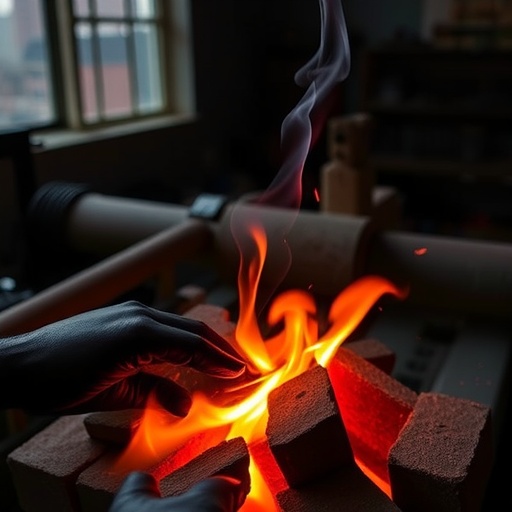
In recent years, the classification of wood as a renewable energy source for residential space heating has ignited significant debate among scientists, policymakers, and environmentalists. At the heart of this controversy lies a critical balancing act: wood remains an economically attractive fuel option, especially for communities seeking affordable heating solutions, yet its combustion emits pollutants that pose serious public health risks. A groundbreaking study published in 2026 has shed new light on a lesser-known but particularly alarming aspect of wood smoke—trace lead emissions in ambient air resulting from wood fuel combustion.
This investigation, spearheaded by Henegan, Bartlett, Traviss, and their colleagues, meticulously analyzed ambient air quality to trace the sources and impact of lead exposure linked directly to residential wood burning. Their findings challenge prevailing assumptions that wood combustion is a benign or minor contributor to environmental lead contamination. While lead emissions have historically been associated with industrial processes, vehicle exhaust, and lead-based paints, the research unveils that wood combustion remains a persistent, overlooked source of this toxic metal in the atmosphere.
Wood’s renewable classification is largely justified by its carbon cycle, wherein the carbon dioxide released during combustion is equaled by the carbon absorbed during tree growth. However, the combustion process inherently generates a complex mixture of particulate matter and gaseous pollutants, including polycyclic aromatic hydrocarbons (PAHs), volatile organic compounds (VOCs), and metallic trace elements like lead. The research team employed highly sensitive detection technologies capable of identifying trace levels of lead isotopes in outdoor air samples, confirming that lead from wood smoke contributes measurably to urban and rural air pollution burdens.
These revelations have profound public health implications. Lead exposure is a well-documented hazard associated with neurological damage, cardiovascular disease, and impaired cognitive development, particularly detrimental to children and vulnerable populations. The presence of even trace amounts of lead in ambient air necessitates a reevaluation of current regulatory frameworks governing residential wood-burning appliances and fuel quality standards. The study underscores that combustion emissions are not limited to carbon-based pollutants but extend to heavy metal contamination with lasting health impacts.
In analyzing the formats of wood fuel used—from seasoned firewood to pellets treated or sourced from different wood types—the researchers highlighted that lead contamination varies by fuel composition and burning efficiency. Ash residues and flue gases emitted during smoldering and incomplete combustion stages exhibit higher lead concentrations, suggesting that stove maintenance, combustion temperature, and ventilation critically influence pollutant profiles. This nuanced view complicates simplistic categorizations of wood as a clean renewable fuel and points to the need for improved combustion technologies and best practices.
This nuanced exposure route through residential heating uses presents a subtle but potentially substantial contribution to cumulative lead burdens in populations, especially in regions relying extensively on woodstoves during cold seasons. Unlike industrial sources emitting airborne lead sporadically or at large scales, residential wood burning produces a diffuse yet persistent emission pattern, integrated into everyday living environments. Consequently, ambient lead levels attributable to this source may evade traditional monitoring programs focused on point sources, highlighting a gap in environmental health surveillance.
The study also situates its findings within the broader context of energy policy and climate change mitigation strategies. As governments promote renewable energy transitions, wood heating is often incentivized to offset fossil fuel consumption. Yet, these policies must reconcile the trade-off between carbon neutrality and toxic emissions, since public health costs borne by lead exposure could undermine perceived environmental benefits. This research prompts a critical reexamination of how renewable energy potentials are weighed against pollutant externalities in policymaking processes.
Further complicating the issue, socio-economic disparities play a crucial role in exposure risk, since lower-income households are more likely to rely on wood stoves and potentially less efficient appliances. The lead contaminant pathway thus contributes to environmental justice concerns, with disadvantaged communities facing disproportionate pollution burdens. Addressing wood smoke lead emissions requires integrating health equity considerations into air quality and energy policies—a challenge demanding collaborative efforts across public health, environmental science, and social sectors.
The researchers advocate for enhanced monitoring networks capable of detecting both conventional pollutants and trace metals like lead from residential combustion. They propose updated regulatory standards encompassing emissions limits for trace metals in wood smoke, alongside incentives that foster adoption of advanced combustion devices minimizing toxic outputs. Public education campaigns informing residents about the health risks of improper wood burning and ways to mitigate emissions through better fuel sourcing and stove operation are equally vital.
This landmark study also encourages continued scientific inquiries into the chemical dynamics of wood smoke, particularly how trace metals behave during burning under varying environmental conditions. Expanding research to diverse geographic and climatic contexts can refine understanding of exposure risks relevant to local populations, shaping targeted interventions tailored to specific community needs and fuel availability. Interdisciplinary approaches integrating atmospheric chemistry, epidemiology, and behavioral science will be key to developing effective mitigation strategies.
Moreover, the research opens dialogue on alternatives to traditional wood heating, such as cleaner biomass technologies, electrification options, and district heating innovations. While renewable energy remains pivotal in climate action, integrating comprehensive health impact assessments into energy planning frameworks is imperative. The paper’s findings serve as a call to action to balance environmental sustainability with human health protection, ensuring that ‘green’ energy choices do not inadvertently jeopardize public well-being.
As the energy landscape evolves, this work elucidates the hidden complexities of classifying wood combusted for heating as a renewable energy resource. It bridges gaps in knowledge regarding pollutant profiles and health consequences, urging regulatory bodies to revisit standards governing wood fuel policies. The recognition of trace lead in ambient air from wood smoke challenges the notion of wood heating as a uniformly safe alternative, providing a crucial evidence base for revising guidelines and fostering cleaner, healthier communities.
In conclusion, the research conducted by Henegan and colleagues presents compelling evidence that residential wood combustion emits detectable and harmful trace amounts of lead into the atmosphere, complicating the debate over wood as a renewable fuel. Their meticulous methodological approach and rigorous data analysis reveal this overlooked pollution source with significant implications for public health, energy policy, and environmental justice. Effective responses will require coordinated interdisciplinary action, technological innovation, and informed community engagement to mitigate risks while pursuing sustainable heating solutions in the future.
Cite Scienmag News
Russell Cooper. (April 22, 2026). Tracing Lead in Ambient Air from Wood Combustion. Scienmag. https://scienmag.com/tracing-lead-in-ambient-air-from-wood-combustion/
Russell Cooper. "Tracing Lead in Ambient Air from Wood Combustion." Scienmag, 22 April 2026, https://scienmag.com/tracing-lead-in-ambient-air-from-wood-combustion/. Accessed 3 September 2026.
Russell Cooper. "Tracing Lead in Ambient Air from Wood Combustion." Scienmag. April 22, 2026. https://scienmag.com/tracing-lead-in-ambient-air-from-wood-combustion/


