


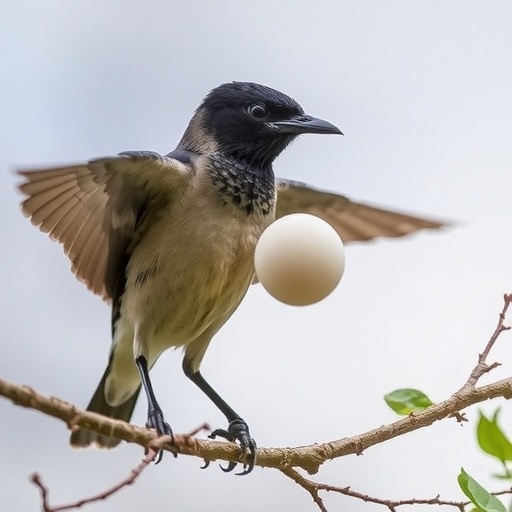
In a groundbreaking study set to redefine avian parasitism, a collaborative team of ornithologists from across the globe has unveiled definitive evidence on the egg-laying behavior of the common cuckoo (Cuculus canorus) when parasitizing cavity-nesting hosts. This research challenges a centuries-old assumption suggesting that cuckoos transport their eggs in beaks prior to deposition, a theory that has lingered since antiquity. By deploying innovative video monitoring technology over several years, researchers captured more than 60 egg-laying events involving the common cuckoo and its primary cavity-nesting host, the common redstart (Phoenicurus phoenicurus), thereby illuminating nuances of parasitic strategies in previously inaccessible nesting environments.
The common redstart is unique among cuckoo hosts as it nests predominantly inside enclosed tree cavities, presenting a complex ecological puzzle: how does a brood parasite like the cuckoo successfully infiltrate such confined spaces to deposit its eggs? Traditional beliefs posited that cuckoos might carry their eggs physically in the beak, allowing them to bypass the challenges posed by cavity architecture. However, the sophisticated video evidence recorded contradicts this widespread notion, revealing instead two behavioral modes of egg deposition tailored to the constraints of cavity nesting.
The first observed strategy involves female cuckoos laying their eggs from the nest entrance, effectively projecting or passing the egg into the cavity without full entry. This method reduces the risk of entrapment within the cavity, which could be fatal or compromise future reproductive opportunities. However, it inherently carries a heightened risk of misplacement, with eggs potentially missing the nest entirely. The second strategy showed cuckoo females entering the nest cavity fully before laying their eggs directly inside the host’s nest chamber, ensuring precise placement but at the cost of potentially destabilizing the nesting structure or facing the physical hazard of becoming trapped.
These behavioral adaptations underscore a critical trade-off between risk mitigation and reproductive success. Dr. Tomáš Grim, co-leader of the study, explained that the higher success rates observed with direct cavity entry are balanced by considerable dangers, suggesting that evolutionary pressures maintain this behavioral polymorphism within the cuckoo population. This variability marks one of the few documented instances of flexible parasitic behavior within a single brood parasitic species and offers fresh insight into the evolutionary arms race between brood parasites and their hosts.
The struggle between brood parasites like the cuckoo and their hosts is emblematic of coevolutionary dynamics, driving adaptive innovations on both sides. In cavity-nesting species such as the common redstart, the enclosed nest environment was previously considered a robust defense mechanism against parasitism. However, common cuckoo females display remarkable plasticity in their laying behaviors to circumvent these defenses, highlighting the ongoing evolutionary tug-of-war. Such behavioral flexibility may be pivotal to the parasite’s continued reproductive success as hosts evolve ever more sophisticated defenses.
Perhaps one of the most profound implications of this research is the thorough debunking of the egg-carrying myth that endured within scientific discourse for millennia. Dating back to Aristotle and other early naturalists, the assumption that cuckoos transport eggs in their beaks filled observational gaps in natural history but lacked empirical foundation. The comprehensive video footage obtained unequivocally demonstrates that no egg-carrying occurs in egg deposition, even in the challenging context of cavity nests, firmly settling this historical debate in favor of direct egg laying.
This revelation emphasizes the importance of high-resolution, long-term behavioral data in ornithological research, particularly in species exhibiting secretive or complex nesting habits. Modern advances in video technology and remote monitoring systems have enabled unprecedented access to previously inaccessible natural behaviors, paving the way for detailed insights into ecological and evolutionary phenomena. The collaborative nature of this study, spanning multiple continents and cultural approaches, further attests to the global interest in understanding species interactions that shape biodiversity.
The significance of these findings transcends ornithology, offering a model for studying host-parasite dynamics and the interplay of behavior and environment in evolutionary biology. By elucidating the specific techniques cuckoos employ to overcome physical nesting defenses, the research sheds light on the adaptive strategies driving the persistence of brood parasitism across diverse ecological contexts. Moreover, this study prompts reconsideration of ecological assumptions about the constraints imposed by nesting environments, revealing the intricate behavioral solutions evolved by parasites to navigate such challenges.
Scientists anticipate that this research will inspire additional investigations into the behavioral ecology of other brood parasitic species, particularly those exploiting cavity nests or other unconventional breeding sites. Understanding the mechanisms that enable parasitic success in difficult ecological niches enhances predictive models of host-parasite interactions under changing environmental conditions. Such knowledge is critical in the context of habitat modification and climate change, factors that may shift the balance of evolutionary pressures on both parasites and hosts.
In parallel, the study underscores the continuing need for meticulous, direct observation in natural settings, as longstanding assumptions—even those held for centuries—can be overturned by rigorous empirical investigation. The capacity of cuckoos to deploy multiple egg-laying strategies represents a striking example of behavioral adaptation, expanding the framework through which scientists interpret the evolutionary flexibility of brood parasites. As the team’s findings enter the scientific record, they provide a foundational reference for future research on the complex life histories of avian brood parasites.
Finally, the collaborative scope of the study, involving researchers from the Czech Republic, Finland, South Africa, and the United Kingdom, exemplifies the integrative approach required to address complex evolutionary questions. The combination of cutting-edge observational tools and multi-disciplinary expertise facilitated discoveries that transcend regional limitations, spotlighting the benefits of international scientific cooperation. Ultimately, this research not only rewrites a key chapter in natural history but also invigorates ongoing explorations into the evolutionary interplay between parasitic birds and their hosts, reaffirming the dynamic nature of biological science.
Cite Scienmag News
Drew Townsend. (April 22, 2026). Scientists Unveil Truth Behind Cuckoos’ Egg-Laying Mystery. Scienmag. https://scienmag.com/scientists-unveil-truth-behind-cuckoos-egg-laying-mystery/
Drew Townsend. "Scientists Unveil Truth Behind Cuckoos’ Egg-Laying Mystery." Scienmag, 22 April 2026, https://scienmag.com/scientists-unveil-truth-behind-cuckoos-egg-laying-mystery/. Accessed 4 September 2026.
Drew Townsend. "Scientists Unveil Truth Behind Cuckoos’ Egg-Laying Mystery." Scienmag. April 22, 2026. https://scienmag.com/scientists-unveil-truth-behind-cuckoos-egg-laying-mystery/


