


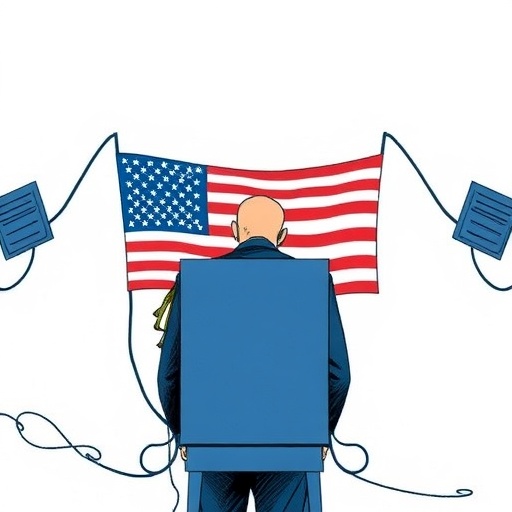
In the evolving landscape of American democracy, a surprising threat looms, not from the fervent support of undemocratic policies by a vocal minority, but from a vast and silent majority of “democratic neutrals.” A groundbreaking study conducted by researchers at the University of Notre Dame challenges the conventional wisdom surrounding democratic decline by spotlighting this large, often overlooked cohort of voters whose ambivalence may be accelerating democratic backsliding in the United States.
This extensive research, recently published in Nature Human Behaviour, delved into the political attitudes of over 45,000 voting-age Americans across multiple large-scale surveys. The findings reveal that approximately half of the population exhibits an attitude of neutrality towards democratic principles — neither actively supporting nor opposing policies that undermine the democratic fabric of the nation. These voters, termed “democratic neutrals,” inhabit a precarious middle ground that scholars now identify as a major threat to democratic stability.
Unlike traditional concerns centered around overt anti-democratic factions, the study’s lead author, Matthew E.K. Hall, a Constitutional Studies professor and director of the Rooney Democracy Institute, elucidates how neutrality functions as an enabler of democratic erosion. Politicians exploit this passive stance, knowing well that when large swaths of the electorate remain indifferent or noncommittal, antidemocratic maneuvers can proceed with less resistance or accountability.
The research methodology entailed deploying focused surveys in the summers of 2024 and 2025, supplemented by continuous polling via a reputable online panel between 2022 and 2023. Survey participants were queried on their stance regarding specific undemocratic practices, including the reduction of out-party polling stations, disregard for court rulings unfavorable to their party, prioritization of partisan loyalty over constitutional fidelity, and censorship of partisan media. Notably, neutrality was often the dominant response category, eclipsing outright agreement with such practices.
The implications of this “neither agree nor disagree” posture are profound. It signals a detachment from the critical vigilance necessary to safeguard democratic institutions. As Hall emphasizes, neutrality is not a passive safeguard but a permissive attitude that tolerates authoritarian tendencies, infringements on democratic norms, and the rise of polarizing extremism. This indifference clouds the electoral landscape by obscuring latent antidemocratic views and diluting collective opposition.
Significantly, this attitude is not confined to any single political party; democratic neutrality pervades across Republicans, Democrats, and independents alike. This bipartisanship in neutrality underscores the complexity of contemporary political engagement and challenges the prevalent narrative of partisanship-driven democratic risk.
The study also probes the psychological and sociopolitical factors driving neutrality. Voters often oscillate between conditional toleration of undemocratic behaviors by favored parties and repudiation when similar behaviors occur within opposing factions, leading to a pragmatic yet unstable equilibrium of “it depends.” Others express genuine uncertainty, lack of political knowledge, or apathetic disengagement. Some harbor conflicted values, torn between competing allegiances, while another subset may feign neutrality to mask socially undesirable antidemocratic sympathies.
Critically, the researchers highlight that these neutrals are just as likely to support authoritarian candidates as the relatively smaller group overtly endorsing undemocratic measures. This parity drastically reshapes the understanding of electoral dynamics and voter psychology in the current era. Neutrality, therefore, emerges not merely as a passive stance but as an active contributor to the vulnerability of democratic governance.
Addressing this challenge requires a paradigmatic shift in democratic advocacy strategies. Traditional appeals to awakened support may fall short unless they explicitly target the sizable contingent of neutral voters. Hall proposes that political messaging must urgently pivot to mobilize these individuals against candidates who seek to undermine democratic norms — advocacy that transcends partisan loyalty and emphasizes the existential stakes of democratic preservation.
The forthcoming 2026 midterm primaries present a pivotal opportunity to operationalize this strategy. By framing elections as a referendum on democratic integrity, rather than mere partisan contests, advocates can galvanize democratic neutrals into decisive political action. Hall warns that continued neutrality will no longer suffice if American democracy is to withstand the centrifugal forces of polarization and institutional decay.
This emergent dynamic reflects a larger trend across Western democracies, where disengagement and ambivalence have paved the way for gradual authoritarian encroachments. Hall’s research situates the United States within this global pattern, underscoring the urgency for renewed civic engagement and institutional vigilance tailored to the nuanced motivations of neutral voters.
The study is embedded within the University of Notre Dame’s broader Democracy Initiative, which intertwines rigorous academic inquiry with public discourse and civic education, aiming to bolster democratic resilience domestically and abroad. Supported by the Rooney Democracy Institute, this work exemplifies an interdisciplinary effort to confront the multifaceted challenges imperiling democracy in the 21st century.
As American political life grapples with deep-seated polarization and the erosion of democratic norms, the findings presented by Hall and his colleagues illuminate an essential paradox: the greatest hazard lies not in the extremes but in the ambiguous center. In this light, fostering democratic vitality demands not only countering extremist ideologies but also awakening the dormant majority whose neutrality inadvertently fuels democratic decline.
Cite Scienmag News
Courtney Benton. (April 21, 2026). How Choosing ‘Neither’ in Voting Might Undermine Democratic Processes in the U.S. Scienmag. https://scienmag.com/how-choosing-neither-in-voting-might-undermine-democratic-processes-in-the-u-s/
Courtney Benton. "How Choosing ‘Neither’ in Voting Might Undermine Democratic Processes in the U.S." Scienmag, 21 April 2026, https://scienmag.com/how-choosing-neither-in-voting-might-undermine-democratic-processes-in-the-u-s/. Accessed 4 September 2026.
Courtney Benton. "How Choosing ‘Neither’ in Voting Might Undermine Democratic Processes in the U.S." Scienmag. April 21, 2026. https://scienmag.com/how-choosing-neither-in-voting-might-undermine-democratic-processes-in-the-u-s/


