


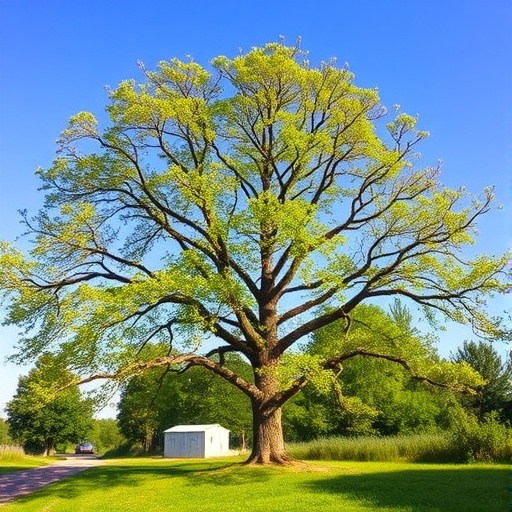
Scientists at the renowned John Innes Centre have pioneered a groundbreaking technique to accelerate the breeding of disease-resistant European ash trees (Fraxinus excelsior), offering hope for the conservation and restoration of this ecologically vital yet imperilled species. At the heart of this advancement lies a refined adaptation of the embryo extraction method, which drastically reduces ash seed germination time from natural periods spanning multiple years to a mere week under controlled laboratory conditions. This swift germination protocol has the potential to revolutionize ash propagation practices worldwide, enabling faster production of robust seedlings that can contribute to restoring devastated ash populations threatened by the devastating ash dieback disease.
The European ash tree faces critical decline due to the fungal pathogen Hymenoscyphus fraxineus, a pathogen responsible for the widespread and aggressive ash dieback syndrome. Traditional seed germination is hindered by the species’ distinctive reproductive biology: ash seeds possess a significant dormancy period controlled by a hard seed coat and physiological stratification requirements. Naturally, seeds endure a warm period followed by a chilling phase, often repeated, resulting in a germination timeline stretching as long as six years. This prolonged dormancy presents a formidable barrier to breeding programs aimed at scaling up disease-resistant trees to meet urgent conservation needs.
Addressing these challenges, the research team harnessed a method initially explored in earlier forestry literature and perfected a meticulous process for embryo extraction from the seed. By delicately separating the embryo from its protective seed coat using fine instruments like knives and tweezers, and subsequently culturing it on nutrient-enriched agar media, scientists effectively circumvent the dormancy-imposed constraints. This nurturing artificial environment encourages rapid embryo growth and seedling development, bypassing time-consuming stratification phases. The embryonic cultures transition to compost-ready seedlings within approximately two weeks, a remarkable acceleration compared to conventional germination.
Dr. Elizabeth Orton, a leading scientist at the John Innes Centre and first author of the pivotal study, emphasizes the significance of this advancement. She notes that while ash seeds historically require two to three years to germinate in natural environments, their protocol condenses this period to about a week in vitro. This rapid seedling generation capability empowers researchers to cultivate hundreds of progeny rapidly, facilitating timely experiments and supporting the establishment of seed orchards comprised of genetically resistant ash families. Such progress is invaluable in ecological restoration strategies aiming to reintroduce ash varieties resilient to dieback.
The protocol has already demonstrated practical success, having yielded over 2,000 seedlings prepared for trials and further research applications. Furthermore, the technology is being considered for adaptation beyond research institutions. The team envisions a simplified, “kitchen-based” variant of the method, leveraging readily accessible materials such as household bleach and standard agar, potentially enabling conservation volunteers, landowners, and amateur gardeners to participate actively in ash restoration initiatives. This democratization of propagation techniques could amplify restoration efforts across diverse geographic regions and communities.
The rapid propagation approach is timely given the global urgency to replenish healthy ash populations decimated by disease and insect threats. Besides dieback, European ash trees face risks from invasive pests like the Emerald Ash Borer, a beetle responsible for significant ecological damage in North America. Current research lines also investigate whether genetic resilience to fungal pathogens correlates with resistance to such pests, promising integrated defense strategies. The accelerated germination protocol, therefore, represents a crucial tool for breeding multifaceted resistance into ash populations.
Preserving the genetic diversity inherent in ash populations remains paramount for long-term ecological resilience and adaptation to evolving environmental stressors, including climate change. Seed propagation uniquely maintains this diversity compared to cloning or grafting, which often limits genetic variation. This diversity confers advantages in combating a spectrum of pathogens and stresses, enabling natural selection processes foundational to healthy forest ecosystems. The embryo extraction and germination technique thus serves not only to expedite seedling production but also to conserve the adaptive potential of ash species.
Once germinated on agar, seedlings undergo a nurturing period of around ten months within glasshouse environments before being transplanted outdoors, where they can flourish and contribute to landscape restoration. One notable application includes the Wendling Beck nature recovery initiative in Norfolk, where seed orchards featuring resilient ash families have been established. These trees are expected to reproduce naturally, generating future generations inherently fortified against dieback, thereby creating hopeful prospects for large-scale ecosystem recovery.
The broader scientific and conservation communities have greeted this advancement with enthusiasm. Researchers across various countries recognize its potential to accelerate restoration timelines and enhance the effectiveness of breeding programs tackling ash dieback. Moreover, the protocol’s adaptability for use by non-specialists heralds a collaborative model of biodiversity conservation, integrating academic research with grassroots restoration activities. This synergy could dramatically increase the pace and reach of ash population recovery efforts over the coming decades.
Ash dieback was first documented in the United Kingdom in 2012, following observations by Dr. Anne Edwards of the John Innes Centre in Norfolk. However, the disease likely arrived earlier and spread through a combination of wind-dispersed spores from continental Europe and the movement of infected horticultural materials. Today, only 5-10% of ash trees exhibit robust resistance, prompting an intensified search for these genetic outliers to serve as breeding stock. The significant mortality among ash trees not only threatens this keystone species but also jeopardizes myriad dependent organisms integral to forest ecosystems.
With climate change exacerbating the emergence and spread of pests and pathogens, the imperative to safeguard species like European ash intensifies. Shifts in temperature and weather patterns facilitate pathogen establishment in previously inhospitable areas, while global trade accelerates pathogen and pest movement. This dynamic necessitates agile and innovative conservation methods capable of rapidly augmenting natural resistance. The rapid germination and embryo culture method developed at the John Innes Centre exemplifies such innovation, paving a path toward more resilient forest ecosystems.
The research published in the Scandinavian Journal of Forest Research marks a milestone in forestry genetics and conservation biology. It elucidates a practical solution to a protracted challenge, bridging fundamental plant developmental biology with applied conservation strategies. By leveraging detailed knowledge of seed dormancy mechanisms and embryonic development, researchers have unlocked an essential avenue to conserve and restore one of Europe’s most valuable tree species. This work sets a precedent that may extend beyond ash, offering insights into the rapid propagation of other threatened tree populations worldwide.
News Publication Date:
5-Feb-2026
Web References:
https://www.tandfonline.com/doi/full/10.1080/02827581.2026.2622937
https://www.afs-journal.org/articles/forest/pdf/2002/02/09.pdf
References:
Orton, E., et al. (2026). Rapid germination of seeds of European ash (Fraxinus excelsior) to restore populations in the face of ash dieback. Scandinavian Journal of Forest Research. DOI: 10.1080/02827581.2026.2622937
Cite Scienmag News
Alan Morgan. (April 21, 2026). Fast-Track Tree Breeding Revives European Ash Populations Across the Landscape. Scienmag. https://scienmag.com/fast-track-tree-breeding-revives-european-ash-populations-across-the-landscape/
Alan Morgan. "Fast-Track Tree Breeding Revives European Ash Populations Across the Landscape." Scienmag, 21 April 2026, https://scienmag.com/fast-track-tree-breeding-revives-european-ash-populations-across-the-landscape/. Accessed 3 September 2026.
Alan Morgan. "Fast-Track Tree Breeding Revives European Ash Populations Across the Landscape." Scienmag. April 21, 2026. https://scienmag.com/fast-track-tree-breeding-revives-european-ash-populations-across-the-landscape/


