


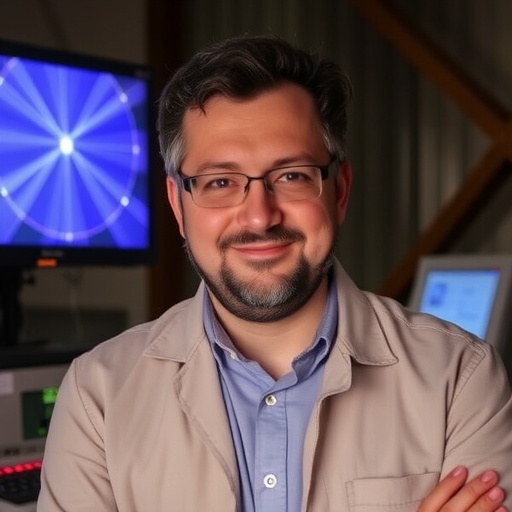
In a groundbreaking development poised to redefine the future of photonics and ultrafast laser technology, an international team of researchers has unveiled a comprehensive theoretical model that unifies the understanding of two seemingly distinct behaviors observed in ultrafast laser pulses. The research, featuring Dr. Sonia Boscolo from Aston University’s esteemed Aston Institute of Photonic Technologies, sheds light on the intricate dynamics of ‘breathing’ solitons in fiber lasers—phenomena that until now necessitated separate mathematical models for their explanation.
Ultrafast lasers, capable of emitting light pulses on the order of picoseconds to femtoseconds, have revolutionized numerous fields, including biomedical imaging, ophthalmic surgeries, precision material processing, and advanced manufacturing. At the heart of these applications lies the laser’s ability to generate stable, ultra-short light pulses that maintain their shape through propagation—a behavior primarily governed by solitons. These solitons, unlike conventional pulses, resist dispersion-induced spreading, leading to remarkably consistent and predictable laser outputs.
Traditionally, laser cavities operate under stable conditions known as steady-state emission, where identical solitons are emitted in rapid succession akin to a rhythmic heartbeat. However, the phenomenon of ‘breather’ solitons presents a more complicated dynamic where these pulses undergo periodic oscillations in intensity and shape as they circulate within the cavity, resembling a breathing pattern. This state of non-equilibrium challenges the steady nature of conventional laser operation, resulting in temporally evolving outputs that have long perplexed physicists and engineers.
The scientific community has observed two distinct breathing regimes in these ultrafast lasers depending on the power relative to the threshold required to sustain pulse emission. Above this threshold, soliton breathing occurs rapidly, completing cycles within just a few cavity roundtrips. Conversely, below threshold, the breathing behavior slows dramatically, with oscillations unfolding over hundreds or even thousands of cycles. These contrasting regimes have historically been treated as separate phenomena, each modeled by entirely different mathematical descriptions.
The innovative breakthrough achieved by Dr. Boscolo and her collaborators lies in the creation of a unified mathematical framework that accurately captures both the fast and slow breathing dynamics within a single model. By integrating the rapid intra-cavity evolution of the light pulses with the much slower modulation of the laser’s gain medium—a key energy source—the team has demonstrated that these behaviors are intrinsically linked rather than distinct entities. This unified theory bridges a critical gap in laser science, providing a coherent explanation for the full spectrum of breathing soliton activities.
Central to their approach is a revised discrete model that meticulously accounts for the slow dynamical processes inherent in the laser’s gain material, while preserving an intricate description of the pulse evolution inside the laser cavity. This dual-scale model successfully replicates the complex oscillatory patterns observed experimentally, revealing mechanisms that were previously obscured. Specifically, the research delineates how below-threshold breathing emerges from interactions between Q-switching phenomena and soliton shaping, whereas above-threshold oscillations are dominated by the interplay of Kerr nonlinearity and dispersion effects within the fiber laser.
The implications of these findings extend far beyond theoretical interest. Understanding the unified dynamics of breather solitons equips scientists and engineers with powerful predictive tools essential for optimizing laser performance across applications. Above-threshold breathers, characterized by rapid oscillations and locking to the cavity frequency, generate comb-like radio-frequency spectra with distinctive optical sidebands—attributes crucial for frequency comb technologies and precision measurement. Meanwhile, below-threshold breathers create densely clustered radio-frequency spectra without strict periodicity or sidebands, offering insights into stable operation regimes critical for certain industrial processes.
Dr. Boscolo emphasized the transformative nature of their work, stating, “Our model transcends previous limitations by simultaneously modeling both rapid and slow breathing dynamics, revealing the unified physical principles governing these regimes. This development closes a longstanding divide in the understanding of ultrafast laser behavior and provides a vital framework for the next generation of light-based devices.”
This work, detailed in the paper titled ‘Unified model for breathing solitons in fiber lasers: Mechanisms across below- and above-threshold regimes,’ published in the prestigious journal Physical Review Letters, is expected to serve as a cornerstone in the evolving landscape of ultrafast laser research. As optical technologies advance towards higher reliability and performance, having a single, comprehensive model will streamline the simulation and design processes. Engineers can now predict complex laser behaviors without resorting to fragmented or regime-specific computational approaches, potentially accelerating innovation cycles.
The scientific community anticipates that this model will facilitate the tailoring of laser dynamics for specific real-world applications. For instance, in biomedical imaging, where pulse consistency and control are paramount to achieving high-resolution images without tissue damage, or in material processing industries demanding precise micromachining capabilities, being able to manage and predict the breathing soliton regimes could translate to enhanced operational precision and efficiency.
While the model fundamentally advances theoretical understanding, it also represents an essential step toward practical implementation. By capturing the nuanced gain dynamics and nonlinear effects in a unified description, researchers can explore new regimes of laser operation previously considered inaccessible or too complex to simulate. This capacity may foster the development of novel laser architectures, ultrafast pulse generators, and frequency combs with bespoke properties tuned for emerging technological challenges.
Ultimately, the successful unification of the two breathing regimes into a single coherent model epitomizes the power of interdisciplinary collaboration and innovative thinking. The fusion of detailed cavity physics with gain medium dynamics exemplifies a level of sophistication necessary for tackling complex nonlinear systems, marking a milestone in mathematical physics and applied photonics. This paradigm shift is expected to influence future research directions and the design of photonic devices integral to next-generation communication, diagnostics, and manufacturing technologies.
As the laser industry marches towards more powerful and adaptable devices, the clarity provided by this unified framework charts a promising pathway for future exploration and development. The collaboration spearheaded by Aston University exemplifies how fundamental research can ignite technological revolutions, highlighting the importance of robust theoretical models in underpinning practical advancements in applied physics and engineering.
News Publication Date: 27-Mar-2026
Web References: 10.1103/rk2z-ymkn
Keywords
Ultrafast lasers, Breathing solitons, Fiber lasers, Soliton dynamics, Kerr nonlinearity, Laser gain medium, Q-switching, Optical frequency combs, Nonlinear optics, Laser cavity modes, Photonics, Mathematical physics
Cite Scienmag News
Bethany Barker. (April 20, 2026). Aston University Researcher Cracks Decades-Old Ultrafast Laser Mystery. Scienmag. https://scienmag.com/aston-university-researcher-cracks-decades-old-ultrafast-laser-mystery/
Bethany Barker. "Aston University Researcher Cracks Decades-Old Ultrafast Laser Mystery." Scienmag, 20 April 2026, https://scienmag.com/aston-university-researcher-cracks-decades-old-ultrafast-laser-mystery/. Accessed 3 September 2026.
Bethany Barker. "Aston University Researcher Cracks Decades-Old Ultrafast Laser Mystery." Scienmag. April 20, 2026. https://scienmag.com/aston-university-researcher-cracks-decades-old-ultrafast-laser-mystery/


