


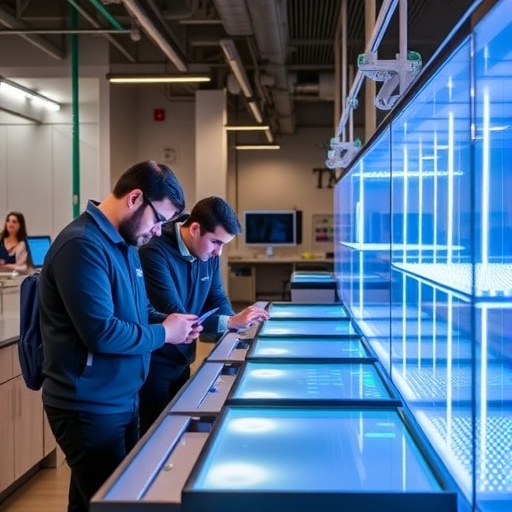
In a significant advancement for environmental engineering research, the Universitat Jaume I (UJI) and the Association for the Research of Ceramic Industries (AICE) have officially inaugurated the Technical Committee for their Joint GEA Environmental Engineering Research Laboratory. This strategic alliance is rooted within the sophisticated infrastructure of the Institute of Ceramic Technology (ITC), located in Castellón, which serves as an epicenter for pioneering technology in ceramics and allied sectors. The committee comprises eminent figures, including UJI’s Vice-Rector for Innovation, Knowledge Transfer, and Science Outreach, David Cabedo, alongside AICE’s Director General, Yolanda Reig. The scientific and technical coordination responsibilities are shared between Eliseo Monfort, representing UJI, and Irina Celades from AICE, ensuring a robust leadership structure for these collaborative endeavors.
This collaboration extends a pre-existing agreement between UJI and AICE, formalized through an addendum signed in October 2025, establishing the GEA – Environmental Engineering Group as a dedicated joint research laboratory. The principal objective aligns with fostering synergistic research initiatives and innovation pipelines aimed at addressing urgent environmental challenges through engineering solutions. Emphasis is placed on knowledge transfer and the mutual exchange of expertise, enhancing the capabilities of both academic and industrial partners within the environmental engineering domain.
The meeting held at the ITC was not merely ceremonial but functioned as a platform to critically assess ongoing projects initiated in 2025 and to delineate a stringent roadmap for prospective activities planned for 2026. Among the envisioned undertakings is the launch of an ambitious European research project scheduled for May, expected to harness cross-border expertise and funding mechanisms. Parallel to this, preparations are underway for an industrial PhD program slated to commence in 2027, which aims to integrate cutting-edge academic research with practical industrial applications, thereby bridging gaps that often exist between theory and practice in environmental engineering.
Furthermore, the collaboration envisages active participation in academic mentorship through the development of student research projects. These include a Bachelor’s Thesis focused on Chemical Engineering and two Master’s Theses centered on Energy Efficiency and Sustainability. These initiatives are designed to offer students hands-on research experiences in partnership with AICE researchers, ensuring that emerging scientists are well-equipped to tackle real-world industrial challenges while fostering innovation.
The Joint GEA Research Laboratory operates alongside the GAIA Research Group, led by UJI professor Eliseo Monfort, creating a formidable research ecosystem within the region. Both entities emphasize deep-rooted partnerships with the industrial sector, facilitating technology transfer, stimulating innovation, and fostering the professional integration of new PhD graduates into relevant industries. This model exemplifies a forward-thinking approach where academia and industry collaboratively contribute to societal advancement through environmental sustainability and technological innovation.
A critical aspect of the collaboration involves strategically targeting competitive public funding calls across diverse programmes. By aligning their research objectives with funding priorities at national and European levels, the GEA laboratory and AICE aim to ensure sustained financial support for their initiatives. This approach not only reinforces the laboratory’s research capabilities but also enhances its capacity to conduct impactful projects with significant environmental and industrial relevance.
The technical foundation underpinning the Joint GEA Research Laboratory’s work leverages advanced ceramic technologies, material science, and environmental engineering principles. AICE’s expertise in ceramic industries complements UJI’s academic prowess, particularly within chemical engineering and energy-efficient process development. This interdisciplinary collaboration aims to innovate environmentally friendly industrial processes, reduce the ecological footprint of ceramic production, and develop novel materials with enhanced performance characteristics that meet stringent environmental standards.
Key research themes addressed by the collaboration include the development of sustainable manufacturing methodologies, optimization of energy consumption in industrial settings, implementation of pollution control technologies, and the advancement of waste valorization techniques. These efforts are vital in addressing global environmental challenges such as resource depletion, emissions reduction, and the circular economy, thereby supporting the EU’s Green Deal objectives and fostering sustainable industrial growth.
The involvement of both entities ensures a continuous feedback loop between applied research and industrial needs, facilitating rapid prototyping, testing, and scaling of innovative solutions. The laboratory’s position within the ITC further amplifies its capabilities by providing access to state-of-the-art facilities and analytical instrumentation crucial for high-precision research activities. This infrastructure supports comprehensive characterization of materials, process optimization studies, and the validation of novel environmental technologies under real-world conditions.
Training and integration of young researchers form a pivotal component of the laboratory’s mission. By embedding graduate students and early-career scientists within industrial projects, the collaboration cultivates a new generation of experts adept at navigating the complexities of environmental engineering challenges. This process is anticipated to enhance employment prospects in the regional industrial sector while infusing academia with fresh perspectives driven by practical industrial insights.
In conclusion, the establishment of the Joint GEA Environmental Engineering Research Laboratory marks a transformative step toward multidisciplinary collaboration between academia and industry. This initiative not only propels forward the frontiers of environmental engineering research but also contributes substantially to the technological and economic development of the Castellón region. Through innovative research, strategic partnerships, and sustained knowledge exchange, the laboratory embodies a model of scientific progress aligned with sustainability imperatives and societal well-being.
Cite Scienmag News
Denise Maddox. (April 20, 2026). Universitat Jaume I and AICE Propel Environmental Engineering Forward with Collaborative GEA Research Laboratory. Scienmag. https://scienmag.com/universitat-jaume-i-and-aice-propel-environmental-engineering-forward-with-collaborative-gea-research-laboratory/
Denise Maddox. "Universitat Jaume I and AICE Propel Environmental Engineering Forward with Collaborative GEA Research Laboratory." Scienmag, 20 April 2026, https://scienmag.com/universitat-jaume-i-and-aice-propel-environmental-engineering-forward-with-collaborative-gea-research-laboratory/. Accessed 4 September 2026.
Denise Maddox. "Universitat Jaume I and AICE Propel Environmental Engineering Forward with Collaborative GEA Research Laboratory." Scienmag. April 20, 2026. https://scienmag.com/universitat-jaume-i-and-aice-propel-environmental-engineering-forward-with-collaborative-gea-research-laboratory/


