


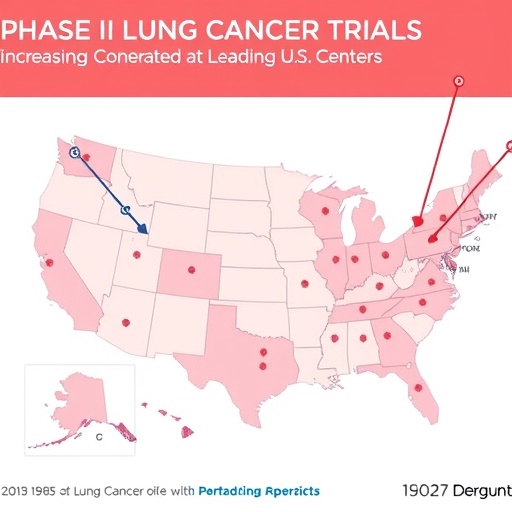
Between 2020 and 2024, a striking transformation has occurred in the landscape of phase I clinical trials for non-small cell lung cancer (NSCLC) within the United States. The number of unique trial sites has dramatically dwindled by approximately 44%, indicating a profound consolidation of research efforts. This contraction in geographic diversity has led to a concentration of trials at a select group of the top 20 highest-volume clinical trial centers, predominantly situated in major metropolitan areas. These findings, recently unveiled at the American Association for Cancer Research (AACR) Annual Meeting 2026, spotlight pressing concerns over accessibility and representation in early-stage lung cancer research.
The U.S. Food and Drug Administration (FDA) has long prioritized increasing the representativeness of clinical trial populations, acknowledging that diverse and inclusive participation is essential for the development of therapies that are effective across the heterogeneous American populace. Recent meetings convened by the FDA’s Oncologic Drug Advisory Committee (ODAC) highlighted a growing apprehension: approvals of emerging oncologic therapies are being hampered, at least in part, by questions surrounding the applicability of trial outcomes, especially when patient enrollment fails to reflect the demographic and geographic diversity of the broader population affected by NSCLC. This regulatory scrutiny underscores the urgency of ensuring that clinical research is both representative and generalizable.
In an effort to elucidate these distributional trends, Brittany Avin McKelvey, PhD, a senior director of regulatory policy at the LUNGevity Foundation, spearheaded an analytical review focused on the spatial and temporal dynamics of phase I NSCLC trial sites. By mining data from ClinicalTrials.gov, her team cataloged all interventional, industry-sponsored phase I trials initiated from January 2020 through December 2024. The methodology entailed mapping unique site addresses associated with distinct National Clinical Trial (NCT) numbers, thereby quantifying both the number of active unique sites and the instances of trial initiations. This granular approach enabled a comprehensive portrait of how clinical trial site engagement evolved over the five-year interval.
Across the global landscape, 555 phase I NSCLC trials commenced during this timeframe, accounting for 8,393 trial instances spread over 47 countries. The United States represented the lion’s share, hosting 45% of these trial instances, followed by China (11%), Spain (8%), Korea (5%), France (4%), and Australia (4%). While the aggregate number of trial instances increased in the U.S. from 819 in 2020 to a peak of 955 in 2022, a subsequent decline to 566 by the close of 2024 was observed. Analogous downward trends were mirrored in other significant jurisdictions such as China, Spain, Korea, and France, whereas countries like Australia, Japan, and Brazil displayed modest upward trajectories.
A particularly disconcerting finding was the sharp contraction in the number of unique trial sites within the United States, which contracted from 395 to 223 over the studied interval. However, this reduction in breadth was offset by a stable volume of trials being concentrated within a narrow cadre of top-tier sites. The 20 highest-volume sites maintained a median annual initiation rate of seven to eleven trials each across the five years, predominantly located in cities with populations exceeding 1.9 million residents. This centralization presents a paradoxical divergence from the FDA’s stated objectives advocating decentralization and broader community-based trial access.
The implications of this trend are multifaceted. Centralizing trials at large, established institutions may enhance operational efficiencies, facilitate access to cutting-edge technologies, and leverage extensive clinical expertise. Yet, it simultaneously risks creating barriers to trial participation for patients residing outside major cities, effectively limiting geographical and socioeconomic diversity within the trial cohorts. This uneven access may dampen the generalizability of trial results and inadvertently bias therapeutic development in favor of patient populations concentrated near these eminent centers.
Several underlying factors have been posited to drive this consolidation phenomenon. Phase I trials, by nature, are characterized by complex and rigorous protocols coupled with the administration of novel agents whose safety profiles may be incompletely understood. These demands necessitate significant infrastructure, specialized expertise, and robust compliance mechanisms—resources that smaller or less well-established sites may find difficult to sustain. Furthermore, escalating regulatory requirements and administrative burdens pose additional obstacles to the activation and ongoing management of clinical trial sites, effectively raising the entry threshold for many institutions.
These competitive dynamics tend to create a reinforcing feedback loop wherein high-performing, resource-rich sites become the preferred partners for pharmaceutical sponsors seeking reliable and efficient trial execution. Such sites accrue greater experience, develop expansive research teams, and enhance their reputations, thereby further attracting subsequent trials. Conversely, lower-volume sites may struggle to maintain capacity and visibility, reducing their ability to compete effectively for new studies and exacerbating the decline in site diversity.
Interestingly, not all lower-volume sites suffered diminished trial activity. Sites integrated within the National Cancer Institute Community Oncology Research Program (NCORP) demonstrated relative resilience, maintaining much of their trial engagement throughout the period. This observation suggests that infrastructure support, resource sharing, and network integration provided by programs like NCORP may serve as critical buffers against the systemic pressures driving centralization. Such models underscore the potential value of collaborative frameworks in preserving and enhancing diversity within the clinical trial ecosystem.
Addressing the ongoing shift toward trial consolidation will necessitate coordinated multi-stakeholder strategies. Concerted efforts aimed at reducing barriers to site activation, enhancing infrastructure capabilities at smaller or community-based sites, and instituting policy incentives designed to encourage a more geographically balanced portfolio of trial sites are paramount. Without these interventions, the risk is that clinical trials will become increasingly detached from the broader patient populations they aim to serve, thereby undermining both scientific rigor and equitable access.
The present analysis carries certain limitations that warrant acknowledgment. The heterogeneity inherent in ClinicalTrials.gov data complicates precise identification of whether proximate sites represent discrete institutions or satellite branches of a larger entity, potentially influencing site counts. Additionally, lack of access to patient enrollment figures precludes direct assessment of actual participant distribution, meaning the number of active recruiting sites may be overestimated relative to trial instance counts. Moreover, the focus on phase I NSCLC trials may not fully extrapolate to other cancer subtypes or later-phase studies, which often entail different operational paradigms and risk profiles.
Future investigations are anticipated to expand these foundational insights by examining later-phase trials, which tend to have more established safety parameters and might allow broader site participation. Such comparative analyses could elucidate whether the trends of site consolidation observed in early-phase NSCLC trials are pervasive across oncology clinical research or largely confined to this niche. These forthcoming studies will be critical in shaping informed policies to promote inclusivity and scientific robustness in cancer drug development.
This body of work was supported by the LUNGevity Foundation through unrestricted grants, and the investigators have disclosed no conflicts of interest, underscoring their commitment to unbiased scientific inquiry. The findings presented here not only highlight the evolving challenges within the clinical trial landscape for lung cancer but also serve as a clarion call for renewed efforts to ensure that the future of oncology research remains accessible, diverse, and effective for all patients.
News Publication Date: April 2026 (based on AACR Annual Meeting 2026 presentation date).
Web References:
- American Association for Cancer Research (AACR) Annual Meeting 2026: https://www.aacr.org/meeting/aacr-annual-meeting-2026/
- ClinicalTrials.gov database.
Cite Scienmag News
Nathaniel Bowman. (April 20, 2026). Phase I Lung Cancer Trials Increasingly Concentrated at Leading U.S. Centers. Scienmag. https://scienmag.com/phase-i-lung-cancer-trials-increasingly-concentrated-at-leading-u-s-centers/
Nathaniel Bowman. "Phase I Lung Cancer Trials Increasingly Concentrated at Leading U.S. Centers." Scienmag, 20 April 2026, https://scienmag.com/phase-i-lung-cancer-trials-increasingly-concentrated-at-leading-u-s-centers/. Accessed 4 September 2026.
Nathaniel Bowman. "Phase I Lung Cancer Trials Increasingly Concentrated at Leading U.S. Centers." Scienmag. April 20, 2026. https://scienmag.com/phase-i-lung-cancer-trials-increasingly-concentrated-at-leading-u-s-centers/


