


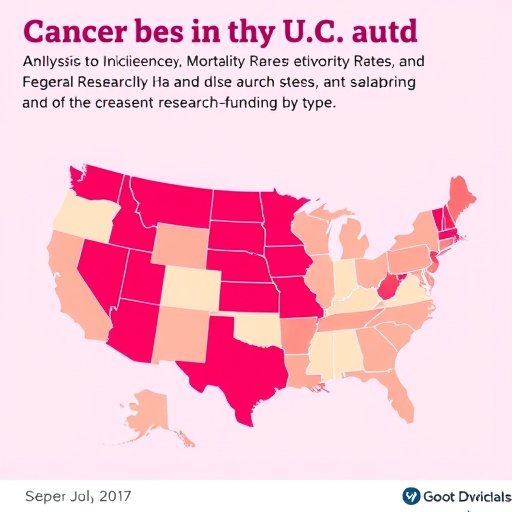
A groundbreaking new study published in JAMA Network Open reveals a striking discrepancy between the lethality of various cancers and the allocation of federal research funding intended to combat them. The research underscores a critical imbalance: cancers responsible for the highest mortality rates are often those receiving disproportionately less financial support. This misalignment signals an urgent call for policy revisions and a strategic reallocation of resources to maximize impact in reducing cancer-related suffering and death.
Despite the immense advances in oncology research over recent decades, mortality rates for certain malignant neoplasms remain unacceptably high. The study meticulously analyzes federal research dollars directed toward different cancer types, highlighting how less lethal cancers tend to attract more funding, while those with more aggressive clinical courses and worse prognoses are comparatively neglected. This paradox identifies systemic inefficiencies in research prioritization that, if corrected, could lead to more effective interventions for high-lethality cancers.
The research emphasizes the necessity of integrating mortality statistics as a primary criterion in funding decisions. Moving beyond traditional factors which often skew toward incidence or public awareness, the study suggests that federal agencies ought to recalibrate priorities based on the absolute and relative lethality of cancers. Strengthening this data-driven approach could focus precious resources on the most devastating cancers, enhancing survival outcomes and ultimately curbing the public health burden.
Importantly, the study expands the discourse beyond mortality to consider additional dimensions of cancer’s impact. It argues for incorporating quality-of-life measures, socio-economic disparities, and the burden on underserved communities into future resource allocation frameworks. This multidimensional outlook acknowledges that some cancers impose disproportionately high suffering on marginalized populations and that addressing this inequity is essential for equitable health advancement.
The findings also detail how research investment tends to concentrate on cancers with improving prognoses, often due to successful advocacy and existing treatment platforms. As a consequence, cancers with poor survival statistics, such as pancreatic or liver malignancies, remain underfunded despite their high lethality. This phenomenon risks perpetuating a cycle where limited breakthroughs occur for the deadliest diseases, leaving many patients without meaningful progress in treatment options.
By advocating for a more strategic research funding posture, the study calls for prioritization that aligns with both scientific opportunity and public health necessity. It highlights the importance of balancing innovation in well-funded cancers with urgent needs in more lethal but understudied neoplasms. Such recalibration would entail challenging entrenched funding paradigms and aligning stakeholder incentives with population health priorities.
The study authors further contend that prevention strategies deserve a stronger role in research planning. Since certain cancers are highly preventable through lifestyle modifications, vaccination, or early detection, prioritizing prevention research could deliver outsized reductions in mortality. Integrating prevention goals into funding decisions emphasizes a proactive model of cancer control, potentially shifting the overall landscape toward fewer cases and improved survival.
This comprehensive analysis leverages a detailed examination of mortality data, funding allocations, and research trends, utilizing advanced epidemiological techniques and health economics modeling. By quantifying the mismatch between disease burden and funding, the authors provide a robust evidentiary foundation for policymakers and funding bodies to rethink current investment frameworks. The study exemplifies how rigorous data analytics can illuminate inefficiencies in public health strategy.
Moreover, the study highlights ethical considerations inherent in funding decisions, particularly the responsibility of public agencies to prioritize human suffering reduction. It critiques the influence of advocacy, public awareness, and political factors that often skew funding distributions away from scientific and medical need. The research calls for transparent, accountable mechanisms to ensure equitable distribution of resources that reflect disease severity and population impact.
In discussing implications, the study forecasts that aligning funding with cancer lethality could expedite the development of targeted therapies for cancers with historically poor outcomes. Increased investment could stimulate scientific breakthroughs by attracting researchers, catalyzing clinical trials, and encouraging innovation in therapeutic modalities. Such alignment promises greater returns on investment in terms of lives saved and quality of life improved.
This undertaking is particularly timely in an era where precision medicine and biotechnology are rapidly advancing. The study underscores the need to extend these technologies to the cancers that currently languish underfunded. Applying novel genetic, immunologic, and molecular approaches to these malignancies has potential to revolutionize treatment, but only if sufficient resources and scientific attention are dedicated.
To ensure ongoing progress, the authors recommend creating interdisciplinary collaborations that bridge epidemiology, social science, and biomedical innovation. This holistic approach would better capture the complex factors influencing cancer lethality and funding disparities. It would also foster inclusion of underserved voices and tailor research agendas to address specific community needs effectively.
Ultimately, this study serves as a clarion call to rethink how federal research funds are distributed across cancer types. By realigning funding priorities with lethality and broader societal impact, the research community and funding bodies could dramatically alter the trajectory of cancer outcomes in the United States. Such recalibration promises a more just, effective, and compassionate investment of limited public health resources.
Corresponding author Anish Thomas, MBBS, MD, emphasizes the urgency of these findings for policymakers and researchers alike, noting that optimized funding can transform not only survival rates but also reduce disparities in care access and quality. Ahead lies a pivotal opportunity to mobilize science, finance, and policy toward a future where the deadliest cancers no longer remain neglected frontiers.
News Publication Date: Not provided.
Web References: doi:10.1001/jamanetworkopen.2026.7837
References: Not provided.
Cite Scienmag News
Nathaniel Bowman. (April 20, 2026). Cancer in the U.S.: Analysis of Incidence, Mortality Rates, and Federal Research Funding by Type. Scienmag. https://scienmag.com/cancer-in-the-u-s-analysis-of-incidence-mortality-rates-and-federal-research-funding-by-type/
Nathaniel Bowman. "Cancer in the U.S.: Analysis of Incidence, Mortality Rates, and Federal Research Funding by Type." Scienmag, 20 April 2026, https://scienmag.com/cancer-in-the-u-s-analysis-of-incidence-mortality-rates-and-federal-research-funding-by-type/. Accessed 5 September 2026.
Nathaniel Bowman. "Cancer in the U.S.: Analysis of Incidence, Mortality Rates, and Federal Research Funding by Type." Scienmag. April 20, 2026. https://scienmag.com/cancer-in-the-u-s-analysis-of-incidence-mortality-rates-and-federal-research-funding-by-type/


