


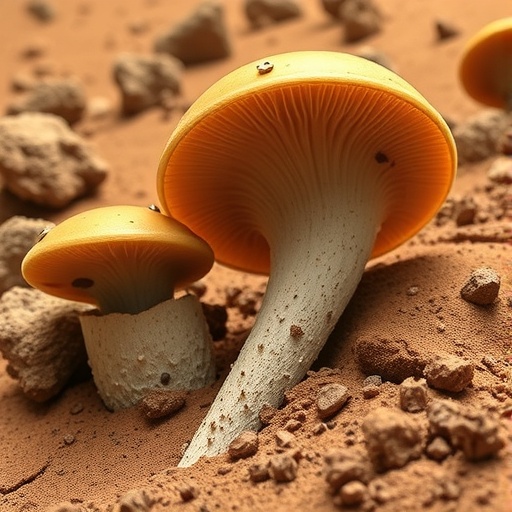
In the relentless pursuit of interplanetary exploration, safeguarding Mars from Earth-origin contamination has emerged as a critical challenge. NASA’s cleanrooms, sterile environments meticulously maintained for spacecraft assembly and preparation, have traditionally focused decontamination efforts primarily on bacteria. However, a groundbreaking study published in Applied and Environmental Microbiology reveals a resilient fungal occupant within these sanctuaries that challenges our assumptions about microbial survivability in space and on Mars. This investigation elevates concerns about fungi, particularly their asexual spores known as conidia, as formidable microbial stowaways capable of enduring the extreme conditions encountered throughout space missions to Mars.
The research team centered their work around Aspergillus calidoustus, a fungal species isolated directly from NASA’s spacecraft assembly cleanrooms. These fungi were collected from environments subjected to rigorous sterilization protocols intended to eradicate microbial life. The most striking discovery was that the conidia of A. calidoustus not only survived the decontamination procedures but also withstood subsequent experimental simulations replicating Martian and interplanetary conditions. These included intense ultraviolet and ionizing radiation, cryogenic temperatures, low atmospheric pressure akin to Mars’ thin atmosphere, and exposure to Martian regolith analogs. This level of resilience signals a potentially underestimated risk for planetary protection.
Conidia are asexual spores specialized for dispersal and survival under adverse conditions. Their inherent robustness makes them evolutionary veterans capable of persisting in diverse, often hostile terrestrial niches. The study’s detailed experiments demonstrated that A. calidoustus conidia resisted individual stressors and only succumbed under a synergistic combination of extreme low temperature coupled with high-level radiation exposure. This finding reveals that microbial survival in extraterrestrial environments is determined not by isolated stress factors but through an interplay of multiple environmental insults, each of which microbes must counteract through an arsenal of stress tolerance mechanisms.
The implications of these findings are profound for NASA’s planetary protection strategy. Historically, spacecraft decontamination efforts and microbial monitoring have been largely bacteria-centric, primarily due to bacteria’s ubiquity and known resilience. Fungi, as microbial eukaryotes equipped with complex cellular structures including nuclei, have often been overlooked or understudied in this context. This study pioneers the evaluation of eukaryotic microbial survival during space missions, establishing that fungi can endure every critical phase of Mars exploration—from ground-based assembly under stringent sterilization to enduring the vacuum, radiation, and temperature extremes of space travel and finally confronting the harsh Martian surface.
Microbial resilience challenges were scrutinized using state-of-the-art simulation chambers replicating the multifaceted environment encountered en route to and on Mars. These simulations included low pressure equivalent to Martian atmospheric levels (~6 millibars), ionizing radiation doses mimicking cosmic rays and solar particle events, extreme temperature fluctuations, and exposure to Mars-like dust and regolith compositions. The endurance of Aspergillus calidoustus conidia under these parameters marks it as a microbe uniquely suited to withstand the critical environmental barrier defenses we assumed effective against microbial persistence.
The study began with a rigorous screening of 27 fungal strains recovered from Mars 2020 mission-associated environments. This mission culminated in the successful landing of the Perseverance rover on Mars. Alongside fungal isolates, the researchers included bacterial strains known for exceptional radiation resistance—benchmark organisms historically deployed as microbial survival standards. The comparative analysis underscored that, in many ways, fungal conidia rival or surpass bacteria in their durability under combined space stressors, a revelation that could upend long-standing paradigms of microbial risk assessment.
Researchers emphasize that while this study does not imply an inevitable contamination of Mars, it significantly sharpens the lens through which microbial survival risk is assessed. Microbial eukaryotes like fungi, with their complex cellular machinery, represent a frontier in astrobiology and planetary protection. The ability of A. calidoustus to withstand simulated Martian stresses raises the possibility that terrestrial fungi could inadvertently hitch rides on spacecraft and colonize extraterrestrial surfaces—thereby complicating our search for indigenous Martian life and potentially contaminating extraterrestrial ecosystems.
Consequently, this research advocates for an expanded decontamination approach that transcends the traditional bacteria-centric protocols. NASA’s current microbial surveillance and sterilization procedures need to systematically factor in fungal robustness to enhance planetary protection efficacy. This encompasses revising germicidal regimes, refining environmental monitoring techniques to detect fungi with greater sensitivity, and incorporating fungal survival data into mission planning and risk mitigation strategies.
Kasthuri Venkateswaran, the study’s lead microbiologist and former Senior Scientist at NASA’s Jet Propulsion Laboratory, underscores the broader implications of these findings. His team’s work is a crucial step toward redefining microbial contamination control, with ramifications extending beyond Mars-bound missions to future explorations of other celestial bodies, including icy moons and asteroids. The research highlights a paradigm shift, advocating for a more sophisticated understanding of microbial ecology in spacecraft assembly and planetary lander environments.
This exploration into fungal endurance on Mars-related missions not only deepens our comprehension of microbial resilience in extreme environments but also enriches astrobiological discourse on life’s boundaries. It challenges scientists to consider eukaryotic microorganisms when developing life-detection instruments and planetary protection protocols. Future studies driven by this research may explore genetic and physiological mechanisms underpinning fungal resistance, potentially revealing novel survival strategies that could analogize to life’s potential adaptations on other planets.
With ongoing Mars missions and ambitious plans for human exploration, the urgency of integrating fungal survival data into planetary protection cannot be overstated. This research offers a cautionary tale that microbial life’s persistence is more tenacious and multifaceted than previously recognized. As humanity extends its footprint into the solar system, ensuring the integrity of both Earth and extraterrestrial environments hinges upon evolving our microbial surveillance and sterilization methodologies to include the full spectrum of microbial life—bacteria, fungi, and beyond.
In conclusion, the groundbreaking discovery of Aspergillus calidoustus conidia survival through simulated Mars mission conditions serves as a clarion call for NASA and the global scientific community. It compels us to rethink microbial contamination paradigms and reinforces the importance of rigorous planetary protection measures. This research not only safeguards our cosmic explorations but also guides the stewardship responsibilities humanity carries as it ventures into the broader cosmos.
News Publication Date: June 2024
Web References: https://doi.org/10.1128/aem.02065-25
References: Applied and Environmental Microbiology journal, ASM publication
Keywords
Mars microbiology, fungal spores, Aspergillus calidoustus, planetary protection, spacecraft sterilization, microbial eukaryotes, conidia, space mission contamination, Martian environment simulation, microbial resilience, NASA cleanrooms, interplanetary contamination
Cite Scienmag News
Roger Howard. (April 20, 2026). How Tough Fungi Could Endure Mars and Space Conditions. Scienmag. https://scienmag.com/how-tough-fungi-could-endure-mars-and-space-conditions/
Roger Howard. "How Tough Fungi Could Endure Mars and Space Conditions." Scienmag, 20 April 2026, https://scienmag.com/how-tough-fungi-could-endure-mars-and-space-conditions/. Accessed 4 September 2026.
Roger Howard. "How Tough Fungi Could Endure Mars and Space Conditions." Scienmag. April 20, 2026. https://scienmag.com/how-tough-fungi-could-endure-mars-and-space-conditions/


