


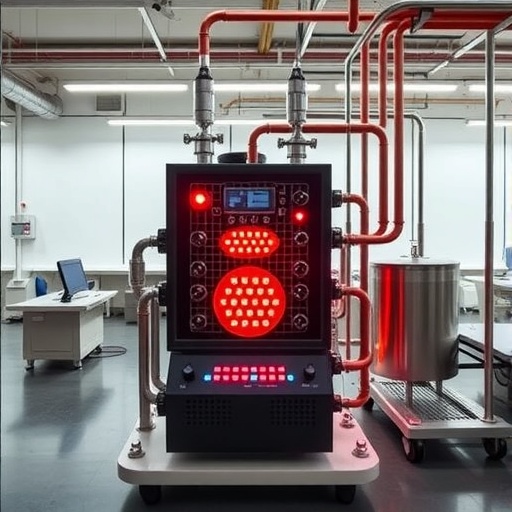
In the relentless global pursuit of mitigating climate change, the capture and conversion of carbon dioxide (CO₂) have emerged as critical scientific frontiers. While technologies exist to separately capture CO₂ emissions and convert purified CO₂ into valuable chemical feedstocks, integrating these processes into a single, cost-effective, and scalable operation has long eluded researchers. A breakthrough from the University of Chicago Pritzker School of Molecular Engineering (UChicago PME) in collaboration with Argonne National Laboratory promises to transform this landscape. This innovative approach enables simultaneous capture and electrochemical conversion of CO₂, significantly streamlining carbon utilization workflows.
Traditional carbon capture mechanisms predominantly rely on aqueous amine solutions—nitrogen-containing organic compounds proficient at chemically binding CO₂ molecules. During conventional processes, captured CO₂ is liberated from the amine solution after subjecting it to elevated temperatures, often exceeding 150°C, in energy-intensive steps that add substantial operational costs. Subsequently, captured CO₂ is typically purified before conversion into industrially useful products. However, performing CO₂ conversion reactions directly in water-related environments introduces complications, such as side reactions that generate hydrogen gas, thereby reducing efficiency and complicating product selectivity.
Recognizing the drawbacks inherent in water-based capture-conversion systems, the research team pursued a novel strategy that replaces water with dimethyl sulfoxide (DMSO), a polar aprotic organic solvent widely used throughout chemical industries. This solvent switch alone dramatically alters fundamental amine-CO₂ binding chemistry. In aqueous systems, amines require dimerization around captured CO₂ molecules, binding at a ratio of two amine groups per molecule of CO₂. In contrast, the DMSO environment enables a one-to-one amine-to-CO₂ binding stoichiometry, effectively doubling the system’s theoretical capture capacity. The modification not only enhances capture efficiency per amine but also suppresses side reactions common in aqueous media, resulting in greater carbon retention and improved conversion outcomes.
Catalytic materials also play a pivotal role in electrochemical CO₂ conversion. Silver, widely utilized for its selectivity and resistance to competing hydrogen evolution reactions in aqueous electrochemistry, poses economic and scalability challenges due to its scarcity and cost. In the water-free DMSO system, the team identified zinc—a far more earth-abundant and inexpensive metal—as an effective catalyst for converting captured CO₂ to carbon monoxide (CO), a vital raw material for many chemical manufacturing pathways. Experimental data revealed that the zinc catalyst achieved a remarkable conversion efficiency of approximately 78%, surpassing expectations and underscoring the potential for decoupling catalyst performance from traditional material constraints.
Beyond fundamental chemistry, the researchers tackled the crucial challenge of applying the system under industrially relevant conditions, which differ significantly from controlled lab environments using pure CO₂ streams. To approximate real-world scenarios, the team employed simulated flue gases containing oxygen — a known inhibitor of many electrochemical reactions due to its propensity to interfere with active sites and generate competing reactions. Encouragingly, even in these more complex gas mixtures, the integrated system maintained approximately 43% conversion efficiency over multiple cycles. This performance level paralleled or exceeded that of state-of-the-art aqueous silver-based systems subjected to purer CO₂ feeds, signaling robust tolerance to industrial exhaust complexities.
Anchoring their breakthrough in practical considerations, researchers undertook techno-economic analyses to evaluate cost implications accompanying the solvent and catalyst modifications. While DMSO is pricier than water, its superior capture efficiency and conversion rates could offset these expenses by reducing downstream energy expenditures and augmenting product yields. Replacing expensive silver catalysts with low-cost zinc further enhances economic viability by leveraging abundant materials. Collectively, these factors suggest that this integrated device stands to offer competitive operational costs compared to conventional two-step capture and conversion systems.
Despite these promising advances, the authors acknowledge significant hurdles before industrial-scale deployment can be realized. Achieving sustained catalyst stability beyond mere days toward thousands of hours is paramount, as is enhancing reaction rates by an order of magnitude to meet commercial throughput demands. Moreover, scaling will require the engineering of reactor architectures tailored to optimize electrochemical interfaces, mass transport, and energy inputs at large volumes. Nonetheless, the establishment of a foundational scientific framework and early patent filings demonstrate strong commitment to bridging laboratory innovation with industrial translation.
The fusion of molecular engineering expertise and national laboratory resources catalyzed this innovation, illustrating the power of collaborative research infrastructures. By leveraging electrochemical principles in non-aqueous environments typically uncommon in CO₂ capture, the team demonstrated a paradigm shift—ushering in design principles where solvent chemistry, catalyst selection, and reaction engineering converge synergistically. The work paves the way to reduced energy consumption, lower operational costs, and enhanced flexibility in utilizing captured carbon for synthetic fuels and chemicals.
Further computational investigations illuminated why zinc exhibits superior catalytic activity in the DMSO solvent matrix compared to silver, identifying lower energetic barriers and enhanced intermediate stabilization as key mechanistic contributors. These insights will guide future catalyst optimization efforts and deepen fundamental understanding of non-aqueous electrochemical CO₂ reduction pathways. Moreover, the absence of water eliminates parasitic hydrogen evolution, effectively channeling electrons toward productive CO formation.
From a broader sustainability perspective, this integrated CO₂ capture-conversion system holds promise to significantly mitigate carbon emissions from industrial sources, including power plants and manufacturing facilities, by converting waste CO₂ streams into value-added products on-site. Such circular carbon utilization approaches align with global decarbonization objectives and could incentivize investments in carbon management technologies through improved returns and operational simplicity.
In summary, this research embodies a transformative advance in carbon capture and utilization. By innovatively melding solvent engineering, catalysis, and electrochemistry, the scientists at UChicago PME and Argonne National Laboratory have demonstrated that simultaneous CO₂ capture and conversion is feasible under industrially realistic conditions with enhanced efficiency and cost-effectiveness. While challenges remain to scale and commercialize this technology, the demonstrated principles and early successes chart a hopeful pathway towards more sustainable chemical manufacturing and climate solutions.
News Publication Date:
17-Apr-2026
Web References:
https://www.nature.com/articles/s41560-026-02035-4
https://pme.uchicago.edu/
https://www.anl.gov/
References:
Gomes et al., “Reactive CO₂ Capture via Controlled Amine Speciation in Nonaqueous Electrolytes,” Nature Energy, April 17, 2026. DOI: 10.1038/s41560-026-02035-4
Keywords
Carbon capture, CO₂ conversion, non-aqueous electrolytes, electrochemistry, amines, dimethyl sulfoxide, zinc catalysis, sustainable chemistry, greenhouse gas mitigation, molecular engineering, techno-economic analysis, industrial flue gas
Cite Scienmag News
Sloane Callahan. (April 17, 2026). Scientists Develop Integrated System for Carbon Dioxide Capture and Conversion. Scienmag. https://scienmag.com/scientists-develop-integrated-system-for-carbon-dioxide-capture-and-conversion/
Sloane Callahan. "Scientists Develop Integrated System for Carbon Dioxide Capture and Conversion." Scienmag, 17 April 2026, https://scienmag.com/scientists-develop-integrated-system-for-carbon-dioxide-capture-and-conversion/. Accessed 4 September 2026.
Sloane Callahan. "Scientists Develop Integrated System for Carbon Dioxide Capture and Conversion." Scienmag. April 17, 2026. https://scienmag.com/scientists-develop-integrated-system-for-carbon-dioxide-capture-and-conversion/


