


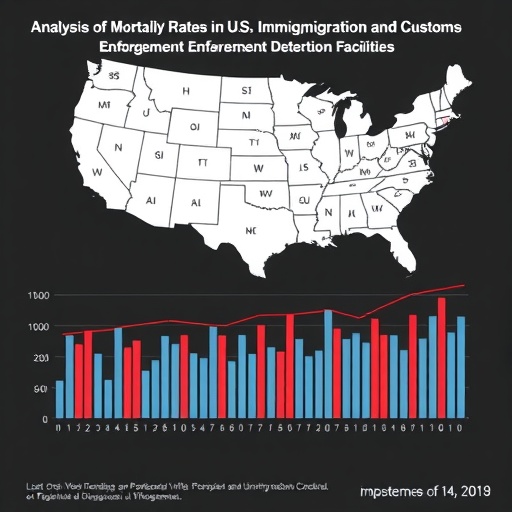
A comprehensive new study published in JAMA meticulously charts the annual mortality rates among individuals detained by U.S. Immigration and Customs Enforcement (ICE) from 2004 through January 2026. Conducted by a team led by Dr. Sanjay Basu of UCSF, this investigation offers an unprecedented longitudinal analysis of mortality trends within ICE detention facilities, elucidating patterns by age and causes of death. By delving into over two decades of data, the study sheds crucial light on the health and human rights considerations inherent in the immigration detention system.
The U.S. immigration detention system has long been fraught with controversy, particularly concerning the treatment and welfare of detainees. Mortality within these settings is not simply a matter of numbers but reflects broader systemic issues including medical care access, facility conditions, and detainee vulnerabilities. This study’s expansive timeframe allows researchers to observe mortality trends against the backdrop of shifting policy landscapes and enforcement strategies, offering a nuanced perspective seldom captured in prior reports.
One of the core technical strengths of this inquiry lies in its robust statistical estimation methods. By employing advanced inferential statistics, the researchers were able to account for variations in detainee populations, age distributions, and cause-of-death classifications over time. This rigorous methodology enhances the reliability of mortality rate estimations and supports causal inferences regarding the factors influencing detainee deaths.
Age stratification emerged as a key analytical focus. The study reveals that mortality risk is not uniform across all age groups within ICE detention but varies significantly, with older detainees exhibiting markedly higher death rates. Such age-related risk differentials are critical for policymakers and detention administrators aiming to target interventions and improve care standards for vulnerable subpopulations.
The analysis of causes of death provides revealing insights into the health challenges facing detainees. Natural causes, including chronic diseases such as cardiovascular and respiratory conditions, dominate the mortality profile. However, the study also highlights instances of death attributable to infectious diseases and, notably, some deaths associated with suicide and unintentional injury. These findings point to complex health needs and underline the importance of comprehensive medical and mental health services in detention environments.
Over the study period, the researchers traced fluctuations in mortality rates that correspond with notable policy shifts and enforcement intensities. For example, spikes in mortality often coincided with periods of increased detention populations or systemic stressors such as facility overcrowding and strained medical resources. This temporal analysis allows for important inferences about the impact of administrative decisions on detainee well-being.
A deeper examination into systemic factors reveals that disparities in the provision of healthcare, including screening, timely diagnosis, and treatment, contribute substantially to adverse outcomes. The study advocates for enhanced transparency and accountability in ICE health services to ensure detainee survival is not compromised by preventable medical neglect or delays.
Technical discussions within the paper address potential limitations, such as incomplete cause-of-death documentation or underreporting biases. Yet, the authors provide thoughtful triangulation with external mortality records and sensitivity analyses to bolster the study’s credibility. This nuanced handling of data integrity lends weight to the conclusions and reaffirms the urgency of reforms.
The implications of this foundational research extend beyond mortality statistics. They intersect with human rights frameworks and ethical obligations governing the treatment of detained populations. By quantifying mortality risks and highlighting systemic vulnerabilities, the study demands a reevaluation of detention policies in light of health equity and dignity considerations.
The study’s findings resonate with broader sociopolitical debates surrounding immigration enforcement and detention. They provide an empirical baseline that lawmakers, advocates, and public health officials can reference in discussions about detention alternatives, medical oversight improvements, and reparative measures for at-risk detainees.
Finally, the extensive collaboration and authorial transparency, including conflict of interest disclosures and funding sources detailed in the original article, enhance the study’s authoritative voice. Correspondence and requests for information can be directed to Dr. Sanjay Basu at UCSF, whose leadership underscores the study’s academic rigor and commitment to social justice in public health.
This landmark work, set to influence policy direction and healthcare delivery in immigration detention, opens avenues for further research including comparative analyses with mortality rates in other detention contexts or nations. Its methodological approach and findings provide a template for ongoing monitoring that could potentially curtail preventable deaths among detained immigrant populations.
News Publication Date: [Information not provided in the source material]
Web References: doi:10.1001/jama.2026.3719
References: [Information not detailed in the source material]
Cite Scienmag News
Reid Dalton. (April 16, 2026). Analysis of Mortality Rates in U.S. Immigration and Customs Enforcement Detention Facilities. Scienmag. https://scienmag.com/analysis-of-mortality-rates-in-u-s-immigration-and-customs-enforcement-detention-facilities/
Reid Dalton. "Analysis of Mortality Rates in U.S. Immigration and Customs Enforcement Detention Facilities." Scienmag, 16 April 2026, https://scienmag.com/analysis-of-mortality-rates-in-u-s-immigration-and-customs-enforcement-detention-facilities/. Accessed 4 September 2026.
Reid Dalton. "Analysis of Mortality Rates in U.S. Immigration and Customs Enforcement Detention Facilities." Scienmag. April 16, 2026. https://scienmag.com/analysis-of-mortality-rates-in-u-s-immigration-and-customs-enforcement-detention-facilities/


