


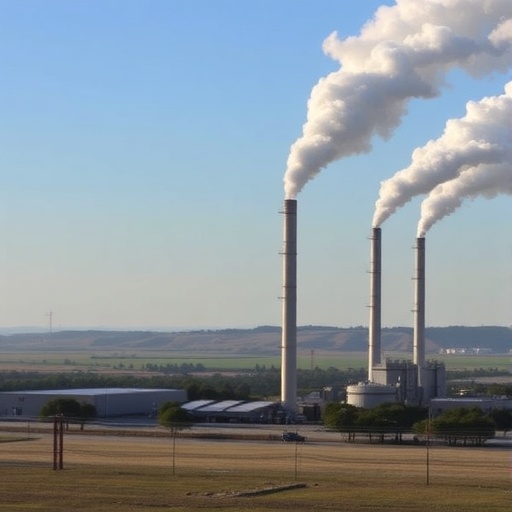
In a groundbreaking study published recently in Nature Communications, researchers have uncovered alarming evidence that ongoing industrial emissions are significantly impeding the recovery of the Earth’s stratospheric ozone layer. This discovery challenges previous assumptions, suggesting that despite the global regulatory efforts to curtail ozone-depleting substances, our planet’s protective shield remains vulnerable due to persistent emissions. The implications are profound, as the stratospheric ozone layer plays a critical role in protecting life on Earth from harmful ultraviolet radiation.
The ozone layer, a fragile yet vital component of Earth’s atmosphere, acts as a shield that absorbs most of the Sun’s harmful ultraviolet B (UV-B) radiation. Its depletion, first observed in the late 20th century, prompted international agreements such as the Montreal Protocol, which successfully phased out many known ozone-depleting chemicals, mainly chlorofluorocarbons (CFCs). While recovery was projected and partial healing has been noted, the new research reveals a disturbing trend—continuing industrial activity is introducing compounds that delay this essential restoration.
Researchers employed an advanced atmospheric chemistry model that traces the lifecycle of various industrial emissions with unprecedented precision, demonstrating how these compounds interact and chemically degrade ozone molecules in the stratosphere. Unlike the well-known CFCs, these emissions are often overlooked or underestimated in their ozone-depleting potential. The study highlights that nitrogen oxides (NOx), hydrofluorocarbons (HFCs), and certain volatile organic compounds (VOCs) remain predominant contributors to ozone depletion, despite regulatory advances.
The persistent presence of nitrogen oxides is particularly concerning. These reactive gases, primarily produced from fossil fuel combustion in power plants, vehicles, and industrial processes, undergo complex photochemical reactions in the stratosphere. They catalyze the breakdown of ozone molecules, perpetuating a cycle that thins the protective layer over time. The researchers found that industrial NOx emissions have not declined at the necessary rate to facilitate meaningful ozone layer recovery.
Furthermore, hydrofluorocarbons (HFCs), introduced as alternatives to CFCs to mitigate ozone damage, have revealed unintended consequences. Though HFCs do not directly deplete ozone, their atmospheric breakdown products can interact with other compounds, indirectly influencing ozone chemistry. More importantly, HFCs are potent greenhouse gases, contributing to climate change, which in itself can affect stratospheric ozone dynamics. The study underscores the need for comprehensive regulation encompassing these replacement compounds as well.
The study also delves into the complex interactions between climate change and ozone recovery. Rising global temperatures alter atmospheric circulation patterns and the distribution of chemical species, potentially exacerbating ozone depletion in specific regions or seasons. These dynamic feedbacks pose significant challenges for predictive models and highlight the delicate balance between climate mitigation efforts and ozone protection strategies.
Intriguingly, the research points to emerging industrial pollutants that have gone largely unregulated but can have significant ozone-depleting effects. Certain perfluorocarbons and other synthetic compounds used in manufacturing, refrigeration, and agriculture show potent chlorine- or bromine-containing degradation products capable of catalyzing ozone destruction. Tracking and controlling these chemicals will be critical in any future international agreements aiming to protect the ozone layer.
The findings underscore that, even decades after the Montreal Protocol’s initial success, the fight to preserve the ozone layer is far from over. Continued vigilance and adaptive policy measures are paramount. The study recommends augmenting current regulations to include newly identified harmful compounds and improving monitoring technologies to detect and respond to industrial emissions promptly.
Moreover, this research highlights the interconnectedness of environmental challenges. Efforts to reduce greenhouse gas emissions, including transitioning to cleaner energy sources and improving industrial efficiency, can provide dual benefits by reducing NOx and other ozone-depleting substances. The emphasis on integrated environmental policy underscores the need for collaboration across climate and ozone protection initiatives.
The researchers employed satellite data combined with ground-based observations to validate their model results, providing robust evidence for the ongoing impact of industrial emissions. These combined observational techniques allow for high-resolution tracking of chemical species in the stratosphere, enabling more accurate forecasting of ozone recovery timelines under various emission scenarios.
In conclusion, the study paints a complex but clear picture: while the global community has made considerable strides in mitigating ozone depletion, continuous industrial emissions threaten to undermine decades of progress. This work serves as a crucial call to action, emphasizing that sustained international commitment and innovative technological solutions are necessary to achieve complete recovery of the stratospheric ozone layer.
The implications extend beyond environmental science, impacting public health, agriculture, and ecosystems worldwide. UV radiation exposure can lead to increased skin cancer rates, cataracts, and immune system suppression in humans, while also harming terrestrial and aquatic life. Ensuring the ozone layer’s recovery is not merely an environmental goal but a fundamental safeguard for global well-being.
As the study underscores, the journey to heal our atmosphere requires a dynamic approach that adapts to new scientific insights and evolving industrial practices. International regulatory bodies, industries, and the scientific community must work together to address the complex, multifaceted threats to the ozone layer revealed by this pioneering research.
Future research directions include refining models to better simulate chemical interactions, identifying emerging pollutants, and assessing their long-term impacts on ozone chemistry. Additionally, expanding global air quality monitoring infrastructure will enhance detection capabilities and enable proactive policy interventions.
This seminal work by Reimann, Western, Lickley, and colleagues sends a powerful message: the battle to protect the stratospheric ozone layer remains an urgent global imperative. Only through continuous scientific vigilance, robust regulatory frameworks, and cooperative international action can we hope to secure a healthier, safer atmosphere for future generations.
Cite Scienmag News
Violet Maxwell. (April 16, 2026). Ongoing Industrial Emissions Hinder Ozone Layer Recovery. Scienmag. https://scienmag.com/ongoing-industrial-emissions-hinder-ozone-layer-recovery/
Violet Maxwell. "Ongoing Industrial Emissions Hinder Ozone Layer Recovery." Scienmag, 16 April 2026, https://scienmag.com/ongoing-industrial-emissions-hinder-ozone-layer-recovery/. Accessed 4 September 2026.
Violet Maxwell. "Ongoing Industrial Emissions Hinder Ozone Layer Recovery." Scienmag. April 16, 2026. https://scienmag.com/ongoing-industrial-emissions-hinder-ozone-layer-recovery/


