


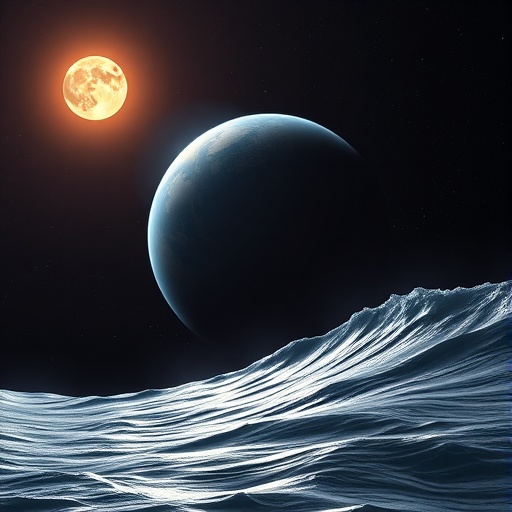
On a tranquil day on Earth, the gentlest breeze may barely disturb the glassy surface of a lake. Yet, on Saturn’s imposing moon Titan, that very same mild wind can summon towering waves reaching ten feet in height. This striking revelation emerges from a groundbreaking wave model developed by an interdisciplinary team of scientists at the Massachusetts Institute of Technology (MIT) that comprehensively simulates wave dynamics across varying planetary environments. This model marks a dramatic leap from Earth-centric views by enabling precise predictions of wave behaviors across a range of planetary bodies with diverse atmospheres, gravitational forces, and fluid compositions.
The innovative model, aptly named “PlanetWaves,” integrates fundamental parameters such as gravitational acceleration, atmospheric pressure, and the physical properties of surface liquids—including density, viscosity, and surface tension—to capture the nuanced interplay that governs wave formation. Unlike previous approaches that typically considered only gravity, this model incorporates the complex rheology of different liquids, allowing it to simulate wave generation from the initial “first puff” of wind to fully developed wave states on alien lakes and seas.
Testing PlanetWaves against Earth data, researchers employed a rich dataset of wave measurements collected over two decades on Lake Superior. The model successfully replicated the threshold wind speeds required to produce ripples and waves, as well as their growth patterns with increasing wind velocity, thereby validating its robustness and fidelity in terrestrial contexts.
Extrapolating beyond Earth, the team applied the model to Titan’s hydrocarbon-rich lakes, a unique environment known from NASA’s Cassini mission radar observations. Titan’s low gravity—only about 14% of Earth’s—and dense, nitrogen-rich atmosphere combine with liquid methane and ethane to create a setting where even soft winds can generate massive, slow-moving waves several meters high. Such dynamics starkly contrast with typical Earth lakes, where similar wind speeds would produce barely perceptible ripples, highlighting how different planetary parameters can invert intuitive expectations of wave behavior.
Titan’s peculiar wave environment suggests potential challenges and opportunities for future exploratory missions. Instruments designed for Earth-like waves might face unexpected mechanical stresses when deployed in Titan’s lakes, emphasizing the necessity of engineering spacecraft with adequate resilience informed by predictive planet-specific wave modeling. Understanding these wave forces is critical for landing stability and operational longevity of probes in these alien aqueous environments.
The researchers also ventured into ancient Mars, examining how its waning atmosphere would have influenced waves in erstwhile water basins such as the Jezero Crater. As atmospheric pressure decreased over geological timescales, the energy threshold for wind to generate waves rose correspondingly, implying that Mars’ coastal morphologies evolved under dynamic wave regimes that weakened and disappeared, potentially reshaping sediment distribution patterns and shoreline features.
Extending the inquiry to exoplanets, PlanetWaves offers unprecedented predictive power. For example, on LHS1140b, a super-Earth with stronger gravity, the model forecasts subdued wave action due to the planet’s enhanced gravitational binding, despite the presence of liquid water. Conversely, on Kepler 1649b—an exo-Venus with lakes rich in sulfuric acid—the increased fluid density demands considerably stronger winds for wave initiation than Earth, painting a picture of inert surfaces where only extreme weather might induce surface agitation.
Perhaps most remarkably, on the fiery lava world 55-Cancri e, featuring hypothesized oceans of molten rock, the model predicts a harsh environment where hurricane-force winds barely nudge the viscous, dense liquid surface to produce centimeter-scale waves. This finding challenges conventional wisdom about “lava oceans” as violently turbulent bodies and introduces nuanced complexities in the interaction between planetary gravity, liquid density, and atmospheric forces.
These planetary insights carry profound implications not only for understanding alien hydrology but also for interpreting landscape evolution and sedimentary processes. The relative paucity of delta formations on Titan, despite an abundant river network, presents a geological puzzle that wave dynamics might help solve: gentle winds producing sizeable waves could suppress sediment settling and delta formation, altering fluvial-coastal interactions in unforeseen ways.
By bridging oceanography, planetary science, and fluid mechanics, the PlanetWaves model ushers in a new era of comparative planetology. Its capability to simulate wave genesis and propagation across diverse conditions expands the horizons of planetary surface process understanding, feeding back into mission planning, remote sensing interpretation, and theoretical frameworks on atmosphere-liquids-solid interactions on extraterrestrial surfaces.
The team, spearheaded by MIT scientists including Una Schneck and Taylor Perron, continues refining the model toward even broader applications, aspiring to integrate wave-current interactions and variable atmospheric phenomena. Supported by NASA and the National Science Foundation, this research represents a profound stride in decoding the dynamic landscapes shaping worlds beyond our own.
As humanity contemplates missions to Titan’s enigmatic lakes or explores exoplanetary oceans through telescopic observations, models like PlanetWaves will be indispensable. They not only sharpen scientific understanding but also ensure the design of robust exploration technologies capable of withstanding the peculiar yet powerful forces sculpting alien shorelines.
This fusion of Earth-based data with sophisticated computational simulations paves the way for comprehending waves as universal agents of geological and fluid phenomena, transcending their familiar Earthly context and revealing the diverse vitality of planetary surfaces across the cosmos.
Web References:
http://dx.doi.org/10.1029/2025JE009490
Cite Scienmag News
Violet Maxwell. (April 15, 2026). Waves Behave Uniquely on Different Planets: New Insights. Scienmag. https://scienmag.com/waves-behave-uniquely-on-different-planets-new-insights/
Violet Maxwell. "Waves Behave Uniquely on Different Planets: New Insights." Scienmag, 15 April 2026, https://scienmag.com/waves-behave-uniquely-on-different-planets-new-insights/. Accessed 3 September 2026.
Violet Maxwell. "Waves Behave Uniquely on Different Planets: New Insights." Scienmag. April 15, 2026. https://scienmag.com/waves-behave-uniquely-on-different-planets-new-insights/


