


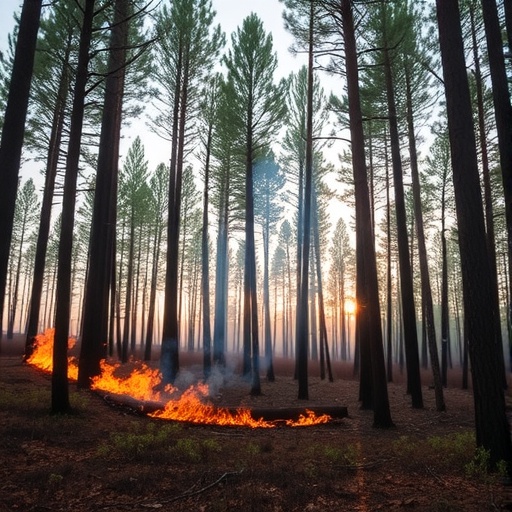
In the evolving landscape of boreal forest management, a recent groundbreaking study from Eastern Finland has unveiled potent strategies to harmonize commercial forestry and biodiversity conservation. Through a meticulous, landscape-scale experiment, researchers have demonstrated that the integration of prescribed burning with thoughtful tree retention fosters robust natural regeneration of pivotal boreal species, notably Scots pine and birch. This synergy not only maintains but in some cases surpasses commercial regeneration benchmarks, suggesting a paradigm shift in sustainable forest practices.
The boreal forest, sprawling across the northern latitudes, is a complex ecological tapestry susceptible to the impacts of intensive forestry operations. Traditional clear-cutting methods, while economically advantageous, often impair natural regenerative dynamics and biodiversity. Contrastingly, the application of prescribed burning—controlled fires set under specific conditions—mimics natural disturbance regimes, invigorating seedling establishment and nutrient cycling. This Finnish study rigorously assessed how combining such fire disturbances with varying levels of green tree retention influences forest recovery over an 11-year period.
Spanning 24 well-distributed sites across the Ilomantsi and Lieksa regions, each ranging between three and five hectares, the experiment deftly balanced burnt and unburnt conditions alongside diverse harvesting intensities. The treatment regimes included clear-cut areas devoid of retention, sites retaining moderate volumes of mature trees (10 m³/ha and 50 m³/ha), and uncut reference patches, providing a comprehensive matrix to evaluate regeneration trajectories. Researchers systematically recorded key metrics such as seedling density, height, diameter, and health, facilitating nuanced insights into species-specific responses post-disturbance.
Results unequivocally indicated that prescribed burning, when coupled with tree retention, catalyzes the natural regeneration of pioneer species like Scots pine (Pinus sylvestris) and silver birch (Betula pendula). These species displayed vigorous growth across the treated plots, underscoring their adaptation to fire-mediated succession pathways. In stark contrast, the late-successional Norway spruce (Picea abies) favored unburnt areas, particularly those where mature trees persisted after harvesting, exemplifying differential species resilience and succession timing in boreal forests.
Intriguingly, the study revealed that protected areas subjected solely to prescribed burning, without harvesting interventions, exhibited sparser and smaller seedling cohorts compared to managed zones. This phenomenon hints at the complex interplay between disturbance type, seed source availability, and regeneration speed, with implications for forest age structure and habitat heterogeneity. Such findings advocate for a balanced approach, leveraging disturbance mimicry alongside retention to optimize biodiversity outcomes without compromising regeneration rates.
The practical implications of this research are profound. Augmenting retention levels during harvesting preserves vital seed sources and habitat continuity, while prescribed burning rejuvenates soil properties and substrate conditions favorable for seedling establishment. Furthermore, reducing mechanical site preparation—commonly involving soil scarification—minimizes disturbances that could otherwise hamper seedling root development and soil microbiome stability. Collectively, these interventions recalibrate forest management towards ecologically attuned practices.
Economically, the integration of prescribed burning and increased tree retention presents a trade-off, as burning entails additional costs and retention limits immediate timber harvest volumes. However, these expenditures can be offset by the enhanced natural regeneration rates obviating costly artificial planting and soil preparation. This naturalistic approach leverages ecological processes to sustain commercial objectives, reflecting an adaptive management ethos suited for the intensively logged Fennoscandian boreal forest.
The broader ecological significance of these findings cannot be overstated. Boreal forests constitute critical global carbon sinks and harbor diverse biota, including species threatened by habitat homogenization and forestry-induced changes. By fostering diversified age structures and natural regeneration dynamics through these management innovations, the study supports resilient forest ecosystems capable of withstanding climatic and anthropogenic pressures.
Notably, the 11-year post-treatment monitoring timeframe provides a robust temporal lens to discern medium-term regeneration trends, affording forest managers empirical evidence to justify policy shifts. Longitudinal data are paramount in adaptive forest management, allowing strategies to evolve in response to observed ecological outcomes and changing environmental contexts.
The collaborative research, helmed from the University of Eastern Finland, represents a model of landscape-scale experimental forestry, combining rigorous field protocols with practical relevance. Such studies bridge the gap between ecological theory and operational forestry, offering actionable insights for practitioners aiming to reconcile timber production and biodiversity conservation.
Moving forward, the study advocates for scaling these integrated practices across boreal forests, accompanied by ongoing monitoring to refine understanding of species-specific responses under varying climate regimes. Additionally, enhancing stakeholder engagement and economic incentives will be crucial to mainstream prescribed burning and retention-oriented silviculture.
This research heralds an exciting chapter in boreal forest management, where ecological nuance informs sustainable timber harvests, biodiversity objectives are met, and natural regeneration processes are revitalized. It exemplifies the transformative potential of blending traditional knowledge of disturbance ecology with modern forestry, creating landscapes that are both productive and resilient for generations to come.
News Publication Date: 7-Apr-2026
Web References:
DOI: 10.1016/j.foreco.2026.123765
Cite Scienmag News
Alan Morgan. (April 15, 2026). Prescribed Fire and Retention Forestry Together Enhance Natural Tree Regeneration. Scienmag. https://scienmag.com/prescribed-fire-and-retention-forestry-together-enhance-natural-tree-regeneration/
Alan Morgan. "Prescribed Fire and Retention Forestry Together Enhance Natural Tree Regeneration." Scienmag, 15 April 2026, https://scienmag.com/prescribed-fire-and-retention-forestry-together-enhance-natural-tree-regeneration/. Accessed 3 September 2026.
Alan Morgan. "Prescribed Fire and Retention Forestry Together Enhance Natural Tree Regeneration." Scienmag. April 15, 2026. https://scienmag.com/prescribed-fire-and-retention-forestry-together-enhance-natural-tree-regeneration/


