


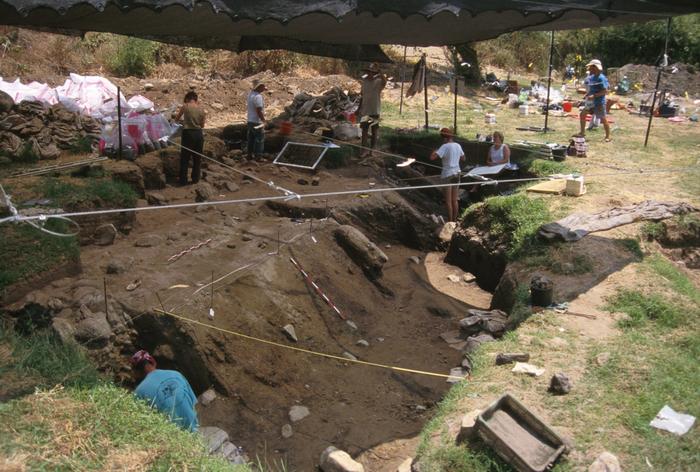
In a groundbreaking study shedding light on early human behavior nearly 800,000 years ago, researchers have unveiled compelling evidence that Acheulian hominins at the Gesher Benot Ya’aqov (GBY) site in northern Israel not only mastered fire use but employed a highly pragmatic and ecologically attuned strategy in procuring firewood. This discovery revolutionizes our understanding of how early humans interacted with their environment, exposing a nuanced relationship between resource availability and settlement choices during the Middle Pleistocene.
The GBY site, nestled along the ancient shores of paleo–Lake Hula, offers a rare archaeological tapestry—a continuity of human activity across more than twenty stratified layers. These layers, dating back to the Acheulian period, represent repeated occupation by hunter-gatherer groups who demonstrably relied on fire as a central element of their daily lives. The exceptional conditions at GBY have preserved numerous artifacts and ecofacts, including stone tools fashioned from diverse lithic materials like flint, basalt, and limestone, alongside faunal remains and plant residues that collectively narrate a story of sophisticated subsistence strategies.
Central to this narrative is the habitual use of fire, first identified decisively at the site by earlier excavations led by Prof. Nira Alperson-Afil. The hearths at GBY provide evidence of spatial organization whereby activities such as tool production, social interaction, and food preparation revolved around persistent fire use. However, until recently, the origins of the fuel sustaining these fires were less understood, particularly regarding the hominins’ selection and procurement behaviors for firewood.
The recent study, published in Quaternary Science Reviews, adopts a cutting-edge microscopic charcoal analysis to paint an unprecedented paleoenvironmental portrait. Examining 266 well-preserved charcoal fragments from a single occupational stratum dating approximately 780,000 years ago, the researchers have decoded the botanical signatures captured in these carbonized remnants. This assemblage comprises ash, willow, grapevine, olive, oak, pistachio, oleander, and notably pomegranate—the earliest known stratigraphic evidence of this fruit tree in the Levantine archaeological record.
This botanical diversity revealed from charcoal contrasts starkly with other botanical remains at GBY, such as uncharred seeds and fruits, suggesting that firewood gathering encompassed a wider environmental spectrum than food collection did. Such findings imply that while early humans may have been selective in consuming certain plants, their approach to fuel collection prioritized practicality and environmental availability.
Strikingly, the researchers infer that rather than harvesting wood from specifically targeted tree species, GBY hominins primarily utilized driftwood naturally deposited along the lakeshore. Such driftwood, transported and accumulated by water currents, would have formed an easily accessible and renewable fuel source. The charcoal composition closely matches the wood species prevalent in this setting, supporting this thesis of opportunistic, yet strategically efficient, fuel use.
The ecological context painted by this study is one of a mosaic landscape—a rich interface of wet lakeshore vegetation intertwined with open Mediterranean woodland. This heterogeneous environment not only provided a diverse range of edible plants and prey species but also created optimal conditions for sustained fire use, reinforcing the idea that hominins selected their settlement locales in part because of reliable access to resources essential for fire maintenance.
Moreover, spatial analyses indicate dense concentrations of charcoal overlapping with fish remains, particularly the distinctive teeth of large carp species. Such co-localization is compelling direct evidence for the controlled use of fire in cooking aquatic resources—a behavior reflecting intricate cognitive planning and resource exploitation nearly 800 millennia ago.
These findings collectively mark GBY hominins as advanced agents in fire technology and environmental management, embedding fire deeply into their socio-economic fabric. The habitual and spatially organized use of fire delineates a cognitive leap, encompassing mastery over a critical resource and a sophisticated understanding of landscape affordances.
Interestingly, despite their evident complexity in tool manufacture and large-game hunting, the study reveals a level of pragmatism in firewood acquisition; rather than engaging in selective harvesting, the hominins demonstrated an adaptive, availability-driven approach. This distinction illustrates an evolved balance between high-order planning for certain activities and efficient opportunism in everyday fuel gathering.
This rich archaeological record enables researchers to refine theoretical models concerning early fire use and its role in hominin evolution. The data argues for fire’s central role not simply as a tool but as a driver in settlement permanence, subsistence diversification, and social cohesion during the Acheulian.
The GBY charcoal assemblage stands as a unique archive to probe the intersection of Middle Pleistocene environmental dynamics and hominin behavior. The integrated botanical, spatial, and archaeological evidence establishes a multidimensional understanding of early fire ecology, underlining the pivotal importance of locally available resources in shaping human evolutionary trajectories.
In sum, this study not only rewrites chapters of early human fire use but also amplifies the voice of ancient landscapes, showing how early humans harnessed natural cycles and resources to innovate life strategies. The enduring occupation of GBY underlines a pattern of ecological insight and adaptive resilience, which arguably laid foundations for subsequent cultural and technological evolutions in human prehistory.
Cite Scienmag News
Courtney Benton. (April 15, 2026). Ancient Charcoal Reveals New Insights into Early Human Fuel Use. Scienmag. https://scienmag.com/ancient-charcoal-reveals-new-insights-into-early-human-fuel-use/
Courtney Benton. "Ancient Charcoal Reveals New Insights into Early Human Fuel Use." Scienmag, 15 April 2026, https://scienmag.com/ancient-charcoal-reveals-new-insights-into-early-human-fuel-use/. Accessed 6 September 2026.
Courtney Benton. "Ancient Charcoal Reveals New Insights into Early Human Fuel Use." Scienmag. April 15, 2026. https://scienmag.com/ancient-charcoal-reveals-new-insights-into-early-human-fuel-use/


