


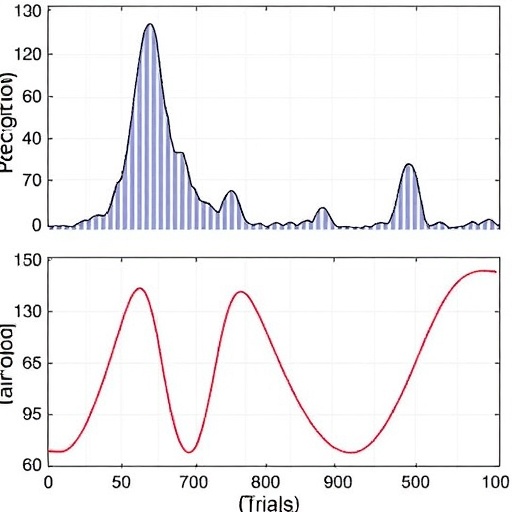
In the constantly evolving landscape of cognitive neuroscience, understanding the temporal dynamics of human perception remains a frontier of immense intrigue. Recent research led by Thomas Schoeberl and Stefan Treue published in Communications Psychology (2026) unravels a fascinating mechanism underlying how our perceptual system operates in rhythmic cycles. Their groundbreaking study, titled “Perceptual rhythms by phase-aligned perceptual performance peaks across trials,” delves into the cyclic nature of perceptual performance, revealing that our perception fluctuates in predictable, phase-aligned rhythms across multiple trials of sensory tasks. This finding not only challenges traditional continuous models of perception but also opens new avenues for exploring how the brain optimizes sensory input processing over time.
The concept that human perception might not be a steady, uninterrupted stream but instead operates through discrete rhythmic phases has been hinted at in earlier studies focusing on neural oscillations. What Schoeberl and Treue have accomplished is a rigorous empirical demonstration showing that perceptual performance peaks, or moments of heightened sensory acuity, become synchronized or phase-aligned across repeated trials. This synchronization effectively creates a perceptual rhythm—a cyclic pattern of optimal moments for sensory processing—that transcends individual sessions and participants, suggesting a fundamental property of the perceptual system.
This discovery has significant implications for cognitive neuroscience because it helps bridge the gap between observable behavior and underlying neural dynamics. Perceptual rhythms align closely with brain oscillations such as alpha and theta waves, which have long been associated with attention, memory, and conscious perception. By mapping performance peaks across trials and analyzing their phase alignment, the study provides a behavioral correlate to these neural rhythms, supporting the hypothesis that perception is temporally segmented by neuronal oscillatory activity.
The methodology employed by Schoeberl and Treue is meticulous and involves tracking participants’ perceptual accuracy across multiple repetitions of sensory tasks. These tasks required subjects to detect or discriminate stimuli presented at regular intervals while their responses were recorded with millisecond precision. Using advanced statistical tools to analyze the temporal structure of performance fluctuations, the researchers identified consistent phase patterns where participants’ accuracy peaked simultaneously across trials, highlighting a rhythmic modulation rather than random variability.
Intriguingly, the findings suggest that these perceptual rhythms are not merely epiphenomena but may confer functional advantages for sensory processing. Rhythmic modulation of perception could enable the brain to sample the environment more efficiently, optimizing the allocation of attentional resources to relevant sensory inputs at specific moments in time. This temporal structuring ensures that periods of high perceptual sensitivity are spaced optimally, potentially preventing sensory overload and enhancing signal-to-noise ratios.
Furthermore, the phase alignment of perceptual peaks indicates a level of temporal predictability that might be harnessed for improving cognitive performance or even clinical interventions. For instance, understanding these rhythms could lead to innovative protocols in neurofeedback, where rhythmic patterns of brain activity are targeted to enhance perceptual capabilities or rehabilitate deficits following injury or neurological disorders. It also raises the possibility of designing sensory stimuli or environments that are synchronized with individuals’ intrinsic perceptual oscillations to maximize engagement and learning.
One particularly fascinating aspect of the study is that perceptual rhythms appear to be remarkably stable across participants, indicating a potential universal feature of human cognition. Despite individual differences in baseline perceptual ability or attention levels, the phase alignment of performance peaks suggests a common temporal framework governing sensory experience. This universality underlines the biological basis of perceptual rhythms and hints at their evolutionary importance.
The neuroscientific community has long grappled with the question of whether perception is continuous or discrete—whether our experience of the world flows seamlessly or is composed of perceptual snapshots. The robust evidence provided by Schoeberl and Treue supports the discrete sampling model, where perception is segmented into cyclic windows of heightened sensitivity. This aligns with accumulating evidence from electrophysiological studies showing that cortical excitability and sensory processing fluctuate in rhythmic patterns that correlate with behavioral outcomes.
From a broader perspective, the interplay of neural oscillations and perceptual rhythms has implications beyond basic science. It touches upon areas such as human-computer interaction, where understanding rhythmic perceptual windows can optimize the timing of visual or auditory cues for enhanced user experience. In education, tapping into these oscillations could inform strategies that align teaching methods with students’ natural rhythms, potentially improving attention and retention.
Moreover, the rhythmicity in perception may extend to other cognitive domains such as working memory and decision-making. If these processes share similar oscillatory frameworks, it could indicate a unifying principle by which the brain organizes time-dependent functions. Schoeberl and Treue’s findings thus represent a crucial piece in the puzzle, suggesting that temporal phase alignment of performance peaks could be a generalizable mechanism across various cognitive faculties.
The implications for technology and clinical practice are equally compelling. Neuroprosthetics, brain-computer interfaces, and cognitive enhancement technologies could benefit from incorporating these rhythmic principles. Aligning device input or feedback with users’ perceptual rhythms could dramatically enhance effectiveness and user satisfaction. In psychiatric or neurological conditions characterized by disrupted oscillatory activity, therapies aiming to restore phase synchronization might improve perceptual or cognitive symptoms.
This line of research also prompts revisiting long-standing theoretical models of perception and consciousness. If perceptual experience is inherently rhythmic, theories that assume continuous consciousness may need refinement to incorporate oscillatory modulation. The temporal structuring indicated by phase-aligned peaks suggests a rhythmic scaffolding for conscious awareness, potentially explaining phenomena such as the subjective “flow” of time or the variability in perceived duration during altered states of consciousness.
The challenge ahead lies in unraveling the neural circuits and molecular mechanisms that generate and maintain these perceptual rhythms. Future studies employing combined neuroimaging and electrophysiological techniques can elucidate how different brain regions coordinate rhythmic activity to shape perception. Experimental manipulations that modulate oscillatory phase or frequency may further clarify causal relationships between brain rhythms and perceptual performance.
Schoeberl and Treue’s research thus marks a pivotal step towards a comprehensive, dynamic understanding of perception. By demonstrating that perceptual performance follows phase-aligned rhythmic cycles across trials, they provide robust evidence for the temporal segmentation of sensory processing. This insight not only advances fundamental neuroscience but also holds transformative potential for applied domains ranging from education and technology to clinical intervention.
As this new perspective on perceptual rhythms gains traction, it is poised to reshape how scientists conceptualize the flow of information through the brain and how we might leverage the natural temporal architecture of cognition to enhance human performance. The rhythmic pulse of perception, as revealed through phase alignment, invites us to consider cognition not as a static process but as a beautifully orchestrated temporal dance, woven into the fabric of our neural circuitry.
Cite Scienmag News
Glenn Wilkins. (April 15, 2026). Rhythmic Perception Peaks Aligned Across Trials. Scienmag. https://scienmag.com/rhythmic-perception-peaks-aligned-across-trials/
Glenn Wilkins. "Rhythmic Perception Peaks Aligned Across Trials." Scienmag, 15 April 2026, https://scienmag.com/rhythmic-perception-peaks-aligned-across-trials/. Accessed 3 September 2026.
Glenn Wilkins. "Rhythmic Perception Peaks Aligned Across Trials." Scienmag. April 15, 2026. https://scienmag.com/rhythmic-perception-peaks-aligned-across-trials/


