


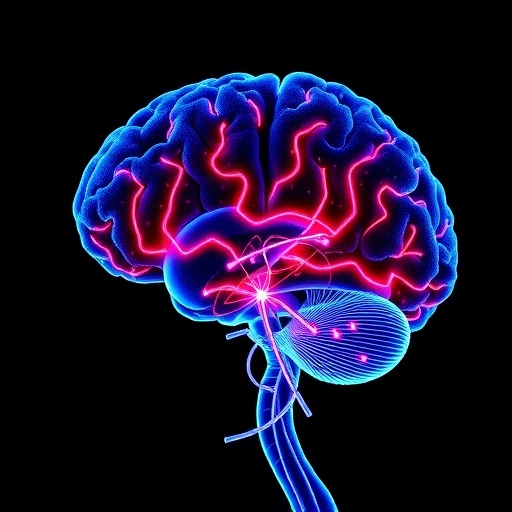
In a groundbreaking advancement poised to reshape depression treatment paradigms, neuroscientists have illuminated the intricate white matter pathways that underpin the therapeutic efficacy of transcranial magnetic stimulation (TMS). This non-invasive technique, which has emerged as a beacon of hope for patients with treatment-resistant depression, primarily targets the dorsolateral prefrontal cortex (DLPFC). Yet, until recently, the precise neural circuits through which TMS exerts its antidepressant effects remained elusive. Leveraging cutting-edge connectome modeling, researchers have now mapped the polysynaptic fiber routes linking the DLPFC to the subgenual cingulate cortex (SCC), a critical region implicated in mood regulation.
The study delves into the complex neuroanatomical highway that channels the electric signals generated by TMS, revealing that the therapeutic response hinges substantially on the length of these white matter pathways. In two independent cohorts undergoing TMS treatment for depression, shorter fiber lengths along these routes corresponded with more robust clinical improvements. This discovery offers a compelling explanation for the variability in patient outcomes observed in clinical practice and underscores the importance of personalized neuromodulation strategies.
Central to the researchers’ approach was the innovative use of connectome-based tractography, a sophisticated method that reconstructs brain-wide fiber pathways using diffusion magnetic resonance imaging (dMRI) data. By integrating these structural maps with TMS targeting sites, the team identified putative cortical and subcortical relay nodes that mediate signal propagation from the DLPFC to the SCC. Intriguingly, the identified routes traverse regions traditionally associated with executive function and emotional processing, such as the anterior cingulate cortex and insula, highlighting the multifaceted nature of the brain networks involved in mood regulation.
Importantly, the study’s findings do more than just map anatomical corridors; they provide quantifiable metrics that correlate directly with clinical efficacy. Treatment response, measured via standardized depression rating scales, improved significantly when TMS targeted brain sites connected by shorter and presumably more efficient fiber tracts to the SCC. This insight rationalizes the emerging clinical practice of functional MRI-guided neuronavigation to personalize TMS coil positioning, ushering in a new era of precision psychiatry.
The implications of this research extend beyond the clinical sphere to impact the fundamental understanding of depression as a network disorder rather than a localized brain dysfunction. The SCC has long been implicated in the pathophysiology of mood disorders, with hyperactivity in this region linked to depressive symptomatology. By demonstrating a direct route through which the DLPFC stimulation modulates the SCC, the study affirms the conceptualization of depression as a manifestation of disrupted neural connectivity patterns.
Furthermore, this connectome-driven perspective paves the way for advancements in TMS therapy protocols. Traditionally, TMS has utilized standardized targets within the DLPFC, yielding heterogeneous outcomes. The revelation that fiber pathway length influences therapeutic success suggests that individualized targeting based on patients’ unique white matter architecture may enhance response rates, reduce the number of sessions needed, and mitigate side effects.
From a methodological standpoint, the study exemplifies the power of combining neuroimaging modalities to dissect complex brain circuits. Functional MRI provided essential insights into dynamic brain activity patterns, while diffusion imaging furnished maps of structural connectivity. Their convergence operationalized a model that could predict clinical response before treatment initiation, an achievement with profound implications for treatment stratification and optimizing healthcare resources.
Equally compelling is the identification of intermediate relay regions that act as neuroanatomical waypoints along the DLPFC-SCC axis. These hubs, embedded within the limbic and paralimbic systems, represent potential targets themselves for neuromodulation or pharmacotherapy, offering avenues for multimodal interventions. Understanding their role in propagating or modulating TMS-induced activity could refine therapeutic strategies further.
The research also addresses a critical gap in the neuropsychiatric field: the mechanistic underpinnings of TMS efficacy. Despite extensive clinical use over the past two decades, the lack of precise neural models has hampered efforts to improve and personalize TMS therapy. By elucidating the white matter pathways that serve as biological conduits of stimulation effects, the study bridges fundamental neuroscience with clinical applications.
Moreover, the study’s replication across independent patient cohorts bolsters the robustness and generalizability of the findings. Consistent correlations between route length and treatment response across diverse samples highlight the potential for widespread clinical implementation of connectome-informed TMS targeting, potentially transforming standard care algorithms for depression.
Innovatively, the authors propose a neuroanatomical framework that aligns closely with functional connectivity patterns observed in resting-state fMRI studies of depression. This concordance suggests that structural pathways mapped through connectomics undergird functional dysregulation in mood disorders, integrating multiple levels of brain organization within a coherent explanatory model.
In light of these discoveries, the field stands at an exciting crossroads. Clinicians and researchers are increasingly equipped to move beyond heuristic TMS application towards data-driven, individualized neuromodulation. The convergence of advanced imaging, neuroinformatics, and clinical neuroscience heralds a future where treatments for depression are tailored not only to symptom profiles but also to the patient’s unique brain wiring.
Looking ahead, the integration of these findings with emerging technologies such as real-time neurofeedback and adaptive stimulation paradigms may further enhance therapeutic outcomes. Continuous refinement of connectome models promises to uncover additional pathways and nodes influencing mood regulation, inviting a reevaluation of current depression treatment frameworks.
Ultimately, this work marks a significant leap in our understanding of how TMS reshapes neural circuits to alleviate depression. By precisely charting the fiber highways that convey stimulation from the prefrontal cortex to emotion-processing hubs, the study offers a beacon of hope for millions struggling with mood disorders, advancing both the science and art of brain stimulation therapies.
Cite Scienmag News
Cassandra Pierce. (April 14, 2026). White Matter Pathways Boosting Dorsolateral TMS Therapy. Scienmag. https://scienmag.com/white-matter-pathways-boosting-dorsolateral-tms-therapy/
Cassandra Pierce. "White Matter Pathways Boosting Dorsolateral TMS Therapy." Scienmag, 14 April 2026, https://scienmag.com/white-matter-pathways-boosting-dorsolateral-tms-therapy/. Accessed 4 September 2026.
Cassandra Pierce. "White Matter Pathways Boosting Dorsolateral TMS Therapy." Scienmag. April 14, 2026. https://scienmag.com/white-matter-pathways-boosting-dorsolateral-tms-therapy/


