


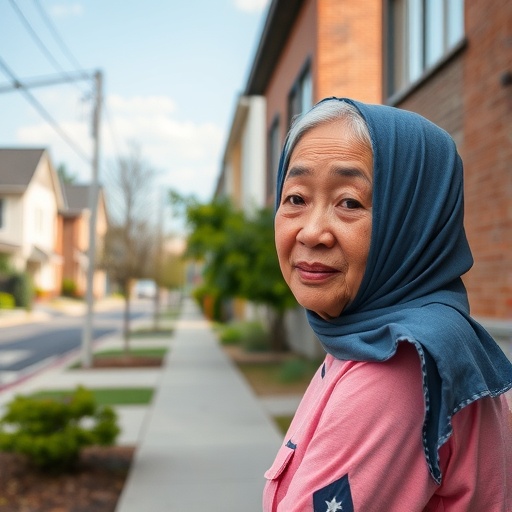
In a groundbreaking longitudinal study, researchers from Rutgers University have unveiled compelling evidence that neighborhood environments profoundly influence cognitive health among older Chinese immigrants. The study, recently published in the esteemed journal Social Science & Medicine, evaluated the impact of community amenities, services, and infrastructure on cognitive decline, offering new insights into how “cognitively supportive” neighborhoods may serve as critical buffers against mental deterioration in aging populations.
This study leveraged data from the Population Study of Chinese Elderly, a comprehensive survey encompassing 2,763 Chinese immigrants aged 60 and above residing in the Greater Chicago area. The researchers focused on examining how various neighborhood resources—ranging from museums and libraries to healthcare services and digital access—interact with cognitive aging processes in this distinct and rapidly growing U.S. demographic segment. Data driven by this extensive cohort enabled an intricate analysis correlating local environmental factors with longitudinal cognitive outcomes.
One of the central findings of this research was that while the initial cognitive performance of participants showed no significant association with neighborhood conditions at baseline, longer-term observations revealed a markedly slower rate of cognitive decline among those living in neighborhoods endowed with higher levels of cultural, social, and healthcare resources. This suggests that the environment’s capacity to sustain mental stimulation and social engagement plays a pivotal role in mitigating age-related cognitive deterioration.
Yanping Jiang, lead author and assistant professor at Rutgers Robert Wood Johnson Medical School, emphasized the nuanced relationship between locale and cognitive health. According to Jiang, the presence of cultural institutions and community infrastructure promotes continuous mental and physical activity, which are known protective factors against dementia and other neurodegenerative diseases. Such supportive settings foster not just cognitive resilience but also enhanced psychosocial well-being among elderly immigrants.
A particularly innovative aspect of the study was the development of the “Cognability Neighborhood Index,” a multi-dimensional metric quantifying a neighborhood’s potential to support cognitive health. This index incorporated diverse variables including the density of museums, recreational centers, educational organizations, availability of parks and public transportation, health services, road networks, and broadband internet access. By integrating these features, the index operationalizes the concept of cognitive affordances at the community level.
Statistical analyses controlling for confounding factors such as age, sex, education, marital status, socioeconomic status of the neighborhood, and duration of residence confirmed that individuals residing in neighborhoods with elevated Cognability scores experienced significantly reduced cognitive decline trajectories. Importantly, this protective effect persisted even after adjusting for a comprehensive array of individual and environmental variables, underscoring the robustness of neighborhood influences.
Not all amenities contributed equally to cognitive preservation, however. The presence of museums and libraries, alongside proximity to healthcare services, stood out as particularly influential. These institutions presumably facilitate sustained intellectual engagement and timely medical attention, both of which are crucial in delaying or managing cognitive impairments. This granular understanding opens new avenues for targeted public health interventions focusing on cultural and healthcare accessibility.
The implications of this study extend beyond the Chinese immigrant population. Alzheimer’s disease and related dementias, which currently affect more than 55 million people worldwide, are increasingly recognized as complex conditions influenced by a confluence of genetic, lifestyle, and environmental factors. Modifiable risk factors, particularly those shaped by neighborhood characteristics, are gaining recognition as viable targets to curb the growing societal burden posed by these disorders.
Moreover, older immigrant populations often encounter unique barriers—including linguistic challenges, cultural isolation, and limited mobility—that amplify their dependence on local amenities. By highlighting the specific needs of these groups within urban ecosystems, the research underscores the imperative for culturally sensitive urban planning and equitable distribution of communal resources to foster cognitive health equity.
This research thereby advocates for policy initiatives and community planning strategies aimed at enhancing neighborhood infrastructure that supports cognitive vitality. Investments in culturally accessible cultural institutions, comprehensive healthcare facilities, and digital connectivity emerge as promising avenues to cultivate environments conducive to healthy aging, particularly in underserved and diverse communities.
The interdisciplinary team responsible for this impactful study includes notable collaborators from Rutgers Institute for Health, the University of Colorado Boulder, and the University of Pittsburgh. Their combined expertise enabled a holistic exploration of how sociocultural and infrastructural elements intersect to shape cognitive aging outcomes in immigrant elders.
In summary, this pioneering study from Rutgers redefines our understanding of cognitive aging by anchoring it within the lived experience of neighborhood environments. These findings amplify calls for integrative approaches that blend healthcare, urban development, and social policy to transform neighborhoods into hubs of cognitive preservation and enrichment. As demographic shifts continue to increase the proportion of older immigrants in metropolitan areas, such insights are invaluable for securing healthier futures for aging populations globally.
News Publication Date: 26-Mar-2026
Web References:
- Study Publication: https://www.sciencedirect.com/science/article/pii/S0277953626002996
- Alzheimer’s Association: https://alz-journals.onlinelibrary.wiley.com/doi/10.1002/alz.13809
- Population Study of Chinese Elderly: https://pubmed.ncbi.nlm.nih.gov/25378444/
Cite Scienmag News
Ophelia Keating. (April 13, 2026). How Neighborhood Amenities and Infrastructure Can Help Slow Cognitive Decline in Older Immigrants. Scienmag. https://scienmag.com/how-neighborhood-amenities-and-infrastructure-can-help-slow-cognitive-decline-in-older-immigrants/
Ophelia Keating. "How Neighborhood Amenities and Infrastructure Can Help Slow Cognitive Decline in Older Immigrants." Scienmag, 13 April 2026, https://scienmag.com/how-neighborhood-amenities-and-infrastructure-can-help-slow-cognitive-decline-in-older-immigrants/. Accessed 5 September 2026.
Ophelia Keating. "How Neighborhood Amenities and Infrastructure Can Help Slow Cognitive Decline in Older Immigrants." Scienmag. April 13, 2026. https://scienmag.com/how-neighborhood-amenities-and-infrastructure-can-help-slow-cognitive-decline-in-older-immigrants/


