


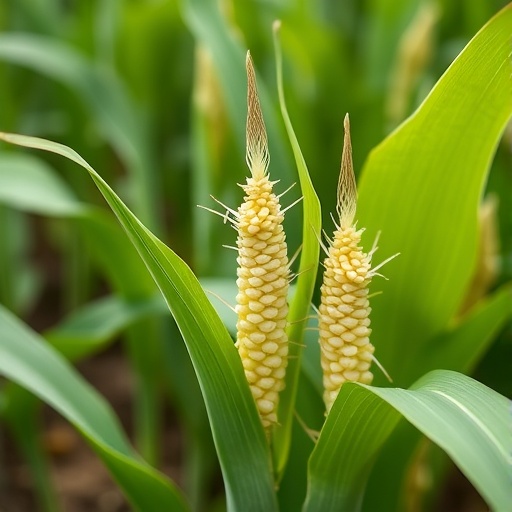
In a groundbreaking advancement for agricultural biotechnology, a team of researchers from China has successfully harnessed the power of CRISPR/Cas9 cytosine base editing to generate a novel sweet maize variety, termed sh2isu1, in a single step. This leap forward signifies an innovative departure from conventional breeding methods that have long relied on natural mutations accumulated over decades. Traditionally, sweet corn varieties depended on a limited germplasm pool, restricting genetic diversity and improvement potential. The introduction of a precision gene-editing system now paves the way for rapid, efficient, and targeted development of maize with enhanced qualities.
Sweet maize, often revered as the “King of fruits and vegetables,” owes its reputation to its rich composition of polysaccharides, dietary fibers, essential trace elements, vitamins, and linoleic acid, making it a nutritionally dense food source. Beyond its culinary appeal, these nutritional attributes contribute to its increasing demand worldwide. However, existing sweet corn varieties have faced obstacles in achieving optimized sweetness levels, texture, and shelf life simultaneously. The revolutionary approach taken by this research team addresses these challenges head-on by utilizing a cytosine base editor (CBE), a sophisticated modification of the CRISPR/Cas9 system designed to perform precise single-base conversions without introducing double-strand breaks.
The researchers focused their efforts on a maternal inbred line known as Jing 724, the maternal progenitor of the commercially successful Jingke 968 variety widely cultivated across China. By employing CBE technology in this elite genetic background, they engineered a targeted single-nucleotide modification within the sh2 (shrunken2) gene. This locus is pivotal in controlling starch biosynthesis in maize kernels, directly affecting sweetness and texture attributes. The base editing promoted specific cytosine-to-thymine transitions, thereby generating the sh2isu1 allele which confers improved phenotypic traits.
One of the standout features of the newly developed sh2isu1 sweet maize is its markedly enhanced sweetness profile, overcoming limitations inherent in conventional sweet corn lines. The edited plants demonstrate a finer balance of sugar accumulation and starch reduction, leading to a more appealing gustatory experience. Importantly, these improvements do not compromise kernel integrity or plant vitality, highlighting the precision and efficacy of the base editing approach. The textural qualities are also optimized, yielding kernels with increased tenderness and reduced graininess, characteristics highly desirable for fresh consumption.
Beyond sensory enhancements, the sh2isu1 genotype exhibits extended shelf life compared to traditional sweet corn varieties. This augmentation is critical in mitigating losses caused by suboptimal storage conditions, transportation delays, and supply chain interruptions. Enhanced durability allows the sweet maize to traverse longer geographical distances without significant degradation, opening new logistical possibilities for producers and retailers alike. Furthermore, improved shelf life addresses concerns related to extreme weather events and scheduling disruptions during planting and harvesting seasons.
The innovation aligns well with contemporary consumer preferences emphasizing natural, safe, and minimally processed food products. Because the CRISPR/Cas9 cytosine base editing method induces specific nucleotide changes without incorporating foreign DNA, the resulting maize can be considered non-transgenic. This classification potentially circumvents regulatory hurdles often associated with genetically modified organisms (GMOs) and promotes broader market acceptance. Additionally, these edited lines integrate seamlessly into existing agricultural practices, requiring no major adjustments to cultivation, harvest, or processing protocols.
From a broader perspective, the use of base editing significantly accelerates the breeding cycle. Traditional breeding methods for specialty maize types typically span several years, often extending beyond a decade for stable trait fixation. In contrast, the CRISPR-mediated single-step editing enables the rapid conversion of elite lines within one to two years, offering breeders an unprecedented tool to respond swiftly to evolving market demands and environmental pressures. The ability to stack multiple favorable alleles through sequential editing further empowers the creation of nutritionally superior and diversified maize varieties.
The researchers carefully validated the stability and efficacy of the sh2isu1 allele across generations, affirming that the introduced mutation is heritable and does not confer undesired pleiotropic effects. Comprehensive molecular analyses, including sequencing and phenotypic characterization, confirmed precise editing at the targeted site and absence of off-target alterations. Such rigorous evaluation reinforces the potential for commercial deployment of the edited sweet maize germplasm.
This development underscores the transformative impact of gene-editing technologies in the realm of crop improvement. By transcending the constraints of natural variation, scientists can now tailor crops at the nucleotide level to enhance quality traits, resilience, and nutritional value. The integration of cytosine base editors represents a significant refinement over earlier CRISPR nucleases, offering enhanced specificity and reduced genotoxicity. This precision breeding toolkit is poised to revolutionize the future of sustainable agriculture.
Moreover, the sh2isu1 project exemplifies the synergistic relationship between molecular biology and agricultural sciences, fostering innovative solutions to global food security challenges. The capacity to develop high-quality specialty maize varieties that cater to diverse consumer demands—ranging from taste and texture to shelf stability—holds promise not only for domestic markets but also for international trade expansion. This advancement contributes to strengthening food systems by reducing post-harvest losses and improving nutrient availability.
The significance of this work was recently published in the Journal of Integrative Agriculture, highlighting the scientific community’s growing recognition of gene editing as a cornerstone of modern crop breeding. The interdisciplinary team credits collaborative support from various Chinese governmental science foundations, emphasizing the role of sustained funding in driving innovation. Looking ahead, integrating additional molecular tools and high-throughput phenotyping methods may further enhance the scope and efficiency of specialty maize development.
In conclusion, the one-step generation of the sh2isu1 sweet maize via CRISPR/Cas9 cytosine base editing presents an elegant and practical pathway for producing next-generation specialty crops. Its multifaceted benefits—ranging from sensory improvement, nutritional enrichment, extended shelf life, to regulatory compatibility—mark it as a milestone achievement in agricultural biotechnology. As gene-editing technologies continue to mature, their application will undoubtedly broaden, offering scalable and robust solutions for the evolving challenges of global agriculture.
Cite Scienmag News
Juliet Wilcox. (April 13, 2026). One-Step Creation of SH2ISU1 Sweet Maize Using CRISPR/Cas9 Cytosine Base Editing. Scienmag. https://scienmag.com/one-step-creation-of-sh2isu1-sweet-maize-using-crispr-cas9-cytosine-base-editing/
Juliet Wilcox. "One-Step Creation of SH2ISU1 Sweet Maize Using CRISPR/Cas9 Cytosine Base Editing." Scienmag, 13 April 2026, https://scienmag.com/one-step-creation-of-sh2isu1-sweet-maize-using-crispr-cas9-cytosine-base-editing/. Accessed 3 September 2026.
Juliet Wilcox. "One-Step Creation of SH2ISU1 Sweet Maize Using CRISPR/Cas9 Cytosine Base Editing." Scienmag. April 13, 2026. https://scienmag.com/one-step-creation-of-sh2isu1-sweet-maize-using-crispr-cas9-cytosine-base-editing/


