


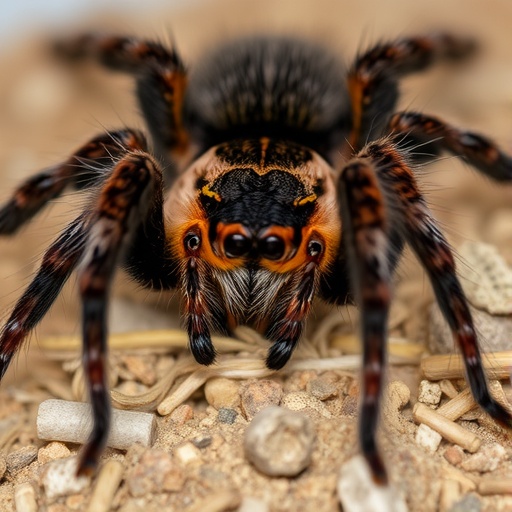
In a groundbreaking study exploring the neural and behavioral complexities of arachnids, researchers Alireza Zamani of the University of Turku and independent scholar Rick C. West have unveiled new insights into the spatial orientation capabilities of tarantulas across diverse habitats in the Americas. Previously underestimated, these formidable spiders display a repertoire of navigational strategies that hint at advanced cognitive functions, challenging longstanding assumptions about invertebrate learning and memory.
Spatial orientation—the capacity to perceive and maneuver within three-dimensional space—is a fundamental survival skill often attributed to vertebrates. However, Zamani and West’s meticulous field observations demonstrate that tarantulas, irrespective of their ecological niches—be they arboreal dwellers or subterranean burrowers—exhibit purposeful navigation behaviors that strongly suggest the involvement of memory and environmental learning mechanisms. Such findings not only broaden our understanding of arachnid intelligence but also illuminate evolutionary pathways of cognition in invertebrates.
Field data collected from populations spanning North and South America illustrate that tree-dwelling tarantulas routinely embark on nightly excursions from their retreats to prey-rich zones located up to two meters away. These predation sites, often illuminated artificially, attract an abundance of flying insects. Remarkably, despite the temporal and spatial separation, the tarantulas consistently return to their original refuges, indicative of spatial memory usage—a trait once thought rare among spiders.
Among the more intriguing behavioral adaptations observed were those of burrow-living species who, under dry seasonal conditions, were seen abandoning their typical foraging grounds on the forest floor to exploit arboreal prey resources. This seasonal niche flexibility underscores an ecological versatility, suggesting an ability to integrate environmental cues and internal states to modify foraging strategies. Such plasticity in behavior is a hallmark of cognitive sophistication and adaptive learning processes.
In flood-prone lowland habitats, ground-dwelling tarantulas have demonstrated the capacity to temporally shift their living quarters into shrubs or trees during periods of inundation. This adaptive migration highlights not only an acute environmental awareness but also a strategic response to ensure survival in dynamic ecosystems. This behavior emphasizes how external environmental stressors can precipitate complex behavioral adjustments in tarantulas.
The study also contrasts ontogenetic niche shifts—developmental stage-dependent changes in behavior—with the plastic navigational abilities observed in adult tarantulas. A particularly compelling case involves a blind cave-dwelling tarantula in Mexico, which appears to undergo a behavioral evolution during maturation: juveniles remain near fixed retreats, whereas adults exhibit less site fidelity, adopting irregular movement patterns likely linked to increased energetic demands and the pursuit of larger prey. This ontogenetic behavioral divergence illustrates the interplay between physiology, ecological demands, and cognitive adaptability.
The behavioral repertoire associated with spatial orientation encompasses rapid and direct retreat to burrows following disturbances, a phenomenon observed even in visually impaired cave tarantulas. The ability of these blind individuals to navigate effectively without visual cues indicates reliance on multisensory integration. Internal proprioceptive feedback regarding movement and orientation is likely combined with subtle environmental signals—such as vibrational, chemical, and possibly tactile cues—to facilitate precise homing behavior.
This presents a compelling argument for a neural integration model wherein tarantulas process and synthesize internal and external sensory inputs to construct a spatial map of their environment. Prior literature corroborates this notion, documenting tarantula capabilities in associative learning, maze navigation, and spatial memory retention. These cumulative data advocate for reconsideration of tarantula nervous systems as supporting behavioral flexibility beyond instinctive responses, suggesting a level of cognitive processing that enables adaptive decision-making.
Despite these promising observations, the researchers emphasize the tentative nature of cognitive interpretations. Tarantulas’ heavy reliance on silk-based and chemical cues could partially explain retreat recognition and foraging site selection without necessitating higher cognitive functions. Distinguishing between associative learning, sensory-driven behaviors, and true cognitive mapping requires further experimental scrutiny under controlled conditions to dissect these intertwined mechanisms.
The novelty and significance of this research reside in coupling extensive field observations with the theoretical framework of animal cognition. By highlighting behavioral plasticity in naturalistic contexts, Zamani and West’s work advocates for an integrated approach combining ethology, neurobiology, and ecology to unravel the complexities of arachnid spatial awareness and learning.
Ultimately, these findings open new avenues for investigating how memory and sensory integration facilitate adaptive behaviors in invertebrates. Developing controlled experimental paradigms informed by field data will be essential for understanding the neural substrates underlying such navigational competence. This multidisciplinary pursuit promises to advance our comprehension of cognition’s evolutionary origins beyond vertebrates.
Published in the peer-reviewed journal Ecology and Evolution, this study marks a milestone in arachnid biology, setting the stage for future research aimed at decoding the neural and behavioral intricacies of one of nature’s most enigmatic predatory groups. As researchers continue to peel back the layers of tarantula cognition, the broader implications extend to bio-inspired robotics, neuroethology, and conservation biology, enriching our collective appreciation of the natural world’s complexity.
News Publication Date: 30-Mar-2026
Web References: http://dx.doi.org/10.1002/ece3.73329
Keywords
Tarantula cognition, spatial orientation, arachnid behavior, neuroethology, invertebrate learning, ontogenetic niche shifts, sensory integration, adaptive foraging, environmental cues, behavioral plasticity
Cite Scienmag News
Grant Pearson. (April 10, 2026). Tarantulas Harness Learning and Memory to Navigate Food Sources and Find Their Retreats. Scienmag. https://scienmag.com/tarantulas-harness-learning-and-memory-to-navigate-food-sources-and-find-their-retreats/
Grant Pearson. "Tarantulas Harness Learning and Memory to Navigate Food Sources and Find Their Retreats." Scienmag, 10 April 2026, https://scienmag.com/tarantulas-harness-learning-and-memory-to-navigate-food-sources-and-find-their-retreats/. Accessed 3 September 2026.
Grant Pearson. "Tarantulas Harness Learning and Memory to Navigate Food Sources and Find Their Retreats." Scienmag. April 10, 2026. https://scienmag.com/tarantulas-harness-learning-and-memory-to-navigate-food-sources-and-find-their-retreats/


