


In a breakthrough that could revolutionize the treatment landscape for autoimmune disorders, a team of researchers has unveiled a novel approach for modulating enzyme activity through precisely engineered nanostructures. The investigative group led by Yan, Liu, Chen, and colleagues has demonstrated how chiral gold nanohelices can selectively regulate the activity of cyclooxygenase-2 (COX-2), a critical enzyme implicated in the inflammatory signaling cascade characteristic of rheumatoid arthritis. Their pioneering work, published in Nature Communications in 2026, introduces a concept at the intersection of nanotechnology, spintronics, and enzymology that holds promise for highly targeted, side-effect-minimizing therapeutic interventions.
Cyclooxygenases, particularly COX-2, catalyze the formation of prostaglandins, lipid mediators essential to inflammatory responses. While inhibition of COX-2 is a long-established strategy for managing inflammation and pain, current drugs often suffer drawbacks such as gastrointestinal toxicity and cardiovascular risks. The challenge has been to finely tune COX-2 activity, achieving therapeutic effects without collateral damage. This new approach leverages the phenomenon of spin selectivity in chiral nanomaterials—structures that distinguish electrons by their inherent spin orientation, a quantum property—allowing selective interaction with biological macromolecules at the nanoscale.
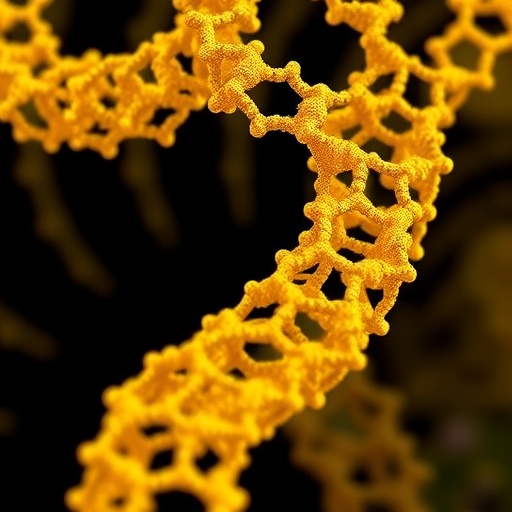
Central to the authors’ method is the synthesis of gold nanohelices that exhibit a defined chirality—essentially a “handedness”—which facilitates spin polarization of electrons. These nanohelices manipulate the electronic environment of COX-2 in a manner that directly influences its catalytic function. The team discovered that by tailoring the chirality of these gold nanostructures, they could differentially modulate enzyme activity, essentially turning it up or down with remarkable specificity. This spin-driven enantioselective regulation stands apart from conventional chemical inhibition by harnessing quantum spin effects to achieve enzyme modulation without introducing toxic small molecules.
Detailed electron spin resonance and circular dichroism spectroscopy analyses confirmed that the nanohelices impart a dominant spin orientation to electrons interacting with COX-2. Such spin-polarized electron transfer facilitated selective binding and conformational changes in the enzyme, effectively altering its catalytic efficiency. Mechanistically, the findings suggest that the spin-dependent electron interactions modulate redox states and transient intermediate formations within the enzyme’s active site, revealing a heretofore unexplored avenue for enzymatic control.
The preparation of these gold nanohelices involves a sophisticated bottom-up synthetic procedure that results in highly uniform and stable nanostructures. Utilizing seed-mediated growth with chiral capping agents, the researchers precisely control the helix pitch and diameter, parameters that are closely linked to the spin polarization effects. Subsequent physicochemical characterization by transmission electron microscopy and X-ray diffraction confirmed the helical morphology and crystallinity critical for the optical and electronic properties necessary for therapeutic application.
In vitro enzymatic assays demonstrated that specific chiral nanohelices could decrease COX-2 activity by up to 70% without affecting structurally homologous COX-1 isoforms. This high degree of selectivity underscores the potential reduction of off-target effects that often compromise current NSAID therapy. Furthermore, these nanohelices showed minimal cytotoxicity in cultured synovial fibroblasts, reinforcing their biocompatibility and safety profile.
Expanding beyond the petri dish, animal models of rheumatoid arthritis treated with the chiral gold nanohelices exhibited markedly reduced joint inflammation and cartilage degradation compared to controls. Notably, the nanohelix treatment maintained systemic homeostasis better than traditional COX-2 inhibitors, as evidenced by preserved gastric mucosal integrity and balanced cardiovascular markers. These encouraging preclinical results point toward an innovative class of enzyme regulators that circumvent common adverse effects.
The implications of this spin-based enantioselective regulation extend beyond COX-2 and rheumatoid arthritis. Given that many biological processes are mediated by enzymes sensitive to electronic and conformational cues, the paradigm of employing chiral nanostructures to modulate activity could transform drug development across numerous pathologies. Diseases with underlying oxidative stress or aberrant enzymatic dysregulation may particularly benefit from precision spintronic therapies.
The intersection of nanotechnology and spintronics in biology is a nascent but rapidly emerging field. By establishing a direct functional link between electron spin orientation and enzyme activity modulation, this study paves the way for integrating quantum physical principles into pharmacology and therapeutic design. It raises fundamental questions about the role of electron spin states in biological catalysis, an area that had previously received little attention in biochemical studies.
Future research will undoubtedly explore the scalability, delivery mechanisms, and long-term safety of chiral gold nanohelices in clinical settings. The ultimate goal will be to tailor these nanoscale devices for patient-specific therapies, potentially enabling dynamic control over pathological enzymes with external stimuli such as magnetic or optical fields. Integration with diagnostic platforms could also facilitate real-time monitoring of enzyme activity and therapeutic efficacy.
The multidisciplinary agenda encompassing synthesis chemistry, quantum physics, enzymology, and immunology showcased in this work highlights the importance of collaborative science in addressing complex medical challenges. The authors’ approach embodies how fundamental advances in material science can spur transformative innovations in therapeutics, underscoring the synergistic potential of combining quantum effects and nanomedicine.
In conclusion, Yan and colleagues’ demonstration of spin-driven, chiral gold nanohelices that remotely and selectively regulate COX-2 marks a milestone in enzyme control technology. Their findings spotlight a new dimension of enzyme modulation harnessing electron spin polarization, offering a promising strategy to devise safer and more effective treatments for rheumatoid arthritis. This research not only enriches our understanding of spin physics in biological functions but also charts a forward path for leveraging nanoscale quantum phenomena in personalized medicine.
As this cutting-edge technology progresses from bench to bedside, it could eventually supersede classical anti-inflammatory drugs, ushering in an era of enzyme-targeted therapies with unprecedented precision and minimal side effects. The advent of spin-dependent bio-nanodevices signals a revolution in how we approach the regulation of biochemical pathways, with vast implications for managing chronic inflammatory diseases and beyond.
Cite Scienmag News
Ophelia Keating. (April 10, 2026). Chiral Gold Nanohelices Target Arthritis via Spin Control. Scienmag. https://scienmag.com/chiral-gold-nanohelices-target-arthritis-via-spin-control/
Ophelia Keating. "Chiral Gold Nanohelices Target Arthritis via Spin Control." Scienmag, 10 April 2026, https://scienmag.com/chiral-gold-nanohelices-target-arthritis-via-spin-control/. Accessed 3 September 2026.
Ophelia Keating. "Chiral Gold Nanohelices Target Arthritis via Spin Control." Scienmag. April 10, 2026. https://scienmag.com/chiral-gold-nanohelices-target-arthritis-via-spin-control/


