


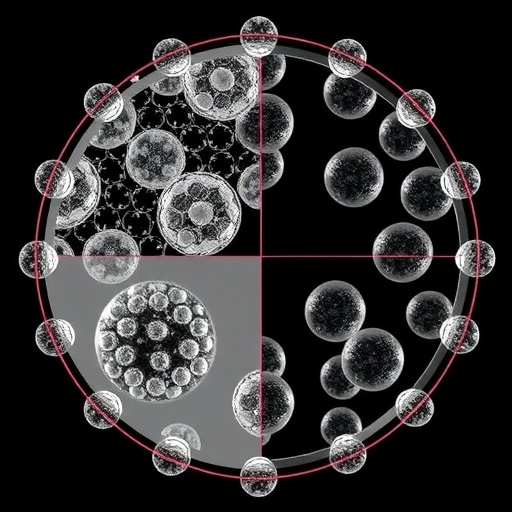
In the intricate world within living cells, the principle of phase separation emerges as a vital mechanism that orchestrates the highly organized yet dynamic cellular environment. Unlike traditional compartmentalization defined by membranes, phase separation creates distinct molecular assemblies through a delicate balance of intermolecular interactions, resulting in regions of concentrated biomolecules adjacent to more dilute phases. This process, fundamental to cellular organization, drives the formation of not only lateral membrane domains known as lipid rafts but also liquid-like condensates composed of proteins and nucleic acids. The recent review by Mangiarotti and Dimova delves deep into the interconnected roles of these phase-separated biomolecular condensates and membrane lipid domains, highlighting their complex crosstalk and implications for cell function and stability.
At its core, phase separation embodies a thermodynamically driven demixing event within the cellular milieu, generating a biphasic system. Here, the dense phase constitutes regions enriched in molecular components with robust intermolecular forces, enabling tighter packing and enhanced functional interaction networks. Conversely, the dilute phase features a lower concentration of these molecules and correspondingly weaker interactions. This binary arrangement not only contributes to the physical segregation within cells but also impacts biochemical pathways by localizing enzymes, substrates, and signaling molecules into microenvironments that optimize reaction efficiencies. Importantly, these principles apply across different spatial scales within the cell, manifesting at membrane surfaces as well as in the three-dimensional cytoplasmic or nucleoplasmic volumes.
The lipid bilayer of cellular membranes serves as a crucial interface where this phase separation paradigm takes on unique characteristics. Membranes are not passive backdrops but active platforms influencing condensate formation and behavior. The lipid composition of membranes, including cholesterol, sphingolipids, and phospholipids, governs membrane fluidity, thickness, and domain formation, all of which affect the nucleation and stability of phase-separated condensates at the membrane interface. Lateral heterogeneity within the membrane, characterized by distinct lipid and protein domains, provides a scaffold facilitating the selective clustering of molecules that can undergo phase separation, thereby influencing the spatial distribution and dynamics of condensates.
Conversely, biomolecular condensates themselves exert reciprocal effects on membrane properties and organization. As condensates form and mature at membrane surfaces, they can impose mechanical stresses or alter lipid packing, thereby modulating membrane curvature and tension. This bidirectional interplay has far-reaching consequences for cellular processes such as membrane trafficking, signaling cascades, and the establishment of cell polarity. The physical coupling between the two-dimensional membrane environment and the three-dimensional condensates enables a finely tuned regulatory network where cellular responses can be rapidly adapted to changing physiological needs or stress conditions.
One of the most compelling arenas where this interplay is evident is in cell signaling. Signal transduction pathways frequently harness phase-separated condensates for efficient molecular assembly and signal propagation. Membrane-associated receptors and scaffolding proteins often cluster into condensates upon activation, creating localized hubs that recruit downstream effectors and amplify signals. These condensates can be modulated by the lipid environment, which dictates receptor mobility and accessibility, thus influencing the initiation and duration of signaling events. Additionally, phase separation ensures signal compartmentalization, preventing crosstalk and preserving fidelity within complex signaling networks.
The assembly of tight junctions presents another vivid example where the synergy between membranes and condensates is indispensable. Tight junctions are critical for maintaining the selective barrier functions of epithelial layers, and their formation relies on the coordinated organization of proteins at the membrane interface. Recent insights reveal that phase-separated protein condensates act as organizing centers for tight junction assembly, providing structural rigidity and dynamic adaptability. Membrane lipid domains facilitate the recruitment and spatial confinement of these protein condensates, underscoring the cooperative nature of membrane-condensate interactions in establishing cellular barriers.
Stress responses within cells, particularly those induced by environmental challenges such as heat shock or oxidative stress, also exploit phase separation dynamics. Stress granules, a form of protein and RNA condensate, emerge rapidly in the cytoplasm to sequester and protect key translational machinery during adverse conditions. These condensates interface intimately with membrane-bound organelles, affecting their functionality and enabling coordinated cellular adaptations. The lipid composition of organelle membranes can influence stress granule dynamics, impacting both their formation and disassembly, thereby linking membrane biology to cellular resilience strategies.
From a mechanistic standpoint, understanding phase separation in biomolecular systems involves dissecting the molecular determinants that drive condensate formation and their modulation by lipid environments. Factors such as protein intrinsically disordered regions (IDRs), multivalent interaction motifs, and post-translational modifications govern phase behavior by tuning interaction affinities and valency. Lipid heterogeneity, membrane surface charge, and curvature further define the energetic landscape that either promotes or inhibits the assembly of condensates at membrane interfaces. Advanced biophysical techniques, including fluorescence microscopy, single-molecule tracking, and in vitro reconstitution assays, are pivotal for unraveling these complex phenomena with high spatiotemporal resolution.
The implications of phase separation in health and disease are profound, as dysregulation of condensate formation or aberrant lipid domain organization can disrupt fundamental cellular processes. Neurodegenerative diseases, cancer, and viral infections have all been linked to pathological phase behavior alterations, highlighting the therapeutic potential of targeting these biophysical processes. By modulating membrane composition or interfering with condensate-interacting proteins, it may become possible to restore cellular homeostasis or selectively disrupt harmful condensate formations, opening new avenues for intervention.
Emerging evidence also suggests that phase separation plays a role in the genesis and maintenance of cellular polarity, essential for asymmetric cell division, differentiation, and tissue morphogenesis. The spatially resolved condensation of polarity regulators at membranes establishes robust directional cues, facilitating the segregation of cellular components. Membrane lipid asymmetry and domain compartmentalization are fundamental contributors to this process, demonstrating how the intricate dance between condensates and lipid membranes orchestrates complex biological patterns.
The integration of phase separation concepts with membrane biology forms a unified framework that enhances our comprehension of cellular organization beyond traditional models. This boundary-crossing perspective fosters new hypotheses regarding the biogenesis of membraneless organelles and their interplay with established membrane-bound compartments. Such insights have the potential to revolutionize our understanding of intracellular compartmentalization, reframe fundamental cell biology paradigms, and inspire innovative technological applications including biosensing and synthetic biology.
Given the rapid expansion of the field, future research is poised to explore how cells modulate phase separation through active, energy-dependent processes. Molecular chaperones, ATP-driven remodeling enzymes, and cytoskeletal elements are increasingly recognized as crucial regulators that balance condensate assembly and dissolution, integrating mechanical and biochemical signals. Delineating how these factors interface with membrane domains could elucidate novel regulatory layers underpinning cellular homeostasis and adaptability.
In summation, phase separation across membranes and condensates orchestrates a rich tapestry of cellular organization and function. The dynamic and reciprocal interactions between biomolecular condensates and lipid domains are central to maintaining cellular fitness, influencing a myriad of processes from signal transduction to stress adaptation. As research advances, unlocking the principles governing this biophysical interplay promises not only to deepen biological understanding but also to unveil new horizons in disease treatment and bioengineering innovations. The work by Mangiarotti and Dimova stands as a pivotal contribution, charting the course for future exploration into this vibrant frontier of molecular and cellular biology.
Cite Scienmag News
Ophelia Keating. (April 9, 2026). Phase Separation Shapes Cell Membranes and Condensates. Scienmag. https://scienmag.com/phase-separation-shapes-cell-membranes-and-condensates/
Ophelia Keating. "Phase Separation Shapes Cell Membranes and Condensates." Scienmag, 9 April 2026, https://scienmag.com/phase-separation-shapes-cell-membranes-and-condensates/. Accessed 4 September 2026.
Ophelia Keating. "Phase Separation Shapes Cell Membranes and Condensates." Scienmag. April 9, 2026. https://scienmag.com/phase-separation-shapes-cell-membranes-and-condensates/


