


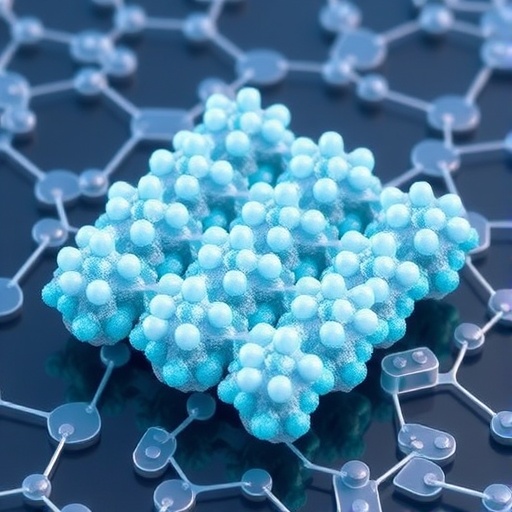
In the ongoing quest to combat climate change and promote sustainable energy solutions, the electrochemical reduction of carbon dioxide (CO2) has emerged as a pivotal technology. Among the spectrum of products obtained from CO2 reduction reactions (CO2RR), formate stands out as a valuable chemical feedstock widely utilized in various industrial processes. The challenge, however, lies in improving the efficiency of CO2RR systems, which traditionally rely on energy-intensive oxygen evolution reactions (OER) at the anode, resulting in elevated energy consumption and hindering their practical scalability.
Recently, the research group led by Professor Junfeng Xie at Shandong Normal University has made a groundbreaking breakthrough in this arena by developing a novel two-electrode system designed to enhance formate production with significantly reduced energy input. This system leverages an innovative combination of a crystalline/amorphous Bi-BiNiOx/NF cathode paired with a β-Ni(OH)2 anode, strategically replacing the conventional anodic OER with methanol oxidation reaction (MOR). This substitution not only lowers the overall energy required but also enables simultaneous formate generation at both electrodes, effectively doubling the output and offering a more sustainable approach to carbon utilization.
Electrochemical CO2RR to produce formate typically confronts the bottleneck imposed by the high overpotentials needed at the anode during OER. The OER process is kinetically sluggish and consumes significant energy, which undermines the overall efficiency of the apparatus. The innovation introduced by Professor Xie’s team resolves this issue by integrating methanol oxidation at the anode instead. Methanol oxidation is a thermodynamically more favorable reaction and proceeds at much lower overpotentials compared to OER, thus drastically decreasing the total cell voltage required for the electrolysis operation.
The core of the new system is the specially engineered Bi-BiNiOx/NF cathode, which exhibits a unique hybrid structure combining both crystalline and amorphous phases. This intricate architecture enhances the catalyst’s active sites and electrical conductivity, thereby amplifying the selectivity and reaction kinetics toward formate synthesis. Simultaneously, the β-Ni(OH)2 anode catalyzes the MOR efficiently, exhibiting outstanding stability and catalytic activity. This novel electrode pair synergistically contributes to achieving high current densities and remarkable formate production rates.
One of the standout features of this two-electrode system is the ability to co-produce formate at both electrodes. While the cathode reduces CO2 to formate, the anode oxidizes methanol to formate as well, providing a dual-pathway that maximizes the utilization of feedstocks and optimizes product output. This tandem production approach represents a paradigm shift in electrochemical CO2RR technologies, highlighting the potential for integrated bi-functional catalytic systems that improve both energy efficiency and carbon yield.
Moreover, the incorporation of methanol oxidation as the anodic reaction introduces additional sustainability benefits. Methanol is a relatively abundant and renewable feedstock, which can be derived from biomass or synthesized from CO2 itself, closing the carbon loop. This aspect aligns the new technology with circular economy principles and paves the way for scalable industrial processes that can effectively convert carbon emissions into valuable fuels and chemicals under ambient conditions.
Beyond the fundamental electrochemistry, the research team has rigorously characterized the structural and physicochemical properties of their electrodes using advanced techniques. High-resolution electron microscopy and spectroscopy analyses revealed the intimate interface between the crystalline and amorphous phases within the cathode, elucidating how this dual-phase nature contributes to enhanced catalytic performance. Electrochemical impedance spectroscopy further confirmed the lowered charge transfer resistance, demonstrating the efficacy of the electrode design in fostering rapid electron flow and reaction kinetics.
The stability and durability of the system constitute another critical dimension of this innovation. Long-term electrolysis tests demonstrated that both cathode and anode materials maintain high catalytic activity over extended periods without significant degradation. This robustness is crucial for real-world applications, where continuous operation and operational lifespan dictate the viability of electrochemical converters.
In addition to laboratory-scale experiments, the researchers have studied the reaction mechanisms underpinning the enhanced formate formation. Density functional theory (DFT) calculations and in situ spectroscopic techniques provided insights into the adsorption and activation of CO2 and methanol molecules on the catalyst surfaces. These mechanistic insights illuminate the pathways for selective formate production and guide future catalyst optimization strategies.
The implications of this research extend far beyond a single chemical reaction. The demonstrated strategy of substituting OER with MOR and achieving dual formate production could revolutionize electrochemical technologies for CO2 utilization, making them more economically competitive and environmentally sustainable. The findings advocate a holistic approach to electrolyte and electrode engineering, where the interplay between anodic and cathodic processes is optimized to overcome intrinsic limitations.
Professor Junfeng Xie’s work exemplifies the power of interdisciplinary approaches that combine materials science, electrochemistry, and catalysis engineering. By rethinking conventional reaction couples in electrolysis systems, the team has unlocked new pathways that reconcile energy efficiency with product selectivity and sustainability concerns, accelerating the transition towards a carbon-neutral future.
Moving forward, the challenge will be to scale this technology and integrate it into practical devices capable of capturing and converting industrial CO2 emissions at commercial scales. Continued research will focus on optimizing catalyst formulations, exploring alternative renewable feedstocks for the oxidation reaction, and developing reactor designs that maximize mass transport and product separation efficiencies.
In summary, the innovative two-electrode system developed by Professor Xie and colleagues represents a transformative advance in electrochemical CO2 reduction research. By cleverly replacing energy-intensive oxygen evolution with methanol oxidation and exploiting a state-of-the-art hybrid Bi-BiNiOx/NF cathode alongside a high-performance β-Ni(OH)2 anode, this technology achieves efficient, low-energy, and dual-site formate synthesis. Such advances not only enrich the scientific understanding of electro-catalytic processes but also herald promising new horizons for sustainable chemical manufacturing and carbon management.
News Publication Date: Not specified
Web References: Not specified
References: Not specified
Cite Scienmag News
Bethany Barker. (April 9, 2026). Crystalline/Amorphous Bi-BiNiOx Electrocatalyst Drives Efficient Simultaneous Formate Production from CO2 and Methanol. Scienmag. https://scienmag.com/crystalline-amorphous-bi-biniox-electrocatalyst-drives-efficient-simultaneous-formate-production-from-co2-and-methanol/
Bethany Barker. "Crystalline/Amorphous Bi-BiNiOx Electrocatalyst Drives Efficient Simultaneous Formate Production from CO2 and Methanol." Scienmag, 9 April 2026, https://scienmag.com/crystalline-amorphous-bi-biniox-electrocatalyst-drives-efficient-simultaneous-formate-production-from-co2-and-methanol/. Accessed 3 September 2026.
Bethany Barker. "Crystalline/Amorphous Bi-BiNiOx Electrocatalyst Drives Efficient Simultaneous Formate Production from CO2 and Methanol." Scienmag. April 9, 2026. https://scienmag.com/crystalline-amorphous-bi-biniox-electrocatalyst-drives-efficient-simultaneous-formate-production-from-co2-and-methanol/


