


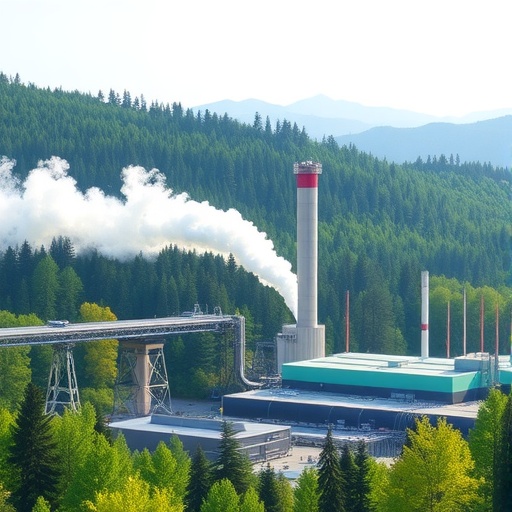
As the world intensifies its battle against climate change, the industrial sector emerges as a critical front where transformative innovation can drive substantial carbon reductions. A groundbreaking study published in Communications Earth & Environment sheds light on one of America’s most carbon-intensive industries—the pulp and paper sector—and explores the pathways through which cutting-edge green technologies might be leveraged to achieve deep decarbonization. This research offers a rigorous evaluation of adoption strategies, revealing both the opportunities and challenges inherent in transitioning a traditionally resource-heavy industry toward sustainability.
The United States pulp and paper industry, long a cornerstone of economic activity across several regions, contends with considerable environmental pressures. From the combustion of fossil fuels in manufacturing processes to the vast quantities of water and energy consumed, the sector generates significant greenhouse gas emissions. The study led by researchers Chen and Jin delves into quantifying how emergent green technologies, if adopted at scale, could drastically reduce the carbon footprint of pulp and paper production, aligning industry practices with federal and global climate targets.
A core strength of the paper is its methodical approach to evaluating the adoption of green innovations. Rather than a single-technology perspective, the study employs a systems-level analysis, integrating the potential impacts of energy efficiency improvements, electrification of heat processes, biomass and biogas utilization, and carbon capture methodologies. This multifaceted assessment acknowledges the complexity of operational retrofitting within existing plants, the necessary capital investments, and the plausible policy incentives that might accelerate adoption.
Electrification emerges as a particularly promising strategy within the analysis, given the increasing availability of renewable electricity grids. Transitioning from fossil fuel combustion to electric boilers and dryers could significantly curtail direct emissions. However, the researchers emphasize that such transitions require overcoming both technological hurdles, such as scaling industrial-scale electric heating solutions, and infrastructural challenges, including upgrades to electric supply lines and grid stability. The interplay of these factors informs the feasibility timeline outlined in the study.
Another innovation of note is the integration of bioenergy solutions. By optimizing biomass residues and converting them into energy carriers like biogas, pulp and paper mills can substitute fossil fuels with renewable feedstocks. This approach not only diminishes carbon emissions but also turns operational waste into a resource stream, embodying principles of circular economy. Yet, the study carefully points out the sustainability caveats, noting that biomass sourcing must be managed to avoid negative ecological impacts and ensure genuine carbon neutrality.
Crucially, Chen and Jin’s study interrogates the role of carbon capture and storage (CCS) technologies in the industry’s decarbonization portfolio. Given the inherent process emissions from pulping and chemical recovery operations, the deployment of CCS could seal the gap where other measures fall short. The authors model scenarios incorporating CCS retrofits and find that policy mechanisms, such as carbon pricing and subsidies, greatly influence the pace and scale at which these expensive technologies are adopted.
Policy frameworks receive significant attention throughout the research narrative. The successful diffusion of green technologies hinges not only on their technical viability but also on coherent regulatory support and market incentives. The study advocates for a combination of carbon taxes, renewable energy mandates, and investment grants tailored to catalyze early movers and offset transition risks. The interplay between federal initiatives and state-level programs is explored, highlighting how jurisdictional coordination can amplify impact.
Another layer of complexity arises from industry heterogeneity. The landscape of pulp and paper operations in the United States varies from large multinational companies to numerous smaller mills with constrained capital and technical capacity. The study’s findings underscore the importance of customizing adoption strategies, with larger firms potentially leading in technological experimentation, while smaller players may require more supportive mechanisms to participate meaningfully in the green shift.
Environmental benefits projected from aggressive adoption scenarios are profound. Beyond carbon emission reductions, cleaner processes reduce air and water pollutants, enhancing local environmental quality and public health outcomes. The researchers also anticipate economic co-benefits including job creation in green technology sectors and improved competitiveness in an increasingly eco-conscious market. These additional incentives bolster the case for industry-wide transformation.
Yet, the transition path is not without risks and uncertainties. The study carefully discusses potential bottlenecks such as supply chain constraints for critical materials, workforce retraining needs, and the temporal mismatch between technology development cycles and urgent decarbonization timelines. The authors invoke the importance of adaptive management strategies and continuous monitoring to navigate these uncertainties effectively.
Chen and Jin’s work notably integrates advanced modeling techniques. Combining life cycle assessment (LCA) with techno-economic analysis (TEA) and scenario planning, the methodology delivers an in-depth understanding of environmental impacts tied directly to economic feasibility. This holistic perspective is invaluable for policymakers and industry stakeholders who must balance ecological imperatives with financial realities.
Beyond purely technical and economic dimensions, the human factor receives thoughtful consideration. Stakeholder engagement, including labor unions, community groups, and environmental organizations, is underscored as pivotal for smooth deployment of innovations. The social license to operate and acceptance of novel processes can significantly influence investment decisions and long-term sustainability success.
Looking forward, the study advocates for continued research and development with an emphasis on real-world pilot projects and demonstrators. These efforts will validate modeled assumptions and refine technologies under operational conditions. The authors call for multi-sector collaboration spanning academia, industry, government, and civil society to build a robust ecosystem that supports ongoing innovation diffusion.
In sum, this pivotal research illuminates a clear roadmap for decarbonizing the U.S. pulp and paper industry through the strategic adoption of green innovations. By examining technological options, economic variables, policy environments, and social dynamics in an integrated manner, it offers a blueprint not only for this sector but also as a model for decarbonizing similarly complex industrial domains globally.
As pressure mounts to meet ambitious climate targets, such comprehensive studies are vital in guiding actionable change. The U.S. pulp and paper industry stands at a crossroads where innovation is both a challenge and an opportunity—an opportunity to pioneer industrial sustainability while securing economic viability in a low-carbon future. Chen and Jin’s contribution is a clarion call to transform one of America’s foundational industries into a leader of environmental responsibility.
Cite Scienmag News
Sloane Callahan. (April 9, 2026). Decarbonizing US Pulp Industry: Green Innovation Strategies. Scienmag. https://scienmag.com/decarbonizing-us-pulp-industry-green-innovation-strategies/
Sloane Callahan. "Decarbonizing US Pulp Industry: Green Innovation Strategies." Scienmag, 9 April 2026, https://scienmag.com/decarbonizing-us-pulp-industry-green-innovation-strategies/. Accessed 4 September 2026.
Sloane Callahan. "Decarbonizing US Pulp Industry: Green Innovation Strategies." Scienmag. April 9, 2026. https://scienmag.com/decarbonizing-us-pulp-industry-green-innovation-strategies/


