


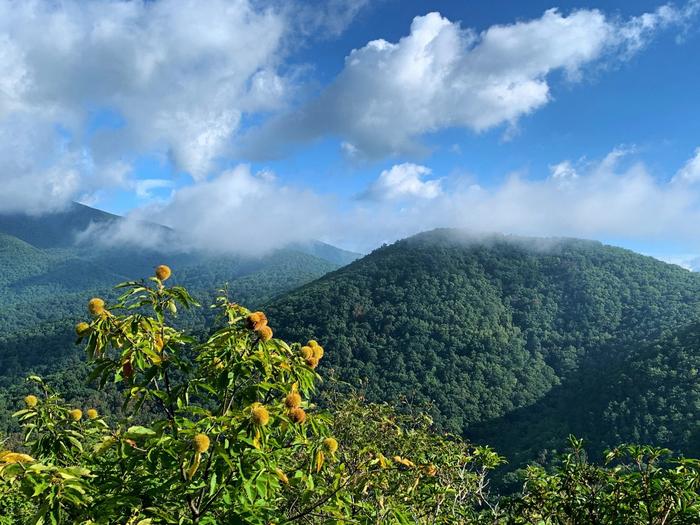
Native trees adapt to the climate and environmental conditions of their area to survive. Researchers in the College of Natural Resources and Environment in collaboration with the American Chestnut Foundation confirmed this by examining the genome of American chestnut trees sampled throughout the Appalachian Mountain range and grouping the samples according to their specific environmental region.

Credit: Photo courtesy of the American Chestnut Foundation.
Native trees adapt to the climate and environmental conditions of their area to survive. Researchers in the College of Natural Resources and Environment in collaboration with the American Chestnut Foundation confirmed this by examining the genome of American chestnut trees sampled throughout the Appalachian Mountain range and grouping the samples according to their specific environmental region.
The research, recently published in the Proceedings of the National Academy of Sciences journal, has the potential to help the foundation restore the American chestnut population and adjust breeding to the changing climate.
“To understand historical local adaptation to climate, we sequenced the genomes of many wild chestnut stump sprouts and identified relationships between the genome in these different places and the environment of those places,” said Jason Holliday, professor in the Department of Forest Resources and Environmental Conservation.
What the team found, not surprisingly, according to Holliday, was a great deal of genetic adaptation to different environments in chestnut trees. Next, team members divided the Appalachian region into three areas based on similar adaptations of the native trees — a group in the North, one in the center, and a third in the South.
Fungal blight decimated the American chestnut tree in the early 20th century, killing billions of trees and altering the life cycle of the species native to the Appalachian Mountain region. Because of chronic fungal blight infections, the species is unable to reproduce, migrate, or evolve in response to climate change. The American Chestnut Foundation has spent the last 40-years creating a genetically modified, blight-resistant species, but adaptive diversity has not been a focus until now.
“The breeding program at the American Chestnut Foundation used pollen from a variety of places in the range, so one question is, have they captured the adaptive diversity that’s present in the wild American chestnut range in a way that would allow them to develop families that are well suited for specific planting locations,” said Holliday.
Using deep learning software, researchers were able to predict the geographic origins of a particular genome sequence by training this model using trees with known origins. Results showed the foundation was doing a good job producing trees with adaptive diversity, although attention must be paid to not losing this diversity through further breeding for blight resistance.
Moving forward, this information, in addition to providing guidance for collecting and conserving more of this diversity from the three regions established by the study, can help the foundation restore specific blight resistant American chestnut families according to regions in which their genome is best matched.
Alex Sandercock, lead author for this paper, was a doctoral student in the genetics, bioinformatics, and computational biology program during the study and an Institute for Critical Technology and Applied Sciences graduate fellow.
Jared Westbrook, co-author of the paper and director of science for the American Chestnut Foundation, said Sandercock’s work developed feasible targets for how many American chestnut trees should be conserved from each of the three regional populations.
“We learned that the American Chestnut Foundation has more work to do to conserve trees from the southernmost American population, which is especially important to conserve because it is most genetically diverse and it is likely to be the best adapted to the warmer climates of the future,” said Westbrook.
Funding for this research was provided in part by the Institute for Critical Technology and Applied Sciences at Virginia Tech and the National Institute of Food and Agriculture.
Journal
Proceedings of the National Academy of Sciences
Article Title
A genome-guided strategy for climate resilience in American chestnut restoration populations
Article Publication Date
16-Jul-2024
Cite Scienmag News
Juliet Wilcox. (July 22, 2024). Genome study informs restoration of American chestnut tree. Scienmag. https://scienmag.com/genome-study-informs-restoration-of-american-chestnut-tree/
Juliet Wilcox. "Genome study informs restoration of American chestnut tree." Scienmag, 22 July 2024, https://scienmag.com/genome-study-informs-restoration-of-american-chestnut-tree/. Accessed 5 September 2026.
Juliet Wilcox. "Genome study informs restoration of American chestnut tree." Scienmag. July 22, 2024. https://scienmag.com/genome-study-informs-restoration-of-american-chestnut-tree/

