


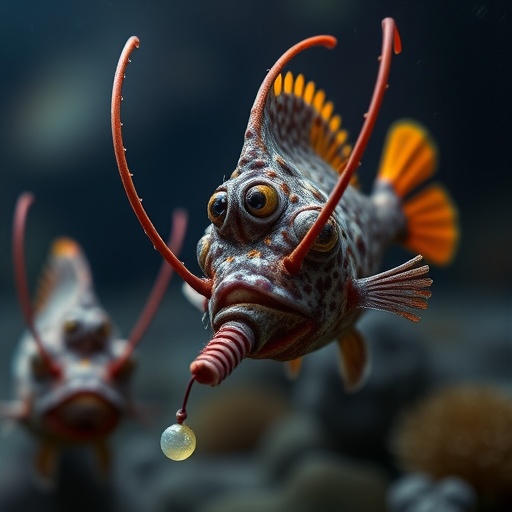
In the shadowy depths of the ocean, anglerfishes reign as one of the most captivating and enigmatic creatures, renowned for their bioluminescent lures that beckon unsuspecting prey in the abyssal dark. Popularized in mainstream culture by films like “Finding Nemo,” these bizarre fish species have intrigued scientists for decades. Recent breakthroughs from researchers at the University of Kansas have shed unprecedented light on the evolutionary intricacies of these lures, revealing a complex history of adaptation and diversification spanning tens of millions of years.
Anglerfish lures, often described as eerie fishing rods extending from their heads, are a remarkable evolutionary modification of the dorsal fin spine. This structure serves not only as a tool to attract prey but also plays an integral role in the mating rituals of deep-sea species. The University of Kansas team embarked on a comprehensive study, analyzing over 100 anglerfish species to map out the evolutionary trajectory and functional diversity of these specialized appendages. Their findings were published in the journal Ichthyology & Herpetology, providing a thorough framework that connects lure morphology, bioluminescence, and ecological niche differentiation.
Contrary to the longstanding assumption that anglerfish lures evolved solely to attract food, the new research posits a dual function—lures are instrumental in both predation and sexual communication, especially in the light-deprived environments of the deep sea. By illuminating the lure using bioluminescent capabilities, female anglerfishes not only trap curious prey but also signal their presence to male counterparts. This dual utility likely confers significant evolutionary advantages, promoting species diversification.
Tracing the origins of these lures, the investigators determined that the primitive form appeared approximately 72 million years ago in the common ancestor of today’s anglerfishes. Initially, these lures were purely motion-based, relying on subtle fluttering to entice prey. However, a transformative leap occurred during the Oligocene epoch, roughly 34 to 23 million years ago, when certain deep-sea lineages developed glowing lures. This evolutionary innovation precipitated an explosion in anglerfish diversity, as bioluminescence allowed the fish not only to manipulate prey but also to establish complex intraspecific communication.
Bioluminescence in anglerfish lures is an exquisite adaptation shaped by evolutionary pressures within pelagic and deep benthic habitats. The research highlights how lures became elongated, allowing them to extend farther from the fish’s body without illuminating the anglerfish itself, minimizing detection by prey. Morphological refinements include features akin to a “window shutter,” permitting the fish to modulate light emission patterns. Such intricate control of light likely facilitates nuanced signaling to potential mates, an advantage akin to a biological Morse code in the abyss.
The study’s methodology integrated fossil records and advanced computer modeling to infer temporal patterns in lure evolution and its correlation with ecological niches and behaviors. Specimens from natural history collections worldwide provided critical data points for phylogenetic analysis, allowing the researchers to reconstruct ancestral states and evolutionary transitions. The phylogenetic framework revealed that anglerfish species possessing bioluminescent lures exhibit higher speciation rates compared to non-luminous species, underscoring the evolutionary significance of light-based communication.
Beyond motion and light, the research unveiled a third dimension to anglerfish lures: chemical signaling. Two distinct anglerfish groups—batfishes and frogfishes—developed lures capable of releasing chemical attractants, albeit through entirely independent evolutionary events. Batfishes, existing since around 49 million years ago, utilize an innovative sliding mechanism inside their neurocranium to extend their lures and release chemicals into sandy substrates. This specialized hunting tactic involves manipulating local currents and sediment to flush out infaunal invertebrates.
Frogfishes, more recent inhabitants of marine ecosystems, about 5 million years ago, employ chemical lures suspended in current flows above the water column. These secreted substances act as olfactory beacons, luring unsuspecting prey into the striking reach of ambush predators. Although the mechanism and extent of chemical luring in these species remain poorly characterized, this discovery opens new avenues for research into chemical ecology and communication in deep-sea fishes.
A particularly exciting dimension of this research concerns the sensory adaptations of male anglerfishes. Males exhibit disproportionately large olfactory organs and eyes, traits likely driven by the need to detect faint bioluminescent signals and chemical cues emitted by females. This sexually dimorphic sensory apparatus indicates a sophisticated evolutionary interplay between signal production and perception, essential for reproductive success in the vast darkness of the ocean depths.
Despite these advances, many mysteries persist. The precise neurological mechanisms enabling males to discern the intricate light patterns and chemical signals remain largely unexplored. Moreover, the dynamics of bioluminescent signal modulation by females, including potential temporal patterns or “flashing codes,” warrant detailed behavioral and physiological investigations. Understanding these interactions promises to illuminate broader principles of communication and mate selection in extreme environments.
This expansive, multidisciplinary study not only enriches our understanding of anglerfish biology but also exemplifies how evolutionary innovation can drive biodiversity. The integration of paleontology, systematics, physiology, and behavioral ecology has culminated in a robust model explaining how functional traits evolve in response to habitat shifts and reproductive challenges. Moreover, this research underscores the ocean’s status as a reservoir of evolutionary marvels, many of which are just beginning to be decoded through modern science.
As scientists continue to unravel the secrets of anglerfish lures, the implications extend beyond marine biology. The principles gleaned from bioluminescent communication could inspire biomimetic technologies in underwater exploration, optical signaling, and chemical sensors. Importantly, this research reminds us that evolutionary adaptations often serve multifaceted roles, weaving together survival and reproduction into elegant biological strategies honed across millions of years.
In a world where much of the deep ocean remains a frontier of mystery, studies like this illuminate the dark corners of biodiversity and evolution. The anglerfish, once merely a monstrous figure in ocean folklore, emerges as a paradigm of evolutionary ingenuity, mastery over light and chemistry, and the profound complexity of life in the abyss.
News Publication Date: Not explicitly specified
Web References:
References:
- DOI: 10.1643/i2025018
Cite Scienmag News
Gavin Prescott. (April 8, 2026). Study Uncovers the Evolutionary History of Anglerfish’s Iconic Fishing-Rod Lures. Scienmag. https://scienmag.com/study-uncovers-the-evolutionary-history-of-anglerfishs-iconic-fishing-rod-lures/
Gavin Prescott. "Study Uncovers the Evolutionary History of Anglerfish’s Iconic Fishing-Rod Lures." Scienmag, 8 April 2026, https://scienmag.com/study-uncovers-the-evolutionary-history-of-anglerfishs-iconic-fishing-rod-lures/. Accessed 4 September 2026.
Gavin Prescott. "Study Uncovers the Evolutionary History of Anglerfish’s Iconic Fishing-Rod Lures." Scienmag. April 8, 2026. https://scienmag.com/study-uncovers-the-evolutionary-history-of-anglerfishs-iconic-fishing-rod-lures/


