


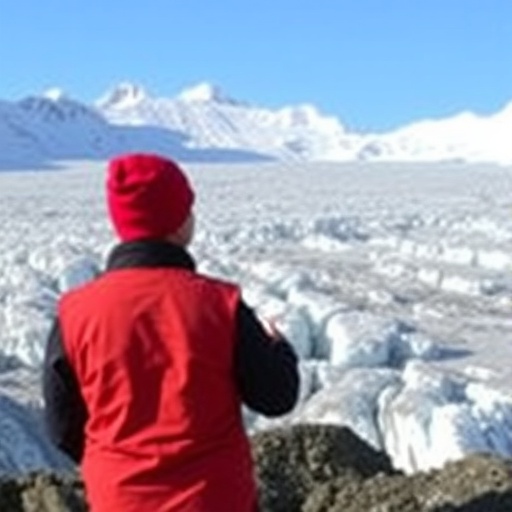
In the towering expanses of High Mountain Asia—a vast region embracing the Tibetan Plateau and its neighboring mountain ranges—an alarming phenomenon is unfolding: glaciers, the crucial water reservoirs of this region, are retreating at an unprecedented rate. New research leveraging NASA’s GRACE satellite mission data reveals significant mass losses in these glaciers from 2002 to 2023, underscoring the precarious future of water availability for millions dependent on these icy reservoirs.
High Mountain Asia, often dubbed the “water towers of Asia,” harbors over 95,000 glaciers scattered across approximately fifteen sub-regions, each with distinctive ecological characteristics. These glaciers are more than frozen landscapes; they act as vital freshwater stores that feed into major rivers, supporting hydropower generation, irrigation systems, and daily water needs of downstream populations. Their accelerated melting, as this study elucidates, poses multifaceted risks not only to regional water security but also to agricultural productivity and disaster management frameworks.
To quantify glacier mass variations, researchers adopted an innovative approach centered on gravimetric measurements from the GRACE satellites, which detect minute fluctuations in Earth’s gravity field caused by the redistribution of mass—including melting ice. By correlating these gravimetric observations with data-driven machine learning models, the team effectively bridged observational gaps in continuous glacier monitoring, creating a more comprehensive temporal picture of these critical cryospheric changes.
This combined methodology revealed an overarching trend: a consistent increase in glacier mass loss throughout the two decades under scrutiny. However, this aggregate trend conceals considerable heterogeneity among sub-regions. For instance, the Eastern Kunlun mountain system, positioned between the Tibetan Plateau and western China’s Tarim Basin, demonstrated an anomalous gain in ice mass over recent decades. Conversely, the West Tien Shan range exhibited pronounced and rapid ice mass losses. These divergent patterns point to complex, localized drivers influencing glacier dynamics beyond simple temperature rise.
Possible explanations for these contrasting glacial responses include fluctuations in regional temperature gradients, variability in precipitation—both in type and quantity—and the differential impact of solar radiation. The intricate interplay of these factors complicates projections of glacier futures, demanding nuanced, high-resolution climate models capable of incorporating localized microclimates and radiative forcings. These efforts are essential, considering the paramount role the High Mountain Asia glacier system plays in regulating global climate dynamics.
The ramifications of glacier mass decline extend well beyond hydrology. As glaciers recede, meltwater availability diminishes, straining agricultural irrigation, potable water supplies, and renewable energy infrastructures dependent on consistent hydrologic inputs. More alarmingly, the newly exposed landscapes foster the formation of glacial lakes, which accumulate meltwater and augment flood risks through potential outburst events. These hazardous conditions imperil downstream communities, amplifying vulnerabilities in socio-economic and disaster resilience frameworks.
Jaydeo Dharpure, the study’s lead author and a former postdoctoral researcher at The Ohio State University’s Byrd Polar and Climate Research Center, emphasizes the dual threats posed by glacier retreat—both through reduced water resource availability and increased geohazards. Dharpure stresses the imperative to intensify glacier monitoring as a pivotal adaptive strategy, emphasizing that while some ice loss is unavoidable, proactive surveillance can mitigate human and infrastructural losses.
The study’s findings reiterate a stark but actionable message: without substantial reductions in greenhouse gas emissions, accelerated glacier melt will likely intensify, exacerbating water scarcity and associated hazards. This feedback loop underscores the urgency of integrating cryospheric changes into global climate mitigation strategies and regional adaptation planning.
Complementing Dharpure’s insights, co-authors Ian Howat from Ohio State University and Akansha Patel from Texas A&M University AgriLife contribute expertise that bolstered this interdisciplinary investigation. Their collective research, supported by the Byrd Postdoctoral Fellowship, pioneers a methodology blueprint for future work interrogating glacier-climate interactions in other vulnerable regions worldwide.
Beyond the immediate scope of High Mountain Asia, this research exemplifies the broader scientific imperative to harness satellite remote sensing, computational modeling, and machine learning to decipher complex Earth system processes. By advancing our predictive capabilities regarding glacier mass dynamics, the study facilitates more accurate projections of global sea-level rise, fresh water availability, and climate feedback loops crucial for policymaking.
Ultimately, the retreat of glaciers in High Mountain Asia resonates as a harbinger of broader planetary challenges. As the melting ice uncovers untapped risks—ranging from novel hydrological pathways to emergent natural hazards—the research community must expand collaborative efforts to monitor, model, and mitigate these changes. Safeguarding the “water towers” in an era of rapid climate change is not only a regional imperative but a global one.
News Publication Date: 13-Feb-2026
Web References:
– NASA GRACE Mission: https://grace.jpl.nasa.gov/mission/grace/
– Scientific Reports Article: https://www.nature.com/articles/s41598-026-39404-8#citeas
References:
Dharpure, J., Howat, I., Patel, A. (2026). Future projections of glacier mass change in High Mountain Asia using GRACE and climate model data. Scientific Reports. DOI: 10.1038/s41598-026-39404-8
Cite Scienmag News
Russell Cooper. (April 8, 2026). Scientists Warn Melting Glaciers Could Jeopardize Future Water Security. Scienmag. https://scienmag.com/scientists-warn-melting-glaciers-could-jeopardize-future-water-security/
Russell Cooper. "Scientists Warn Melting Glaciers Could Jeopardize Future Water Security." Scienmag, 8 April 2026, https://scienmag.com/scientists-warn-melting-glaciers-could-jeopardize-future-water-security/. Accessed 4 September 2026.
Russell Cooper. "Scientists Warn Melting Glaciers Could Jeopardize Future Water Security." Scienmag. April 8, 2026. https://scienmag.com/scientists-warn-melting-glaciers-could-jeopardize-future-water-security/


