


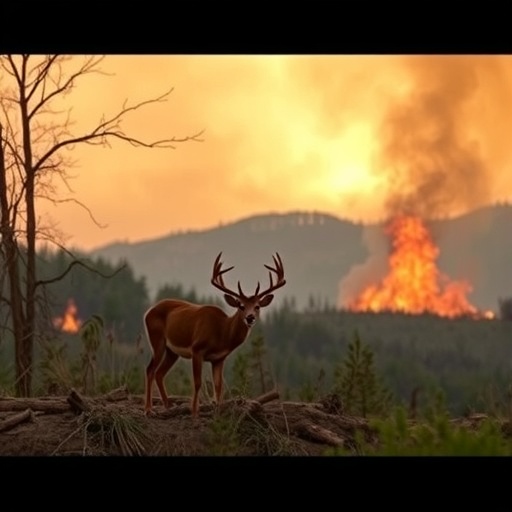
As the climate crisis intensifies, the frequency and magnitude of wildfires around the globe are rapidly increasing, presenting a new and alarming threat to biodiversity. Researchers from the University of Gothenburg have recently published a pivotal study in Nature Climate Change that elucidates the extent to which climate-driven wildfires will imperil thousands of species of plants, animals, and fungi. Their work provides a sobering projection of how continued global warming could exacerbate wildfire risks, even extending fire seasons and expanding burned areas closer to the poles, thus impacting ecosystems previously thought to be relatively safe from fires.
The study harnessed the power of advanced computational simulations and aggregated results from thirteen distinct climate models to produce a robust forecast of wildfire dynamics throughout this century. By integrating a machine learning approach with established climate projections, the research team was able to precisely estimate changes to both the expanse of land susceptible to wildfire and the temporal duration of fire seasons under varying greenhouse gas emission scenarios. This approach marks a significant leap forward in understanding the granular effects of climate change on wildfire patterns and, by extension, biodiversity vulnerability.
One of the central findings of the study is the predicted rise in global wildfire-affected areas by approximately 9.3% under a moderate warming scenario that projects a 2.7°C increase compared to pre-industrial temperatures. Concurrently, fire seasons are expected to lengthen by nearly 23%. These alterations not only exacerbate existing fire threats but also introduce new challenges for species adapted to specific fire regimes. Such an increase could lead to devastating ecological consequences as species struggle to cope with more frequent and prolonged exposure to fire disturbances.
Biodiversity loss driven by habitat degradation has been a well-studied consequence of climate change; however, the influence of climate-induced wildfires on species extinction risk has not been sufficiently quantified until now. This research specifically targets that gap by coupling wildfire projections with vulnerability assessments based on the International Union for Conservation of Nature’s Red List. The team analyzed data on 9,592 species known to be susceptible to wildfire impacts, revealing that nearly 84% of these species will face heightened risks by the century’s end.
The mechanisms underlying these increased risks are multifaceted. Higher ambient temperatures and altered precipitation patterns cause vegetation and soils to desiccate more rapidly, greatly enhancing the susceptibility of ecosystems to ignition and fire spread. The expansion of fire activity into higher latitudes further threatens species previously insulated from such disturbances, including those in boreal and subpolar environments. The shifting spatial boundaries of wildfires pose challenges for conservationists, demanding dynamic and region-specific responses to protect vulnerable flora and fauna.
Interestingly, the study highlights a significant geographic disparity in wildfire risk changes. Areas such as South America, South Asia, and Australia are forecasted to suffer the greatest increases in wildfire activity and consequent biodiversity threat. Many species endemic to these regions occupy narrow ranges and already exist in precarious conservation states, intensifying the urgency for targeted intervention. Conversely, certain parts of Africa may experience diminished wildfire extents in the future, attributed to predicted increases in wet climate conditions, underscoring the complexity and regional heterogeneity of climate impacts on fire regimes.
This burgeoning wildfire threat compounds existing pressures on ecosystems, particularly for species with limited dispersal capacities and those confined to small geographic ranges. The increased frequency and intensity of fires can rapidly degrade critical habitats, reduce food availability, and disrupt reproductive cycles. Furthermore, recurrent fires may alter ecosystem composition and structure in irreversible ways, favoring fire-adapted invasive species over native biodiversity, thereby accelerating ecological homogenization and biodiversity loss.
The research also underscores the significant role that climate mitigation policies can play in ameliorating future wildfire risks. By comparing high-emission scenarios to more moderate emissions pathways, the study demonstrates that limiting greenhouse gas emissions could reduce the increase in species vulnerability to wildfires by over 60%. This finding reinforces the critical importance of aggressive climate action not only for stabilizing global temperatures but also for safeguarding global biodiversity from increasing fire threats.
Importantly, the researchers point out that current species conservation strategies may be insufficient if they fail to integrate the emerging wildfire risks fueled by climate change. Conservation planning traditionally emphasizes habitat protection and restoration while often underestimating disturbance regimes such as fires. There is a pressing need to reconcile these approaches with dynamic climate models and wildfire forecasts to develop adaptive management plans that anticipate and mitigate wildfire-driven biodiversity losses.
This comprehensive investigation also shines a light on major knowledge gaps, especially regarding species and regions where wildfire exposure has thus far been minimal. Projected encroachments of fire into novel ecosystems demand greater research to understand the tolerance limits and adaptive capacities of unfamiliar species to such disturbances. Addressing these gaps is essential for building predictive frameworks that can guide proactive conservation under an uncertain and rapidly changing climate landscape.
The nexus of climate warming, wildfire regimes, and biodiversity vulnerability as revealed by this study portrays a complex and urgent global ecological challenge. It spotlights the necessity of cross-disciplinary collaboration between climatologists, ecologists, data scientists, and conservation practitioners to develop holistic strategies capable of counteracting the accelerating risks. As wildfires become a more pervasive force shaping ecosystems worldwide, leveraging advanced modeling and data integration will be fundamental in framing effective responses.
In conclusion, the escalating wildfire risk driven by anthropogenic climate change poses a dire threat to a vast array of species across multiple continents, compelling a paradigm shift in biodiversity conservation and climate mitigation policies. The insights offered by the University of Gothenburg-led team provide crucial evidence to guide international efforts aimed at curbing emissions while simultaneously enhancing ecosystem resilience. Without coordinated action, the unfolding wildfire crisis could severely undermine global biodiversity and ecosystem services on which human societies critically depend.
News Publication Date: April 6, 2026
Web References:
10.1038/s41558-026-02600-5
Cite Scienmag News
Margaret Porter. (April 6, 2026). Rising Wildfire Risks Pose Growing Threat to Wildlife Amid Climate Change. Scienmag. https://scienmag.com/rising-wildfire-risks-pose-growing-threat-to-wildlife-amid-climate-change/
Margaret Porter. "Rising Wildfire Risks Pose Growing Threat to Wildlife Amid Climate Change." Scienmag, 6 April 2026, https://scienmag.com/rising-wildfire-risks-pose-growing-threat-to-wildlife-amid-climate-change/. Accessed 3 September 2026.
Margaret Porter. "Rising Wildfire Risks Pose Growing Threat to Wildlife Amid Climate Change." Scienmag. April 6, 2026. https://scienmag.com/rising-wildfire-risks-pose-growing-threat-to-wildlife-amid-climate-change/


