


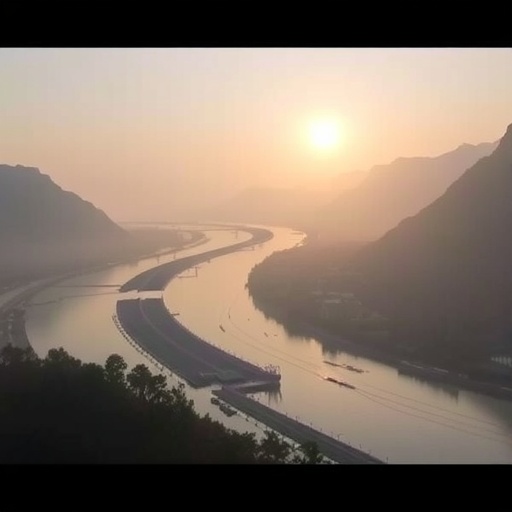
In a groundbreaking new study published in Communications Earth & Environment, researchers Wang, Zhuang, and Knouft reveal a troubling and profound disconnect between ecological science and environmental legislation affecting the Yangtze River, the longest river in Asia and one of the most critical aquatic ecosystems globally. This investigation exposes how laws, lacking a solid scientific foundation, are gravely compromising the ecological health of the Yangtze, with wide-ranging implications for biodiversity, public health, and sustainable human activity along its banks.
The Yangtze River basin supports hundreds of millions of people and hosts an array of endangered species, making its protection vital not only for regional but global ecological stability. However, the study highlights that existing legislation—largely constructed without input from comprehensive ecological data—fails to address key environmental drivers such as pollution, habitat fragmentation, and climate change impacts that critically threaten the river’s resilience and biodiversity.
The researchers used an extensive array of longitudinal ecological data collected over decades, including water quality metrics, species population assessments, and hydrological modeling, to evaluate the effectiveness of current legislative measures. Their findings reveal that laws designed to curb pollution, regulate industrial activities, and manage water resources have fallen short of their intended goals. In many cases, legislation is outdated, fragmented, or contradictory, creating enforcement gaps and regulatory uncertainty that undermine conservation efforts.
One of the most alarming aspects uncovered is how legislation prioritizes economic development over ecological sustainability. The authors note that industrial policies driving urbanization and infrastructure along the river’s banks often neglect ecological thresholds identified through scientific monitoring. This patchwork approach leads to cumulative environmental degradation, including the loss of critical wetlands, declines in fish populations crucial to local food security, and increasing eutrophication driven by nutrient runoff.
The study also draws attention to a fundamental issue: a persistent disconnect between environmental policymakers and the scientific community. The researchers argue that insufficient dialogue and integration of ecological knowledge into lawmaking processes have resulted in policies that do not reflect the complexity or urgency of the Yangtze’s environmental challenges. This lack of science-driven governance not only risks failing to halt the river’s ecological decline but also reduces the resilience of human systems dependent on its water resources.
Moreover, the authors highlight that many legal provisions lack clear benchmarks or measurable goals aligned with ecosystem health indicators. Without scientifically grounded targets for water quality, habitat restoration, or species recovery, legislation becomes symbolic rather than actionable, allowing environmental conditions to deteriorate unchecked. This hampers effective monitoring and adaptive management, which are essential for responding to dynamic ecological changes exacerbated by climate variability and human pressures.
The paper further investigates how fragmented jurisdiction across provincial and local governments complicates cohesive management of the Yangtze basin. Overlapping authorities and inconsistent enforcement result in regulatory loopholes that industrial polluters and land developers exploit. The authors propose that unified, science-informed governance structures are critical to harmonize policies and coordinate actions to restore and protect the river’s ecological integrity on a basin-wide scale.
To underpin legislative reforms, the study calls for enhanced scientific research programs focused on integrative ecosystem assessments and predictive modeling. These programs should inform adaptive policy frameworks that can flexibly respond to emerging environmental threats and leverage real-time data for decision making. By embedding science as a foundational pillar of environmental legislation, the Yangtze’s ecological future could be dramatically improved.
The researchers underscore the urgency of this transition, given the river’s ongoing declining trends and the increasing pressures from population growth, industrial expansion, and climate change. They caution that continuation of legislation based on outdated or incomplete science risks triggering irreversible damage to the Yangtze’s ecosystems—damage that would profoundly affect biodiversity, food security, and livelihoods across the basin.
Intriguingly, the study also discusses how incorporating indigenous knowledge systems and local ecological insights could enrich the scientific basis for legislation. Recognizing the perspectives of riverine communities who have coexisted with the Yangtze’s ecosystem for generations offers a valuable complement to formal scientific methods, fostering more inclusive and sustainable environmental governance.
The paper’s conclusions have significant implications for environmental governance beyond the Yangtze. It serves as a cautionary tale illustrating the pitfalls of policy disconnected from ecological realities, resonating globally as nations grapple with balancing development and conservation amid accelerating environmental change. By shining a spotlight on the Yangtze, the authors advocate for a model of environmental legislation informed by rigorous science, transparency, and inclusive stakeholder engagement.
In light of these insights, future legislative reforms must prioritize ecological integrity through legally binding, science-based objectives. This includes setting enforceable pollution limits, expanding protected areas, restoring degraded habitats, and instituting comprehensive basin-wide management plans reflecting ecological thresholds and resilience principles. Without these measures, the Yangtze’s fate hangs in jeopardy, imperiling one of the planet’s greatest rivers and the diverse life forms it sustains.
Ultimately, Wang, Zhuang, and Knouft’s study represents a clarion call to policymakers, scientists, and civil society alike. It underscores that safeguarding the Yangtze requires bridging the gap between science and legislation—a transformative process essential to ensure the river can continue supporting ecological and human well-being for generations to come. Their work exemplifies how advanced ecological science can and must directly inform the legal frameworks that govern our most precious natural resources.
This research contributes a critical perspective to environmental science and policy discourse, highlighting the urgent need to overhaul outdated legislative regimes to better align with rapidly evolving ecological knowledge. As the threats facing the Yangtze River intensify, the integration of robust science into lawmaking emerges not merely as ideal but as imperative for sustainable future management of the world’s vital river systems.
Cite Scienmag News
Gavin Prescott. (April 4, 2026). Flawed Laws Threaten Yangtze River Ecology. Scienmag. https://scienmag.com/flawed-laws-threaten-yangtze-river-ecology/
Gavin Prescott. "Flawed Laws Threaten Yangtze River Ecology." Scienmag, 4 April 2026, https://scienmag.com/flawed-laws-threaten-yangtze-river-ecology/. Accessed 4 September 2026.
Gavin Prescott. "Flawed Laws Threaten Yangtze River Ecology." Scienmag. April 4, 2026. https://scienmag.com/flawed-laws-threaten-yangtze-river-ecology/


