


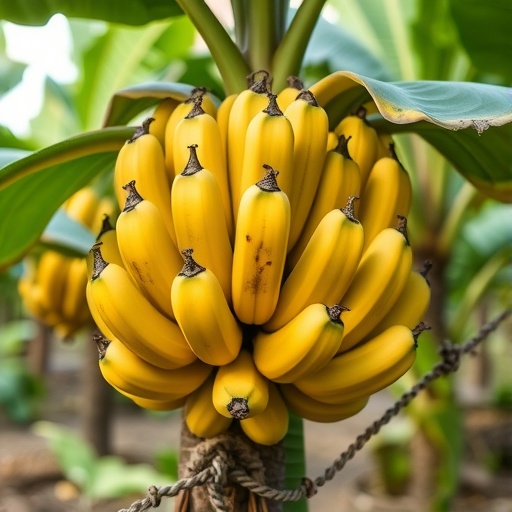
In a groundbreaking advancement in plant molecular biology, a recent study has unveiled a pivotal cooperative mechanism involving two NAC transcription factors, MaNAC029 and MaNAC19, that orchestrate the complex regulation of ethylene biosynthesis and sucrose accumulation during banana fruit ripening. This discovery elucidates the intricacies underlying banana sweetness development and quality enhancement postharvest, providing a molecular framework that could revolutionize agricultural practices and postharvest management for one of the world’s most important staple fruits.
Banana ripening is a highly coordinated physiological process predominantly governed by the phytohormone ethylene, which catalyzes an array of biochemical and morphological changes. These changes encompass peel color transformation from green to yellow, softening of fruit tissue, aroma development, and significant alterations in taste. Transcription factors belonging to the NAC (NAM, ATAF, and CUC) family have been posited as critical regulatory nodes within these ripening pathways. Notably, prior studies had identified MaNAC029 as a regulator of genes involved in ethylene biosynthesis, while MaNAC19 was linked to the control of MaSPS1, a gene central to sucrose phosphate synthase activity. However, the nature of interaction—if any—between these two transcription factors remained previously uncharted, constraining holistic interpretations of ripening regulation.
The study, published in the prestigious journal Plant Hormones on January 27, 2026, from researchers led by Wei Shan at South China Agricultural University, breaks new ground by revealing a synergistic interaction between MaNAC029 and MaNAC19. This synergy manifests as a cooperative transcriptional module that integrates hormone signaling with metabolic regulation, thereby fine-tuning downstream gene expression to foster optimal fruit maturation and sweetness.
Comprehensive phenotypic monitoring during ethylene-induced postharvest ripening highlighted coordinated temporal expression profiles for MaNAC029 and MaNAC19. Quantitative measurements demonstrated that their transcript abundance peaks concomitantly with the ethylene burst phase, a critical window in ripening marked by accelerated ethylene production and substantial biochemical transitions. This tight coupling suggested a potential functional interplay, stimulating the researchers to probe their physical and functional interactions.
Employing state-of-the-art yeast two-hybrid assays, the researchers provided compelling evidence that MaNAC029 and MaNAC19 physically interact, forming a heterodimeric complex within the nucleus. This finding was robustly corroborated by bimolecular fluorescence complementation (BiFC) in tobacco BY-2 protoplasts, where fluorescence reconstitution confirmed direct protein-protein interaction in a cellular context. Co-immunoprecipitation experiments conducted in transiently transformed tobacco leaves further substantiated this interaction, emphasizing the biological relevance of this protein complex in planta.
Delving into DNA-binding specificity, electrophoretic mobility shift assays (EMSA) elucidated that MaNAC029 directly associates with the promoter region of MaSPS1, directly influencing sucrose biosynthesis pathways. Conversely, MaNAC19 exhibited affinity for the promoters of MaACO1 and MaACO13, pivotal genes encoding 1-aminocyclopropane-1-carboxylate oxidase enzymes integral to ethylene biosynthesis. These distinct, yet complementary, promoter binding specificities underscored a division of labor within the heterodimeric transcriptional complex.
Further transcriptional assays utilizing dual-luciferase reporter systems revealed an intriguing synergy: co-expression of MaNAC029 and MaNAC19 resulted in significantly enhanced activation of target promoters compared to individual expression. This amplification suggests that the heteromeric complex enhances transcriptional output beyond additive effects, creating a robust molecular nexus that coordinates hormonal cues with metabolic outputs.
Mechanistically, the research data propose a model wherein the MaNAC029–MaNAC19 complex operates as a regulatory amplifier during ripening. By potentiating expression of MaACO1 and MaACO13, this complex intensifies ethylene synthesis, reinforcing the autocatalytic ethylene burst characteristic of climacteric fruit maturation. Simultaneously, activation of MaSPS1 drives sucrose accumulation, a critical determinant of fruit sweetness and consumer appeal. Such integration ensures that ethylene-driven ripening progression is coupled with enhanced sugar metabolism, optimizing fruit quality and marketability.
This pioneering study not only advances fundamental understanding of ripening biology but also opens prospective avenues for agricultural innovation. Manipulating the MaNAC029–MaNAC19 module holds promise for tailored control over ripening rates, sweetness parameters, and shelf life extension, which are crucial for reducing postharvest losses and enhancing banana fruit supply chain resilience.
Moreover, the research exemplifies sophisticated multilayered transcriptional regulation as a common strategy employed by plants to synchronize hormonal and metabolic networks. The insights gained here could inform comparative studies in other climacteric fruits such as tomato, apple, and peach, where similar transcriptional modules might operate.
The identification of such a molecular node also invites exploration of stress-responsiveness, as environmental factors often modulate ripening and quality traits. Understanding how MaNAC029 and MaNAC19 respond to abiotic cues could enable breeders to develop cultivars with enhanced tolerance to climatic fluctuations while preserving desirable fruit characteristics.
In sum, this study reveals that banana ripening is governed not by isolated transcription factors acting independently, but by an integrated transcriptional circuitry where MaNAC029 and MaNAC19 physically collaborate to amplify ethylene biosynthesis and sucrose synthesis pathways. This cooperative module exemplifies molecular synergy driving the complex physiology of fruit maturation, carrying profound implications for plant biology, crop improvement, and global food security.
As bananas are a staple food providing vital nutrition to millions worldwide, harnessing such molecular insights could transform practices in horticultural production, enabling precision ripening control tailored to diverse market demands. The convergence of transcription factor biology, molecular genetics, and postharvest physiology embodied in this work paves the way for next-generation innovations in crop science.
This landmark contribution to plant hormone research underscores the value of dissecting transcriptional networks to unravel how plants orchestrate developmental programs in synchrony with environmental and endogenous signals. With the foundation laid by MaNAC029 and MaNAC19’s elucidation, the field moves closer to a comprehensive mechanistic understanding of fruit ripening’s genetic regulation.
News Publication Date: 27-Jan-2026
References:
DOI: 10.48130/ph-0025-0029
Cite Scienmag News
Juliet Wilcox. (April 3, 2026). Two NAC Factors Collaborate to Trigger Banana Ripening. Scienmag. https://scienmag.com/two-nac-factors-collaborate-to-trigger-banana-ripening/
Juliet Wilcox. "Two NAC Factors Collaborate to Trigger Banana Ripening." Scienmag, 3 April 2026, https://scienmag.com/two-nac-factors-collaborate-to-trigger-banana-ripening/. Accessed 3 September 2026.
Juliet Wilcox. "Two NAC Factors Collaborate to Trigger Banana Ripening." Scienmag. April 3, 2026. https://scienmag.com/two-nac-factors-collaborate-to-trigger-banana-ripening/


